
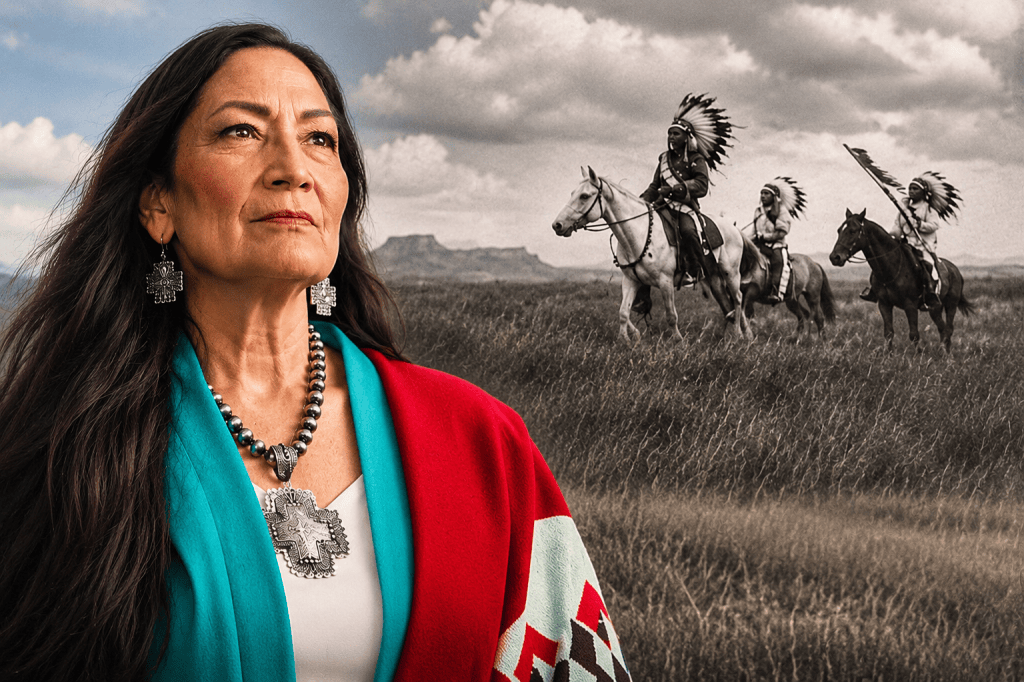
Deb Haaland’s victory in New Mexico goes beyond the divide between Democrats and Republicans. It marks a moment of recognition for a people who endured centuries of massacres, forced removals, humiliation and the loss of their lands. I am speaking of those many of us first learned to call American Indians, more accurately known as Native Americans: the first inhabitants of a continent others came to conquer.
Deb Haaland and the recognition of Native peoples
Deb Haaland, 65, a member of the Laguna Pueblo people, has been elected governor of New Mexico. She is the first Native American woman elected governor in the United States. Amid the many commentaries on the midterm results, this is the story I want to dwell on: a woman descended from the continent’s original peoples rising to lead a U.S. state. Think about what that means.
The people who were here long before Europeans arrived had lived on these lands for millennia. They were fought, forcibly removed, confined to reservations and stripped of their land—and often their languages as well. In many regions, more Indigenous people died from diseases brought by colonizers than from weapons. Smallpox, measles, influenza and infections met communities with no immunity. This catastrophe accompanied the conquest of the continent.
There were many massacres. At Sand Creek, Colorado, in November 1864, U.S. soldiers killed more than two hundred Cheyenne and Arapaho people, most of them women and children. Captain Silas Soule refused to take part and ordered his men not to fire. He reported what had happened and was murdered a few months later. In December 1890, at Wounded Knee, the Seventh Cavalry massacred hundreds of Lakota. These are only two episodes in a much longer history.
For years, cinema portrayed Native Americans as villains and the blue-coated soldiers as heroes. Then, in 1970, Ralph Nelson’s Soldier Blue, inspired by Sand Creek, showed audiences what had happened from the other side.
I imagine Marlon Brando would have been glad to see Deb Haaland become governor. In 1973, when he won the Oscar for The Godfather, he did not go to accept it. He sent Sacheen Littlefeather, a young woman who refused the statuette onstage to protest the treatment of Native Americans. There was applause, but also boos. At the same time, activists from the American Indian Movement were occupying Wounded Knee to demand that treaties and their rights be respected. Brando chose to protest in front of the very Hollywood that had spent decades telling the story of the West’s conquest from the victors’ side.
The consequences of that history are present in Haaland’s own family. Her grandmother Helen was eight when she was taken from her village and sent to a boarding school for Indigenous children. Her grandfather also attended these schools, where children were forced to give up their languages and traditions. As Secretary of the Interior in the Biden administration, Haaland launched the Federal Indian Boarding School Initiative. The Department of the Interior’s investigation confirmed that at least 973 American Indian, Alaska Native and Native Hawaiian children died while attending federally operated or supported schools.
On election night, she remembered her grandmother and said a sentence that carries a great deal of weight: “Yet we are still here.”
Five hundred years of history cannot be undone by an election. The lands taken remain taken; the massacres belong to a past no one can change. But today, a Laguna Pueblo woman is set to lead New Mexico.
I think of Marlon Brando, the young woman who refused the Oscar, and Captain Silas Soule, who would not fire. I wish I could have seen their faces when they heard this news.
After five centuries, a woman from among America’s first peoples will govern part of her ancestors’ land.
Originally published in Italian on Alessandro Sicuro Comunication.
Contacts
Brand Strategist | Photographer | Art Director | Project Manager
Alessandro Sicuro Comunication


