
3 MIN READ
NEW OIL 2026
The green gold is about to reach the table. The harvest is under way, the olives are in good condition and the damage from the olive fly is limited, according to the first indications. Now it is up to the olive mills to tell what kind of year it will be. Meanwhile, the fettunta (toasted Tuscan bread rubbed with garlic and dressed with new oil) is back.
In the meantime, the way the harvest is organized has changed a lot. Some people booked the olive mill as early as August, because at the most sought-after plants finding a slot during this period can become complicated. And not all olive mills are the same. Those who remember the old stone mills and the fiscoli, those woven discs of plant fibers stacked in the presses, now face continuous-cycle machinery, able to control crushing, malaxing and oil separation with precision. Expensive plants, in which the training of the miller matters as much as the technology.
Then there is a misunderstanding to clear up. Quality does not depend exclusively on the words cold extracted. Temperature is important, but so are the condition of the olives, the time elapsed since the harvest and the way the processing is carried out. To obtain that bold taste many appreciate in Tuscan oil, olives that are still green or at the beginning of veraison are often picked, accepting lower yields in exchange for a more intense fruitiness, with grassy hints, notes of artichoke and that characteristic bitter and peppery note that can be felt in the throat.
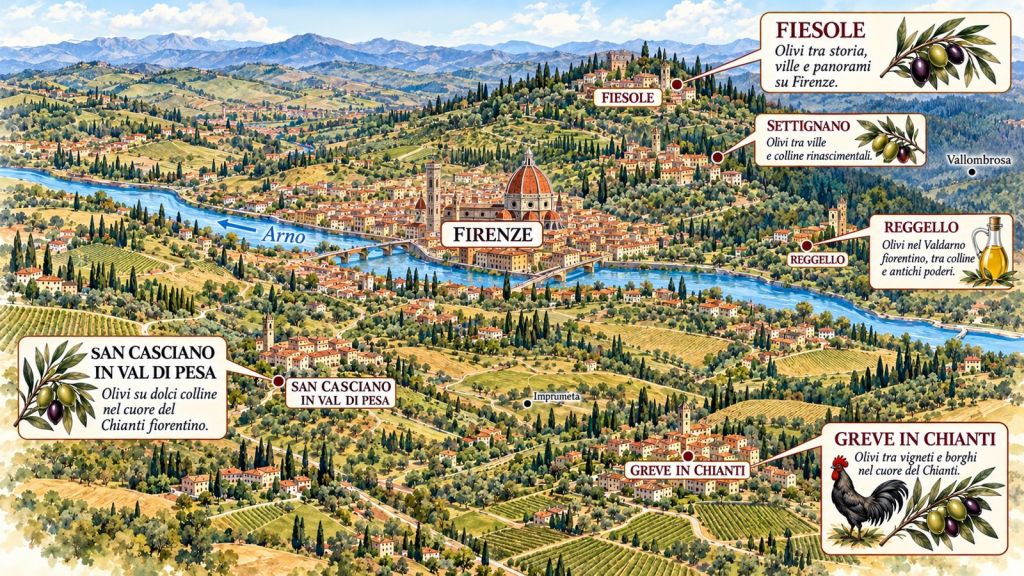
THE FOUR TERRITORIES OF TUSCAN OLIVE OIL
If I had to draw my own geography of Tuscan olive oil, I would choose four territories. Reggello and the Florentine Valdarno, Greve in Chianti, San Casciano in Val di Pesa and finally the hills around Florence, from Fiesole to Settignano. These are areas I know and where I find the character of the oil I prefer, intense and persistent. Of course Tuscany has many other areas with a great olive-growing tradition, from the Lucchesia to the Terre di Siena, but these four are my reference points.
TUSCAN OLIVE OIL AND ITS VALUE
One question remains to be reflected on. Why can a bottle of average-quality wine cost twenty or thirty euros, while for a liter of quality extra virgin the same amount is often judged excessive? An oil obtained from selected olives, picked at the right moment and processed with care has significant costs, especially when one chooses to bring the harvest forward, sacrificing part of the yield.
Restaurants too are giving greater importance to extra virgin olive oil. Chefs choose it according to the preparations and use it raw, as a finishing oil, to complete a dish with a fragrance or a peppery note. The same oil which, when bought directly from the producer, is sometimes considered too expensive.
For Tuscans this is one of the most awaited moments of the year. The first cold days arrive, autumn dishes return to the table, roast meats, beans, seasonal vegetables. But above all the fettunta returns, a slice of toasted Tuscan bread, rubbed with garlic and generously dressed with freshly pressed oil. It is perhaps the simplest and most direct way to recognize its fragrance, its freshness, the intensity of the fruitiness and that peppery note that stays in the throat. Extra virgin olive oil, thanks above all to the presence of monounsaturated fatty acids and phenolic compounds, also has recognized nutritional properties, which make it an important element of the Mediterranean diet.
The 2026 harvest has only just begun. To know whether it will truly be a good year we will have to wait for the first pressings and taste the oils of the different territories. In the meantime, for those who live in Tuscany, there is already a familiar image that accompanies the wait: a slice of warm bread and the first green oil of the season.
Gallery
–

Alessandro Sicuro
Brand Strategist | Photographer | Art Director | Project Manager
Alessandro Sicuro Comunication


