
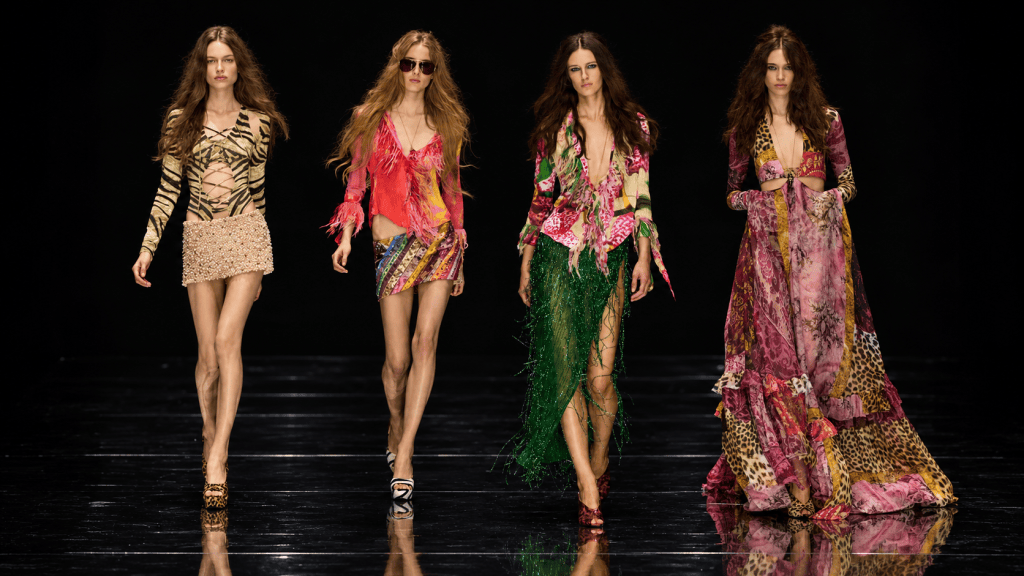
I really liked yesterday’s show, and not only for the clothes. I was glad to find again an atmosphere that belongs deeply to the history of Cavalli: the lights, the set, the very way the show was built around the woman. It brought back the Cavalli I had seen in person many years ago, when Roberto was still there, inside his world and inside the vision he had built and made instantly recognizable.
But today the driving force behind this new image is Fausto Puglisi, and it is right to say so clearly. He is the one who chose to bring Cavalli back to its own archive, to its strongest codes, to the sensuality and visual power that built the identity of the maison. It is a retrospective operation, certainly, but when it is done well it does not become nostalgia: it becomes language.
And it is above all here that I found something that had gradually faded in fashion over recent years: femininity. Puglisi does not try to diminish women, he does not make them awkward, and he does not seem afraid of their beauty. On the contrary, he makes them beautiful, sensual, aware of their own charm. A woman who wears a dress because she enjoys feeling feminine and attractive, and who is not at all uncomfortable being looked at. In fact, she likes being looked at, because she knows she feels good in what she is wearing.
The photographs accompanying this article also come from this reading. They are shots caught in movement, not posed images and not the classic front-facing runway pass. I chose the moments when the subject is unaware of the camera: an expression, a posture, a gesture, the natural movement of the body as the dress follows it. That is often where you understand a garment best, in the way it falls, opens, follows a leg, a shoulder, a twist. They are authentic, unprepared details, and in this collection they show clearly how much Puglisi worked on the dress to enhance the woman’s body, instead of hiding or distorting it.
And then there are the prints. Here Puglisi did, in my opinion, one of the smartest things: he went looking for Cavalli within its own history. Roberto Cavalli, even before becoming the designer known all over the world, was born as an experimenter and a master printer. At Osmannoro, that research had become technique, production, knowledge, craft. Colors, fabrics, leather, processes built up over time. And this is exactly where history cannot be cut off. Because Cavalli is this too.
Losing facilities and skills of that kind means losing not just a production, but a part of the know-how that made Made in Italy great. Textile printing, tailoring, shoemaking, leather, denim: crafts that require time, schooling, and the passing of knowledge from one generation to the next. And which all too often we risk scattering, just as others come to Italy to learn them.
That is why I like what Puglisi is doing. He is not simply recovering an archive. He is recovering the craft, the culture and the origin from which Cavalli was born. He is trying to understand Roberto Cavalli before reinterpreting Cavalli.
Prints, animalier, color, transparencies, denim, fringes, embroidery, dresses that follow the body: Puglisi has put these elements back together without fear of excess. And that is probably exactly what worked yesterday.
Fausto Puglisi looked back, yes. But not out of nostalgia. He looked back to find Cavalli again.
Gallery


Alessandro Sicuro
Brand Strategist | Photographer | Art Director | Project Manager
Alessandro Sicuro Comunication


