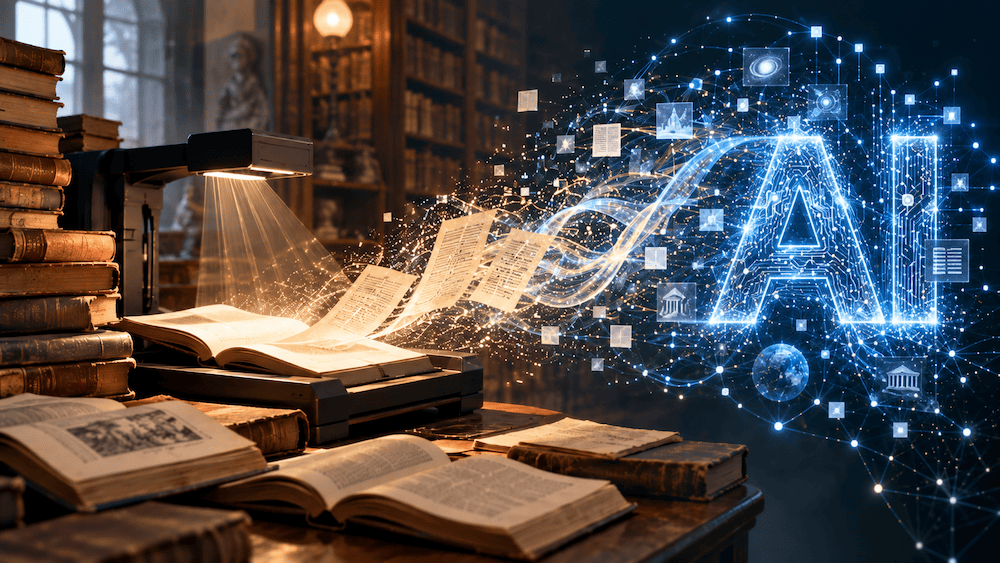
Anthropic’s Project Panama is making headlines these days. One detail in particular is hard to ignore: millions of books bought, cut apart, scanned, and then sent to recycling to feed artificial intelligence systems. But if we stop at the image of destroyed books, we miss the most interesting part of the story. Those volumes weren’t chosen because they were useless.
Quite the opposite. They were used because they contained something the web alone can no longer provide in the same way: quality writing, structured thought, depth, accumulated knowledge. To build more advanced systems, they went back to the source. Books.
And here’s the first paradox. On one hand, we spend less and less time on long-form reading. We’ve grown used to shorter texts, summaries, simplified content that lasts the length of a scroll. On the other hand, machines need the exact opposite to improve: long, complex texts written by humans, full of experience, culture, mistakes, insights, and contradictions. It’s almost ironic. While we lose patience after ten pages, they’re devouring millions.
But the real point begins when the path to knowledge changes. For centuries, an author wrote a book and someone, sooner or later, read it. Today, more often than not, that book gets absorbed by a system. It analyzes the text, connects it to millions of others, and returns a piece of it as an answer. Between us and the source stands a powerful intermediary. One capable of processing an amount of knowledge no human could tackle in a lifetime.
And here another question opens up. If tomorrow we ask an AI system everything we want to know, we’ll have to hope that system can return what it read accurately, completely, and honestly. And that assumes something else: that everything written in books over the past five hundred years is correct, complete, and free of bias. That’s not a given.
History, geography, science—even the way we’ve told entire eras—can contain errors, omissions, biased interpretations, and knowledge that today would need serious revision. But that’s a different conversation.
The point here is even simpler. Searching for an answer is not the same as receiving one. I do this myself. When someone asks me to explain something, I often go up to a point and then say: now go look it up. In a book, in a library, online—it doesn’t matter. But look it up. Because the very act of searching activates something a ready-made answer risks shutting down: curiosity, imagination, attention, the desire to understand.
Take something completely ordinary. If someone asks me why leaves turn yellow in autumn, I can quickly explain the mechanism. But if that person goes looking for the answer alone, they discover what happens to chlorophyll, what changes with light, what emerges when the green fades. Maybe they even stumble on a detail they weren’t looking for. That knowledge sticks. Not because someone handed it to them, but because they went and got it themselves.
This might be one of the things we risk losing. Not knowledge itself, but the journey required to reach it. That journey matters deeply. It’s where memory forms, connections spark, insights emerge, and the hunger to know more takes hold.
So the problem isn’t just whether machines will answer us well. The problem is whether we’ll still want to go beyond the answer.
Project Panama, then, isn’t just a story about millions of destroyed books. It might mark the moment we started transferring to machines not just information, but part of the very journey that has always led us to knowledge.
WHILE WE STOP READING BOOKS, THE MACHINES HAVE FIGURED OUT THEY NEED THEM.

Alessandro Sicuro
Brand Strategist | Photographer | Art Director | Project Manager Alessandro Sicuro Comunication


