
LFW
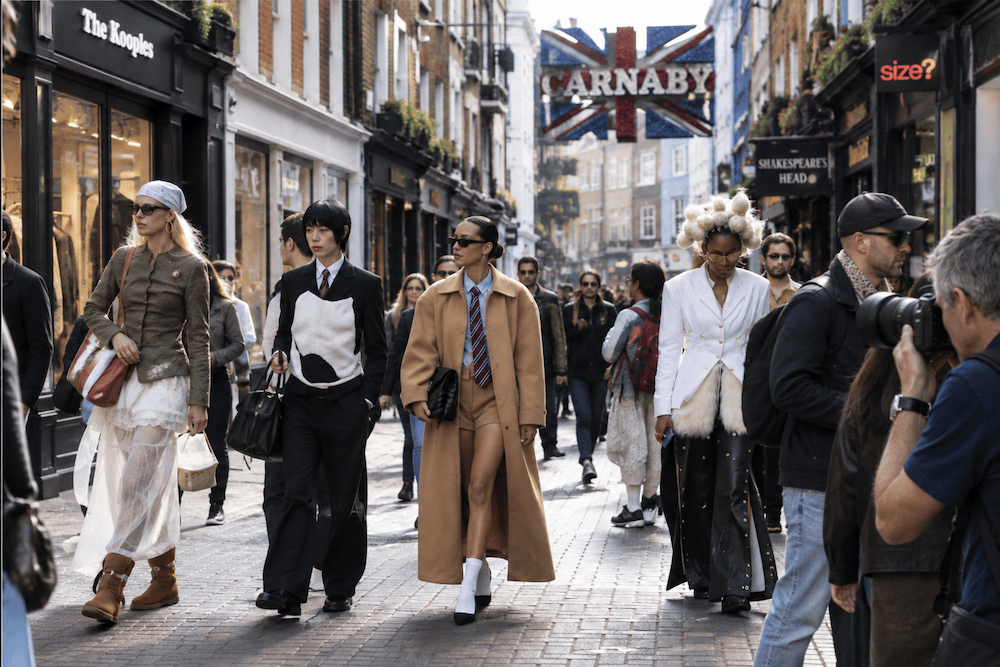
London Fashion Week kicked off on September 17. The first collections already show some interesting signals. Not a clear direction yet. Probably not even fully conscious. But something seems to be moving: London is tapping into its cultural memory to find a new identity.
And maybe that’s exactly the point. London knows what it means to turn fashion into something bigger than fashion. It did it in the Sixties with Swinging London. A city brought together music, style, photography, cinema, art, street culture, and new social behaviors. It transformed them into a single cultural movement. It wasn’t just an aesthetic shift. The way people dressed changed because the way they lived was changing. The way they listened to music. The way they experienced the city. Above all, the way they represented themselves.
That was a true cultural Renaissance. Fashion was part of it. But it wasn’t isolated from the rest. Mary Quant. Carnaby Street. King’s Road. The Mods. British music. Photography. A new youth culture. They all belonged to the same ecosystem. A generation wasn’t simply choosing different clothes from their parents. They were building a new social identity.
Today it would be impossible—and pointless—to try recreating that era artificially. But London seems to be tapping into that same mechanism again. Reclaiming what belongs to its memory. Taking ownership of it once more. Remixing it. Bringing it into the present. Not to repeat the past. To find a new direction.
It’s a form of cultural appropriation in the most natural sense: reclaiming your own codes and transforming them. British tailoring. Club culture. Uniforms. Street style. Music. The blurring of masculine and feminine. They’re returning as elements of a vocabulary London knows well. These aren’t quotes for a shop window. They can become material for rebuilding an identity.
This also concerns brands. In recent years, we’ve seen too many collections that seemed to erase the ones before them. Creative direction changes came with the need to start from scratch. New narratives built every six months. As if memory had become a limitation. But a strong brand works exactly the opposite way. It builds over time. Proportions. Details. Craftsmanship. Materials. Gestures and signs that become recognizable. Then it modifies them. Contradicts them. Takes them elsewhere. But it doesn’t erase them.
Brand memory doesn’t mean standing still. It means having something to transform. Without memory, there’s no evolution. Only replacement.
Maybe this relentless pursuit of novelty is exactly what has weakened part of contemporary fashion. Lots of images. Lots of operations. Lots of noise. But fewer and fewer codes that stick. And when memory fades, it becomes harder to build belonging. The audience may recognize a product. But they won’t necessarily recognize themselves in an identity.
London, at least from the first signals of this Fashion Week, seems to be trying to circulate something different. We don’t know yet if it will become a clear trend. Maybe even those working in this direction aren’t fully aware of it. But some signals are coming from right there: from the need to return to memory in order to move forward.
It’s happened before in this city’s history. In the Sixties, London didn’t build its cultural Renaissance by planning one. It happened because music, fashion, art, photography, style, and society all started changing language at the same time. They influenced each other. They produced something far greater than the sum of its parts.
Maybe that’s exactly what we’re waiting for today. Not the return of Swinging London. Not an imitation of it. But the birth of a new cultural system. One capable of making fashion, music, art, style, and social identity speak to each other once again.
It’s too early to say London has found a new identity. But some signals—perhaps even unconscious ones—finally seem to be coming from that direction.
And that would already be an excellent place to start over.
GALLERY


Alessandro Sicuro
Brand Strategist | Photographer | Art Director | Project Manager Alessandro Sicuro Comunication


