
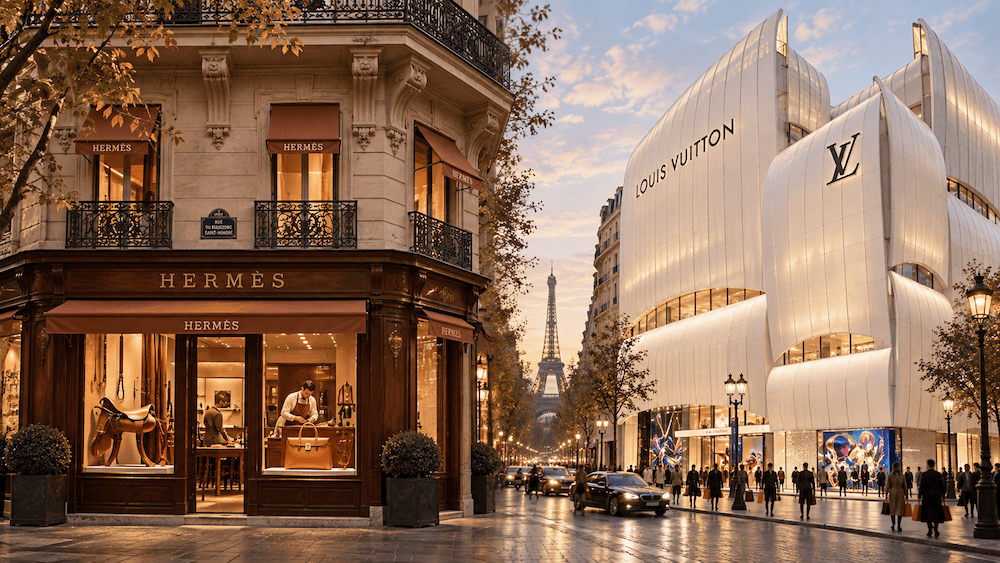
The story between LVMH and Hermès has resurfaced once again and, beyond the financial aspects, it says a lot about two different ways of understanding luxury. Reuters has reconstructed court documents showing that as early as 2002 LVMH had signed an agreement to buy Hermès shares held by Nicolas Puech and other members of the family. In the following years Bernard Arnault’s group came close to 23% of the maison, before the 2014 exit. Today that affair re-emerges within a still-open question about the fate of Puech’s shares.
LVMH built its strength on acquisitions, size, financial capacity and global distribution. Hermès took another road, more controlled, more family-run, more tied to craftsmanship and to the defense of its own codes. Two almost opposite models, both extremely strong.
The real difference, however, lies in desire. Because luxury can grow enormously, but if it becomes too present, too available, too exposed, it risks losing part of its strength. Hermès built much of its value precisely on rarity and on the feeling of never being completely accessible. LVMH, instead, built a system able to occupy the market with a power that few other groups can afford.
Today this difference is even more visible. The sector has become harder, demand is less linear, and financial strength alone is not enough to build symbolic value. In the end, the match between Arnault and Hermès is not only about shares or stakes. It is about identity, control and growth. And above all about a question that always returns in fashion: how much can a brand grow without losing what makes it desirable?
What do you think? Tell us in the comments.

Alessandro Sicuro
Brand Strategist | Photographer | Art Director | Project Manager Alessandro Sicuro Comunication


