
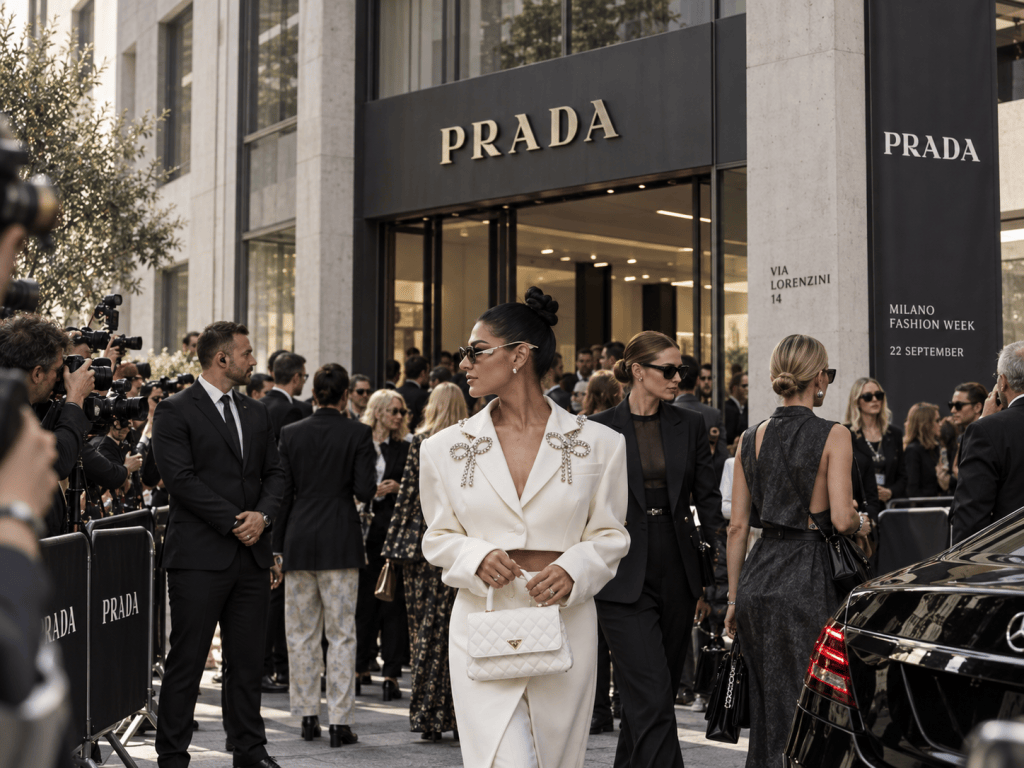
From September 22 to 28, Milan returns to the center of international fashion with Spring/Summer 2027. The calendar is very packed and confirms how Fashion Week has become something more than the runway alone. Today fashion also means storytelling, image, communication and the ability to build a system around the product.
Milan comes after New York and London, two weeks that in recent years have lost some of the strength that once seemed untouchable. And Milan still has a precise advantage: behind fashion there is still a real industry, made of production districts, manufacturing, craftsmanship and skills that together form a supply chain hard to replicate elsewhere. And perhaps this is exactly where we should start again.
Because while the noise around fashion grows, the numbers tell a less brilliant reality. The sector keeps suffering, revenues are slowing, exports are falling and many companies are going through a far from easy phase. It is an increasingly evident contradiction: there has never been so much communication around fashion and, at the same time, it has become much harder to turn that visibility into market.
The Milan calendar remains important and brings together big maisons, new creative balances and delicate transitions in the history of some brands. But what interests me is not so much the debut itself or the new name at the head of a maison. I want to understand what remains afterwards, whether a vision really exists and whether that vision manages to turn into identity and therefore into desire. Because fashion, in the end, still lives on this.
Some choices of this edition also go in an interesting direction. Antonio Marras opens his show to a wider audience, while Vogue World arrives in Milan for the first time, putting at the center the relationship between human work and technology. A far from secondary theme, because fashion is entering a phase in which know-how will have to coexist more and more with new tools and languages.
But technology alone does not build better fashion. It can amplify, accelerate and tell. First, though, there must be something of real value to tell.
And this is where Milan is probably playing its most important game. Not in the number of shows or events, nor in the quantity of images that will circulate over the coming days.
The real question is whether Milan will still be able to turn its creative and industrial heritage into a recognizable identity, giving greater value precisely to those districts and that supply chain that built the strength of Italian fashion over time.
Because the real value has always been this: not only creating a product, but building a world around that product.

Alessandro Sicuro
Brand Strategist | Photographer | Art Director | Project Manager Alessandro Sicuro Comunication


