
September has never been just about Fashion Week. It’s the moment when international fashion returns to the spotlight. More importantly, it’s when the gap between storytelling and actual sales gets measured.
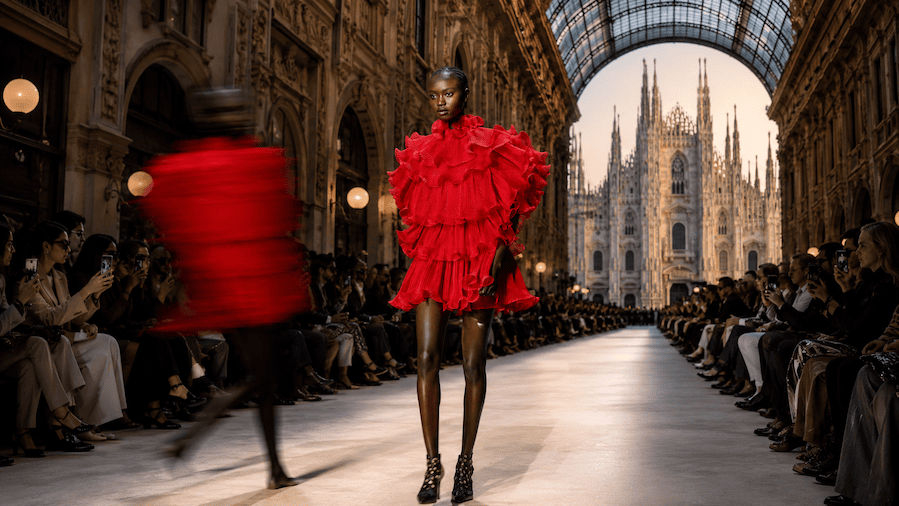
The image I created for the cover is no accident. It’s deliberately descriptive. It illustrates this article, but also a personal wish: to finally see a real runway show in Galleria Vittorio Emanuele II, transformed into a space entirely dedicated to fashion.
New York, London, Milan and Paris will present their Spring/Summer 2027 collections. This reopens the long season of shows, presentations and events that captures the entire industry’s attention for weeks. But this time, the real interest won’t just be about what we’ll wear in six months. It will be about which brands still have a clear direction. And which ones are still trying to find it.
Because fashion, before being communication, remains product, business, distribution, margins and the ability to create desire. The runway can amplify all of this. But it cannot invent it. And that’s exactly where September gets interesting.
In recent years, we’ve seen constant changes in creative directions. Relaunches. Repositionings. High-visibility campaigns. An almost relentless production of images. Everything moves faster. But the market keeps reminding us of a simple rule: being visible doesn’t necessarily mean being desirable. And being desirable doesn’t automatically mean selling.
A collection’s success isn’t measured only by image impact or the volume of content it generates. It’s measured by its ability to restore coherence to the brand. Today’s consumer sees everything. Compares everything. Has access to information that didn’t exist just a few years ago. They figure out quickly when a brand’s story aligns with the product. And when communication is just compensating for a lack of identity.
That’s also why Fashion Weeks are changing function. They remain spectacle, image, relationship-building. But they’ve also become a public test of brand strategy. A new creative direction, a repositioning, an attempted relaunch—all are observed simultaneously by buyers, press, investors, clients and the public.
Milan, in this sense, remains one of the most interesting observatories. Its strength continues to lie in the intersection of creativity and industry. Behind the Italian runway exists a structure made of companies, supply chains, manufacturing, distribution and expertise. That’s why the question can’t just be whether a collection is beautiful. It must be whether it strengthens brand identity, generates a credible product and builds value over time.
Gucci will inevitably be one of the most watched. Demna’s arrival has opened a new chapter. The point won’t just be seeing what aesthetic he brings to the brand. It will be understanding whether this new identity can turn into desirability—and then into results. But Gucci is just the most visible case of a much broader phenomenon.
The constant movement of creative directors in recent years tells the story of a system seeking new balance. The designer remains central. But today that role operates within a much more complex structure. Creativity, product, market and management must work together. Changing a brand’s creative face is no longer enough to automatically change its destiny.
New York, London, Milan and Paris will naturally continue to represent four different fashion cultures. New York retains its ability to merge fashion, business and pop culture. London remains a laboratory where new languages often emerge. Milan continues to express the relationship between style and industry most clearly. Paris maintains the great symbolic and commercial power of international luxury.
But perhaps this year, it will be even more interesting to observe what they have in common.
All must confront the same problem: staying relevant in a market saturated with images and constantly bombarded by new messages. Communication has increased enormously. But precisely for this reason, attention has become more fragile. A show can dominate social media for twenty-four hours and disappear the next day. A collaboration can go viral without actually building value. A new creative director can generate plenty of curiosity. But curiosity is not yet brand loyalty.
Branding, ultimately, is measured afterward. When the show’s effect has faded. When the campaign is no longer new. When what remains is understanding what the consumer actually retained about the brand. That’s where identity, recognition and perceived value matter.
It’s also the principle I try to apply in my work. When I work with a brand, I’m not simply interested in increasing visibility. I focus on elevating the narrative. Enriching it. Imprinting it with personality and identity. Because storytelling, when intelligent, sophisticated and aligned with positioning, becomes one of the most effective forms of branding. It’s not just about getting people to talk about a brand. It’s about deciding how it enters the mind of those who observe it.
And perhaps that’s the most interesting point about September. Not so much what we’ll see on the runways. But what we’ll understand by watching them. Who is truly building a new phase. Who is just changing image. And who can still transform creativity and product into real desire.
Because today, a Fashion Week tells us much more than a season. It reveals the health of brands. And in some ways, the direction the entire fashion system is taking.

Alessandro Sicuro
Brand Strategist | Photographer | Art Director | Project Manager Alessandro Sicuro Comunication


