
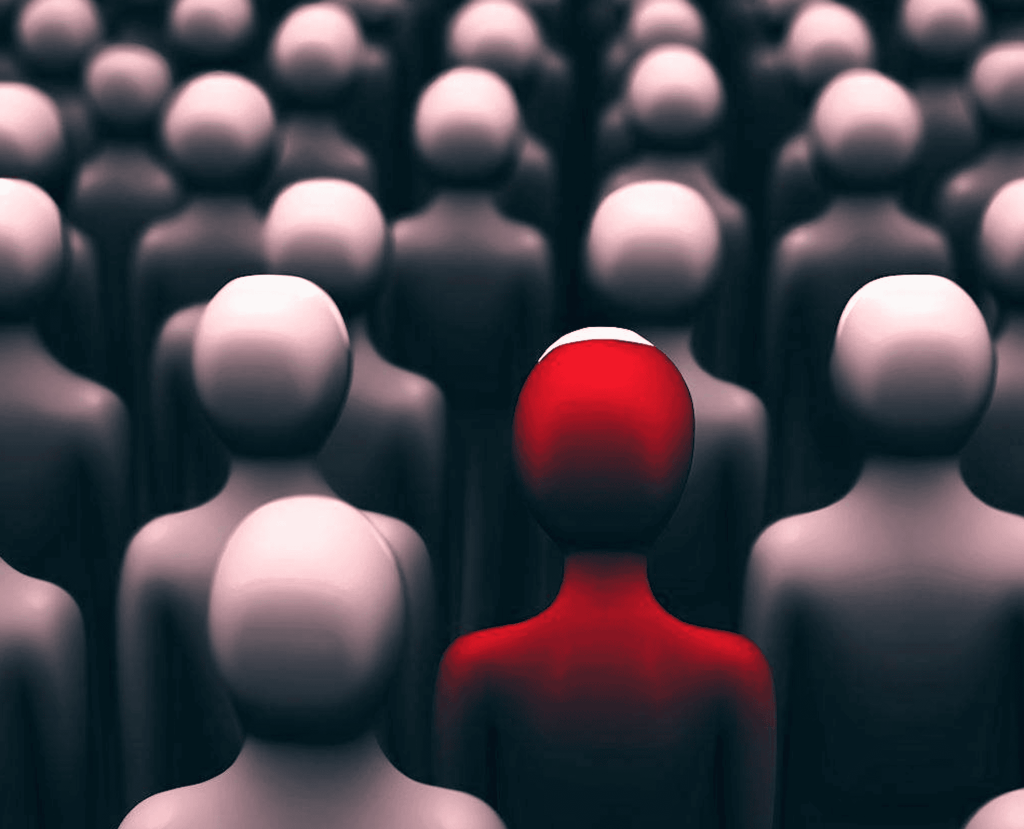
Never before have we had so many tools to express ourselves, tell our story, show who we are and reach others. And yet this enormous possibility of communicating seems to have produced a paradox: while the tools for being different increase, the tendency to resemble one another grows at the same time.
We see it constantly on social media. A language, a way of photographing oneself, an aesthetic, a behavior or a trend is born, gets attention and, within a very short time, is taken up, imitated and multiplied. The protagonists change, but very often the codes remain the same. There isn’t necessarily someone imposing all this, and speaking simply of “one-track thinking” would be reductive. The phenomenon is subtler: when millions of people constantly observe what works and platforms keep resurfacing what has already earned attention, convergence inevitably follows.
Algorithms contribute to this process because they learn from our preferences and tend to show us what resembles what we have already watched, liked or shared. It is an effective system, because it increases our interest and keeps us there longer, but it can also slowly narrow the field of what we encounter. In the end we risk moving inside environments built more and more around our tastes, our beliefs and our habits, meeting less and less of what might challenge them.
For young people this dynamic matters even more, because precisely in the years when a person should experiment, change their mind, build their own tastes and slowly understand who they want to become, they find themselves immersed in a continuous flow of ready-made models. It isn’t just about fashion or aesthetics. Social media constantly suggest how to dress, how to present oneself, what to desire, which places to frequent, which words to use and even which opinions seem to receive the most approval. The problem is not taking inspiration from others, because we have always done that; the problem arises when it becomes hard to tell where inspiration ends and homogenization begins.
The most effective form of homogenization, in fact, is not the imposed one. It is the one we end up considering spontaneous.
Something very similar happens in the world of brands too. A company rightly observes what happens around it, studies the market, analyzes competitors and tries to understand which languages work. But when everyone looks at the same signals and chases the same trends, the result is that many brands end up communicating in the same way. You see interchangeable campaigns, photographs built on almost identical codes, words repeated until they lose meaning and stories that could belong equally to a brand or to its competitor.
This is where uniqueness acquires even greater value. It doesn’t mean being eccentric at all costs, nor wanting to look different at any price. It means preserving something that has its own origin, its own language and its own physiognomy. For a person it can be a way of thinking, a sensibility, a personal culture, a skill; for a brand it can be its history, its product, its way of working, its quality, its language or simply a vision that becomes recognizable over time.
In this sense uniqueness is also a form of protection. For people it means not being completely absorbed by dominant models; for brands it means not losing that difference that allows the public to recognize and remember them. And this is precisely where the big platforms represent both an opportunity and a risk. Their distribution capacity is extraordinary and it would be absurd to think we could do without them, but precisely because they can bring content in front of enormous audiences, it becomes essential that what is distributed doesn’t lose its identity along the way.
There’s no need to compete with the giants on their own ground. A small brand doesn’t necessarily have to talk like a multinational, a young person doesn’t have to resemble someone with millions of followers to feel recognized, and an author shouldn’t keep changing their language just because at that moment a certain format gets more attention. True strength lies in being able to use all these tools without letting the tools completely decide our shape.
Platforms change, languages change and trends last less and less. What remains is what others manage to associate with us without confusing it with everything else. And this is probably the most interesting point of our time: the more the possibilities of being visible increase, the harder it becomes to be truly recognizable.
That is why uniqueness today is not only a creative or personal value. It is a form of freedom and, for a brand, also one of the most important defenses against homogenization.
Being different doesn’t mean isolating oneself from the world. It means crossing it without completely losing one’s own shape.

Alessandro Sicuro
Brand Strategist | Photographer | Art Director | Project Manager Alessandro Sicuro Comunication


