
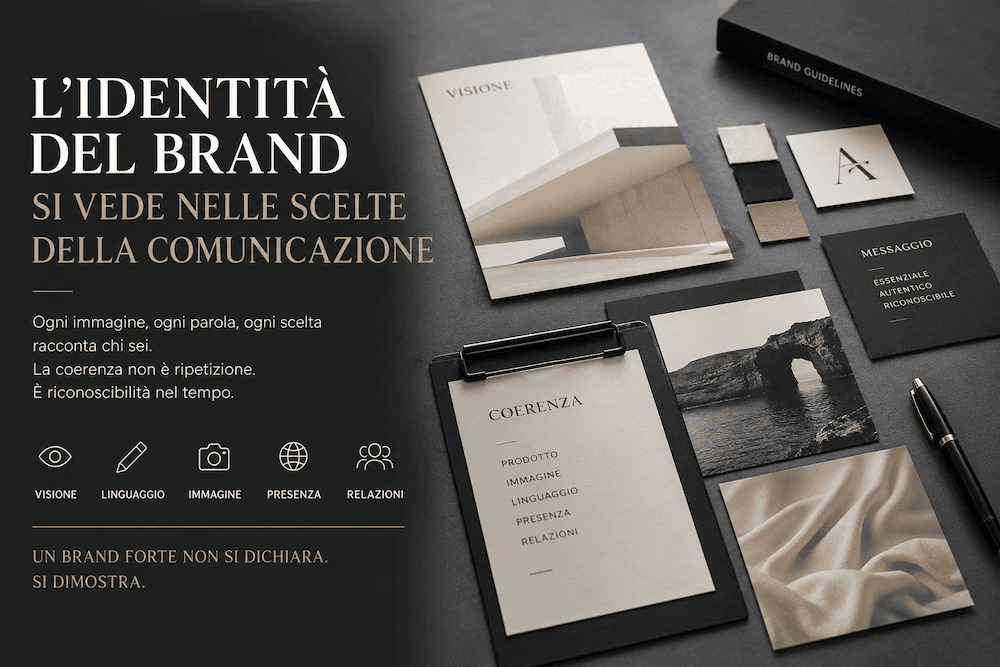
A brand is not just what it says about itself.
It is mainly what it chooses to show, how it chooses to show it, and how consistently it maintains that choice over time.
Identity comes through the product, of course. But it also takes shape in photography, language, campaigns, websites, social media, public relations, retail locations, collaborations, and every other place where the brand meets its audience. Identity becomes visible in these choices.
A brand can claim exclusivity. But if it communicates exactly like a hundred other competitors, it immediately loses power. It can talk about craftsmanship, research, and quality. But if it uses generic images, standardized language, and content without personality, it ends up contradicting what it wants to represent.
Pricing is part of this system too. Price must align with the product, with the market the brand wants to occupy, and above all with the value that communication has built around it.
But the central point is something else: every element must speak the same language.
This does not mean repeating the same image or using the same codes over and over. A strong identity can evolve, change campaigns, experiment with new languages, and move through different eras. But it must remain recognizable. This is the difference between simply having communication and having a true brand identity.
Today we are surrounded by perfect images, very similar campaigns, technically flawless photography, and language that often seems to belong to the same brand. Formal quality has become much more accessible. That is exactly why it is no longer enough. You need direction.
You need to know what to tell, what not to tell, which images to use, which collaborations to choose, where to appear, and also when not to appear. Because communicating does not mean constantly occupying space. It means building a perception.
A wrong collaboration can weaken years of positioning. An off-tone campaign can create confusion. Too much presence can trivialize a brand that built its value on exclusivity.
On the other hand, consistent communication gradually creates a recognizable universe. Product, image, language, and reputation end up reinforcing each other.
And this is exactly where identity becomes something concrete. It is no longer a definition written in the company presentation. It becomes the way the market recognizes that brand among many others. Because a brand does not become recognizable when it says it is different.
It becomes recognizable when all its communication choices prove that it is.

Alessandro Sicuro
Brand Strategist | Photographer | Art Director | Project Manager Alessandro Sicuro Comunication


