
From word of mouth to specialization: why standing out matters even more today
How does an idea that can circulate, be repeated and become recognizable come to life? And why do some manage to get into people’s heads while others vanish in the general noise?
Part of the answer still lies in word of mouth, one of the oldest and most powerful mechanisms of communication. When we tell something to someone else we are not simply transferring information: we are attributing value to what we received. If we decide to repeat it, it is because it struck us, it represents us, or it comes from a source we consider credible.
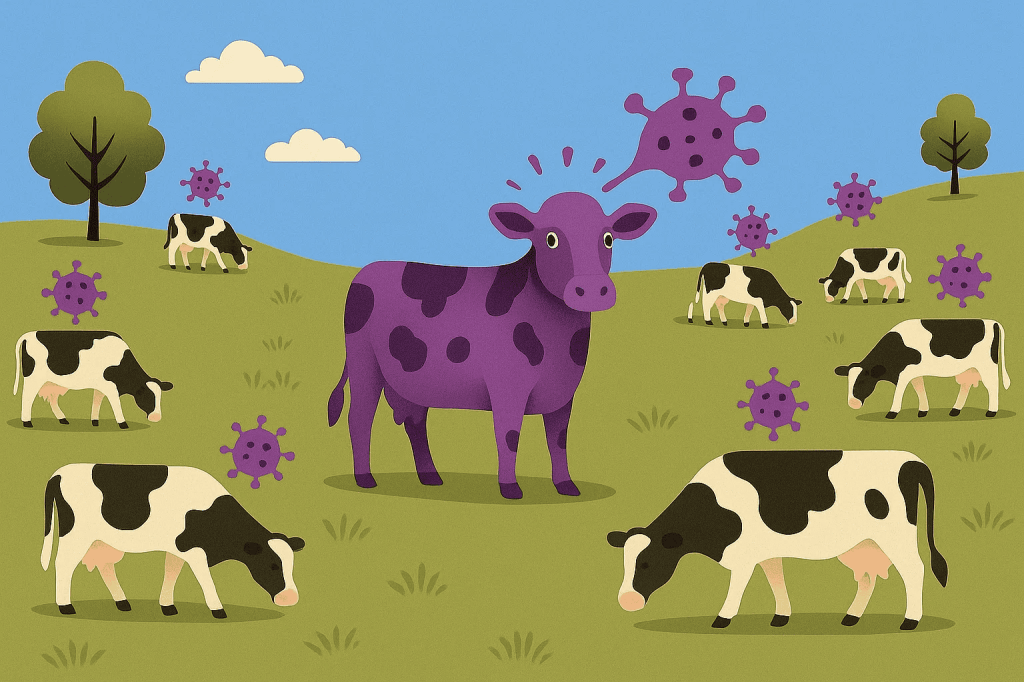
This is exactly where Seth Godin’s thinking retains a surprising relevance today. In 2003, with Purple Cow, Godin uses a very simple metaphor: in a field full of identical cows, after a while we stop even looking at them. But if there were a purple one among them, it would be impossible not to notice it.
That metaphor is perhaps even more effective today than it was then, because we live immersed in an enormous amount of images, products, content, messages and stimuli. Abundance, however, also produces a paradoxical effect: many things end up looking alike. We observe what works, replicate it, adapt it and re-propose it. The same languages, the same visual patterns, the same narrative formulas, often even the same behaviors.
So we slowly enter a great chorus in which everyone tries to be contemporary in the same way. Homogenization often arises precisely from the habit of constantly looking at what others do to understand what we should do. And the more this mutual imitation grows, the harder it becomes to recognize an individual voice.
This is where the Purple Cow still makes sense. It doesn’t simply invite us to be eccentric or extravagant, but to avoid becoming indistinguishable. Being different means, above all, understanding what space you want to occupy, and for which skill, characteristic or vision you want to be recognized.
From this point of view, finding your own niche becomes essential. In an enormous market it is very hard to matter to everyone, while it is possible to become highly relevant for a specific group of people, for a sector, for a specific skill or for a particular way of interpreting a problem.
Specialization, therefore, doesn’t necessarily narrow possibilities. It can do exactly the opposite. It means building a territory precise enough to become recognizable and solid enough to then progressively widen your range of action.
The Purple Cow, after all, doesn’t have to be different from everything that exists. It has to be immediately recognizable in its own territory. And it is precisely when this recognizability exists that another of Godin’s still very current insights can arise: that of the viral idea.
A viral idea is a concept that begins to spread through people. Not because someone necessarily keeps pushing it with large advertising investments, but because those who encounter it feel the need to tell it, share it, reinterpret it and pass it on to others.
And here we must distinguish simple virality from the authentic spread of an idea. A piece of content can reach millions of views and disappear a few days later leaving practically nothing behind. An idea, instead, can start slowly, settle, enter people’s language and keep living long after the original content has been forgotten.
The real strength, then, is not in the post, but in the concept that manages to outlive the post.
For this to happen, we also need people capable of transmitting it. Godin provocatively calls them the “sneezers” of ideas: not necessarily figures with millions of followers, but credible people within a community, able to transfer along with the message their own authority.
Many ideas that become big in fact begin in much smaller environments: a community, a niche, a small group of people who understand them, recognize them and spontaneously begin to circulate them. It is a process that resembles propagation far more than simple advertising.
That’s why trying to speak to everyone immediately can be less effective than managing to speak very well to someone. If a niche truly recognizes the value of an idea, it can become the first engine of its spread and gradually carry it much further.
This is perhaps one of the most interesting lessons of contemporary marketing. In a society overloaded with messages, the difficulty is no longer simply being able to communicate, but being remembered without becoming yet another indistinguishable voice in the chorus.
The Purple Cow therefore remains current precisely because it reminds us that automatically following the herd progressively reduces the ability to be recognized. Finding your own territory, deepening it, specializing and developing a personal point of view becomes instead the condition for an idea to truly start traveling.
And when that idea goes beyond the person who created it, passes from one person to another and keeps circulating without needing to be continuously pushed, marketing probably reaches one of its most effective forms: it is no longer just us telling the message, it is others who have decided it is worth continuing to do so.

Alessandro Sicuro
Brand Strategist | Photographer | Art Director | Project Manager Alessandro Sicuro Comunication


