
Some misconceptions to overcome if you want to understand how brand identity, reputation, and reach are truly built
When people talk about launching a brand today, their minds jump straight to social media. It makes sense. These channels are the most visible, the fastest, and seemingly the most accessible. But this immediacy has created one of the most common misconceptions of recent years: thinking that just showing up, posting, grabbing attention, and maybe hitting some impressive numbers means you’ve built a brand. That’s not how it works.
Social media can be an extraordinary accelerator. But first, something worth accelerating must exist. And that something doesn’t come from an algorithm, a viral reel, or a well-executed campaign. It comes much earlier. It starts the moment a brand begins to truly understand who it is and why it should exist. That’s where you need to dig.
Go back to the original idea. To the person who had it. To how that product or project took shape. Understand what need it addresses. Most importantly, understand what makes it different. It could be an innovation, a style, or simply a new way of interpreting something that already existed. But there must be a recognizable core. Without it, there is no identity. There’s just a product looking for visibility.
This is where the real work begins. Identity isn’t invented at a desk. It’s identified, brought into focus, and made legible. Only then can it be told.
And storytelling, in turn, isn’t about flooding the internet with content. It’s not about constantly producing something just because you’re afraid of disappearing from the feed. It’s about shaping a credible story. One built on real, verifiable elements that align with what the brand truly is. This is where a concept I care deeply about comes into play: respect for communication.
Telling a brand’s story means taking responsibility for what you’re saying. It means not building artificial mythologies just because they perform better. It means not turning a small insight into a legend. It means not confusing the communicator’s craft with simply making noise. Good communication doesn’t invade. It settles.
Over time, it delivers consistent elements. It makes them recognizable. It connects them. It allows the observer to gradually build a precise image of that brand. This is where reputation is formed. And only at this point does it truly make sense to talk about channels.
Strategy, at its core, is knowing what image you want to build and where you want to take the brand. Tactics are about how you pursue that direction, choosing the right tools along the way. Social media belongs mostly to the tactical level.
You can use them from the start, of course. But they shouldn’t become the place where you decide who you are. They can support the building of an identity, give it visibility, and massively expand your audience. But they don’t replace the work that comes before. And this is exactly where many get fooled.
A piece of content can go viral and bring in a massive wave of views, engagement, and contacts in just hours. But that explosion doesn’t automatically mean you’ve built a brand. It might depend on a single moment, an image, a provocation—something that exists almost independently of the brand itself. That’s the leverage effect of social media. It’s powerful. But leverage multiplies what it finds.
If there’s a solid foundation behind it, that amplification can be incredibly useful. If there’s no real identity yet, the risk is getting a huge spike in attention and leaving nothing in people’s memory. This is the difference that’s often underestimated. Visibility can come in a day. Reputation cannot.
Building it takes time. The audience must learn to recognize that brand and associate it with a specific meaning. They must naturally distinguish it from others. That’s why I consider it a mistake to start by asking which social platform to use or which format might work best.
The question you should ask first is different: What are we actually putting in front of people? If the answer is weak, no platform will fix it. But if a strong identity exists, along with a credible story and a clear direction, then social media can do what it does best: carry that signal much further.
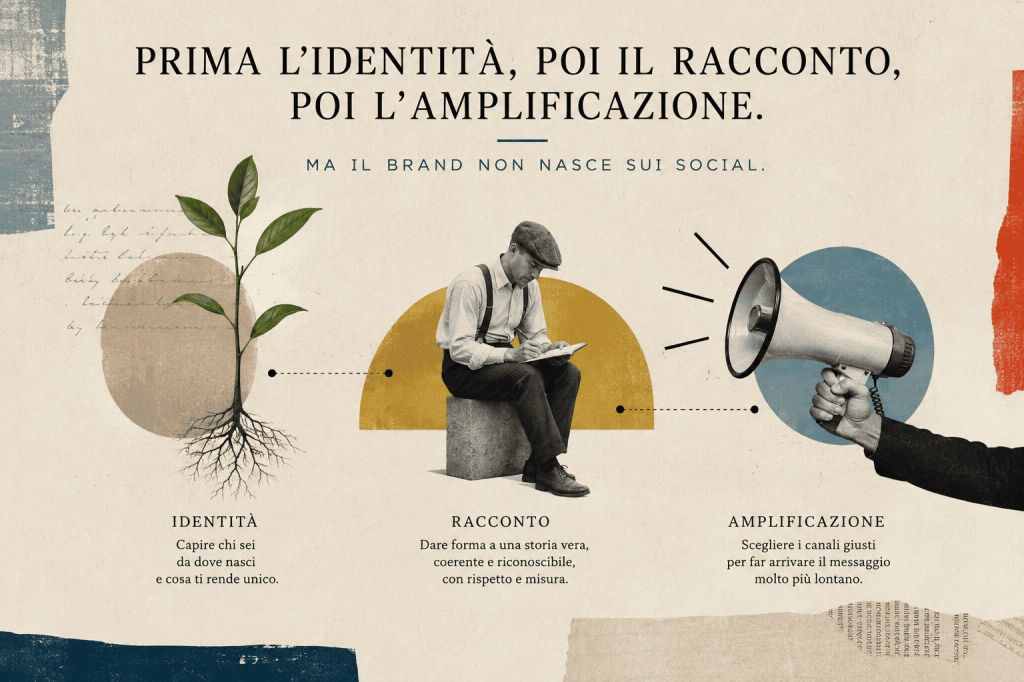
Because the order never changes: Identity first, then storytelling, then amplification.
Social media comes into the picture within this process. Not before.
–

Alessandro Sicuro
Brand Strategist | Photographer | Art Director | Project Manager Alessandro Sicuro Comunication


