
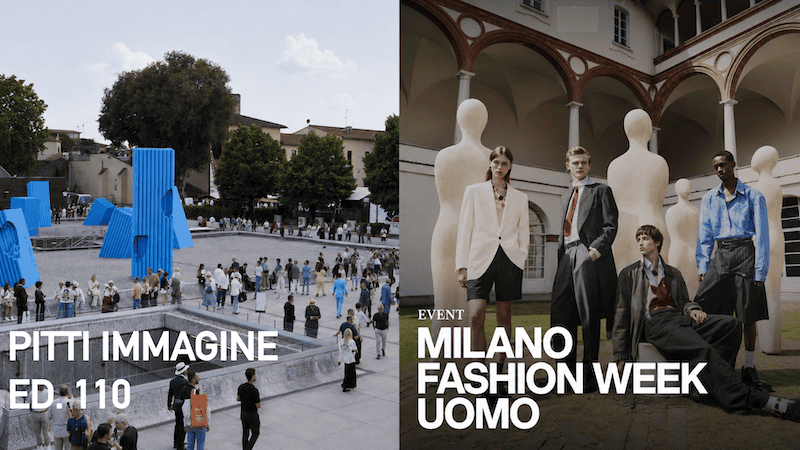
Pitti Uomo 110 is over, and SS2027 menswear moves from Florence to Milan, as per the calendar. Before looking at the Milanese week, however, we still have to read the balance sheet of the Fortezza da Basso.
Pitti confirms its centrality in the menswear system, but has not yet returned to pre-Covid levels. It holds, and these days that is no small thing. But it doesn’t accelerate.
Edition 110 closed with over 720 brands present, about 11,000 buyers, more than 15,000 visitors overall and over 5,200 foreign distribution and retail operators from more than 90 countries.
The fairest comparison is with the previous summer edition. Pitti Uomo 108, in June 2025, had recorded 740 exhibitors, over 11,400 buyers and more than 15,000 visitors overall. The gap is not huge, but it tells the moment well: Pitti 110 doesn’t mark strong growth, it records substantial resilience.
And resilience, in this phase, is already a significant figure.
The menswear market is going through a more cautious season. Consumption is selective, stores buy with greater care, buyers weigh prices, deliveries, production continuity and company reliability. Even taking part in a trade fair has become an investment to be calculated precisely.
Being at Pitti doesn’t only mean paying for a stand. It means bearing costs for setup, staff, travel, hotels, catering, sample collections, commercial materials, agents and appointments. For many brands, especially small and medium ones, the return has to be concrete. Today it isn’t enough to be there. You have to know why you are there.
This also explains why the return to pre-Covid numbers has not yet been completed. Before the pandemic Pitti ran on a larger scale, with exhibitors reaching around 1,100-1,200 brands and higher overall attendance. That volume has not yet come back. The system has shrunk, costs have grown, and companies select trade fairs, travel and commercial investments better.
It doesn’t mean Pitti is losing its role. It means its role must be read with more realism.
The Fortezza da Basso remains one of the most concrete places in international menswear. Here the product is seen up close: fabrics, construction, fit, price, distribution, margins, deliveries. It is a moment of commercial verification, before being one of image.
From this balance sheet the second phase of the season begins.
From June 19 to 23, Milan Men’s Fashion Week brings SS2027 menswear into the calendar of shows, presentations, events, showrooms and international communication. On the program are heavyweight names such as Prada, Dolce&Gabbana, Paul Smith, Ralph Lauren and Giorgio Armani.
Among the most significant presences is Thom Browne, who presents his menswear collection for the first time during the Milanese week. It is an important signal, because it comes at a time when many brands are rethinking timing, formats and presentation strategies.
The closing entrusted to Giorgio Armani also has a precise value. Leo Dell’Orco and Silvana Armani will present together the co-ed Giorgio Armani collection and a selection of pieces from the women’s cruise 2027. A step that confirms Armani’s weight as a reference point for continuity, identity and control of language.
Pitti thus hands Milan a clear snapshot: menswear holds, but moves within a more cautious market. The buyers are there, the international operators too, the brands keep investing. But the context is not expansive as it once was.
Milan now opens the most visible part of the season.
After the Florence balance sheet, the question is not only who will show. It is which brands will be able to turn product, image and market into a credible direction.
SS2027 menswear starts from here: less euphoria, more selection. Less automatism, more substance.

Alessandro Sicuro
Brand Strategist | Photographer | Art Director | Project Manager Alessandro Sicuro Comunication


