
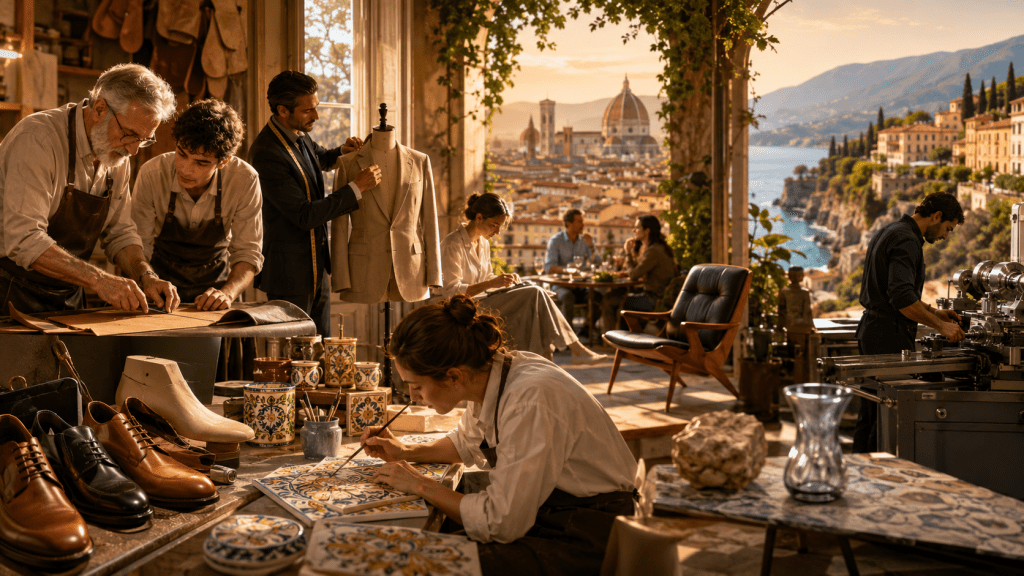
A nation doesn’t just defend its borders. It also defends what makes it recognizable, productive, desirable, and necessary in the world.
For Italy, this means protecting a heritage that isn’t made of a single sector. It’s a complex system of culture, manufacturing, beauty, industry, landscape, expertise, and reputation.
Made in Italy doesn’t come from an abstract formula. It comes from a sum of worlds that hold together: a city of art, a fabric, a wine, a well-designed chair, a ceramic surface produced with advanced technology, an industrial machine, a hand-stitched bag, a recognizable cuisine, a production district, a workshop, a factory, a museum, a landscape. When all of this works, it becomes economy. It becomes tourism, exports, jobs, international attraction, desire, trust, identity.
That’s why a nation’s assets shouldn’t just be celebrated. They must be understood, measured, protected, and developed. Not to turn the country into a spreadsheet. But to prevent what makes it strong from being slowly consumed, almost without noticing.
The greatest risk isn’t always sudden loss. Sometimes it’s silent loss: a supply chain that thins out, a workshop that closes, a district that loses energy, a brand that keeps its name but loses its roots, a territory that lives on image but no longer invests in its own structure. Within this silent loss lies an even more delicate point: the transmission of knowledge.
When an entrepreneurial family can’t manage generational transition, when a young person isn’t guided into a trade, when a tailor shop, a leather workshop, a shoemaker, a winery, a weaving mill, or a small manufacturer can no longer transfer knowledge, we don’t just lose production.
We lose material culture.
We lose manual skill, sensitivity, eye, experience, proportion, discipline, relationship with materials. We lose that part of Italian know-how that can’t be learned from a manual. And can’t be rebuilt with an advertising campaign.
This is where the issue becomes strategic.
While we sometimes treat these trades as something minor or outdated, many international observers study them closely. Japanese, Chinese, American, and other foreign operators come to Italy. They enter workshops. They observe artisans and small businesses. They learn techniques, processes, details, production sensibilities. Then they bring that knowledge back to their own markets. They build brands, shops, companies, products, and commercial narratives inspired by that culture.
This isn’t an accusation. It’s a signal.
It proves our knowledge is still precious. But it also proves that if we aren’t the first to protect and transmit it, that knowledge can continue generating value elsewhere. While here, it risks weakening.
Fashion, tourism, food, design, furniture, ceramics, mechanics, and culture aren’t separate chapters. They’re parts of the same productive story.
A tourist arriving in Italy doesn’t just encounter a monument. They encounter a way of living. They encounter food, hospitality, architecture, fashion, craftsmanship, landscape, light, materials, the quality of objects, the memory of places.
An Italian product sold worldwide doesn’t just carry a function. It carries a perception. It carries a promise. It carries an idea of quality.
Italy’s strategic capital isn’t nostalgia. It isn’t folklore. It isn’t an archive to dig through when a new vision is lacking. It’s a living structure. Economy, culture, industry, expertise, territories, and reputation hold together within it.
And precisely because it’s alive, celebrating it isn’t enough. It must be nourished, updated, and carried into the future. A nation that knows its assets can better decide what to strengthen, what to protect, what to innovate, which skills not to lose, which supply chains to support, which districts to accompany over time.
This isn’t an ideological issue. It’s a management issue.
Because a nation that doesn’t know its strategic assets risks consuming them without realizing it.
And when a productive, cultural, or industrial heritage is lost, it can’t always be rebuilt.
–
–

Alessandro Sicuro
Brand Strategist | Photographer | Art Director | Project Manager
Alessandro Sicuro Comunication


