
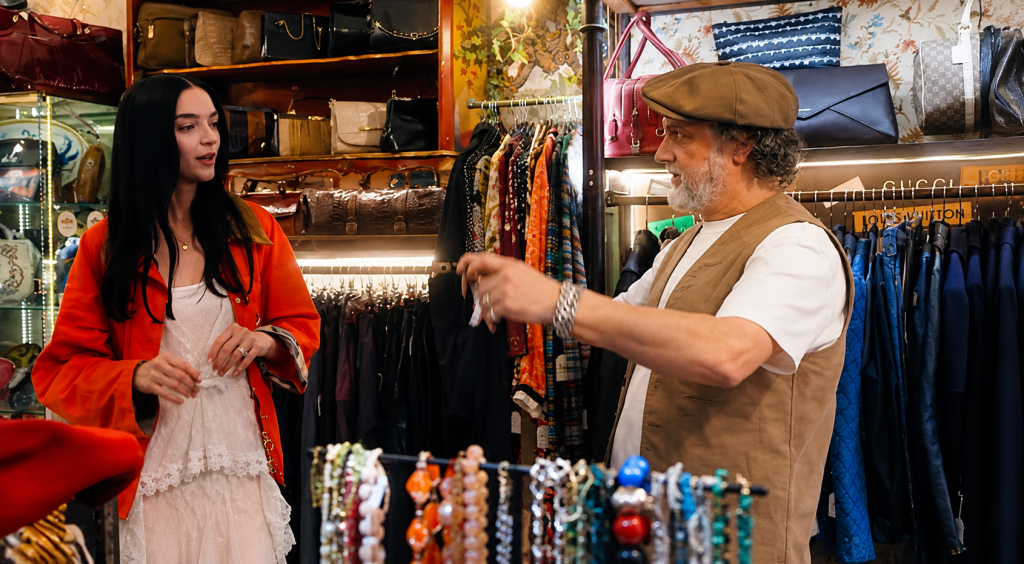
At Momo Vintage, Nicola Naimoli presents archive clothing as living matter. Memory of style. A form of contemporary culture.
There’s a moment in fashion when a garment stops being just something to wear. It becomes a document. A clue to an era. Evidence of material culture. It tells how it was conceived, constructed, lived in. This is Nicola Naimoli’s territory. He founded Momo Vintage, a Florence-based venture born from deep knowledge of fabrics, stitching, details, and the stories each piece holds.
Nicola hails from Naples. He discovered vintage long before it became a trend. As a teenager, he developed a natural interest in period clothing. He bought and wore pre-owned pieces when this language hadn’t yet entered mainstream taste.
He moved to Florence over twenty years ago. His first steps were at the San Lorenzo Central Market, when it still held authentic commercial and working-class character. There he opened a stall for buying and selling vintage clothing. American, military, and denim were his focus. Practical worlds. Functional. Yet already rich with codes, shapes, and references.
Success came quickly. Customers wanted pieces different from contemporary industrial production. Objects with a previous life. A stronger physicality. Nicola gradually expanded his selection. Alongside denim, military, and American wear came tailored garments. Designer pieces. Rarer finds. Accessories that could narrate an era.
In 2006, he launched a specialized wholesale business. He curated quality vintage for sector retailers. Working with professionals, collectors, and buyers sharpened his eye. Selection no longer happened by instinct alone. It required precise expertise: recognizing a fabric, reading a construction, evaluating a seam, understanding when a piece truly has something to say.
From this experience, Momo Vintage took shape. It opened in August 2017 at Via dei Serragli 7/R, in the heart of Florence’s Oltrarno district. Between Santo Spirito and San Frediano. A neighborhood where artisan workshops, antique dealers, artists, historic trattorias, and new creative spaces coexist. Over time, the shop grew. It relocated to Via dei Serragli 24/R. Same street. Same urban fabric that shaped its identity.
Entering Momo Vintage means crossing a small geography of fashion history. Evening gowns. Day dresses. American denim. Iconic accessories. Objects that complete an aesthetic built on details, memory, and presence. Each piece seems placed not merely to be sold. But to be recognized.
For Nicola, vintage isn’t nostalgia. It’s a way of reading. A method for understanding where certain lines come from. Why some pieces cross eras. What separates a product built to last from one made only to be consumed.
His expertise comes from practice. The eye. The touch. Daily experience. Over the years, he learned to spot the nearly invisible details that separate an authentic piece from a mere imitation. That’s why many people consult him. To evaluate important pieces. To distinguish real from fake. To read quality behind a label, a button, a lining, a metal accessory.
In his work, quality isn’t abstract. It lives in fabric texture. In how a garment falls on the body. In stitching precision. In material choice. Elements that, according to Nicola, have often weakened even within major fashion houses. They’re increasingly driven by marketing logic, rapid consumption, and serial production.
This is where vintage speaks to the present. Many people aren’t just seeking a prestigious label. They want substance. Construction. Identity. Something that has crossed time. Not something born merely to follow a season. In a market that constantly renews images and desires, archive clothing holds different power. It doesn’t need to seem current. It has already proven it can endure.
When discussing fashion’s relationship with archives, Nicola doesn’t reject recovering forms, codes, or historical references. The past can be a fundamental resource. On one condition: it must not be copied mechanically. It must be understood. Transformed. Brought into the present with fresh purpose.
A clear example: the wide-leg U.S. Navy pants mentioned in conversation. That silhouette, later absorbed into fashion’s imagery, wasn’t born as a decorative choice. It served a precise function. The wide leg made it easier to grab a sailor and pull him from the water if he fell overboard. A form born from technical necessity became, over time, an aesthetic language.
The story of Mariacarla Boscono in his shop also illustrates this relationship between eye, experience, and recognition. A model accustomed to wearing first collections, major houses, and iconic pieces immediately recognized the power of an authentic garment. Specifically, a Roberto Cavalli piece tied to the season of his most celebrated prints. That sensual, recognizable imagery that marked a significant chapter in Italian fashion.
In that moment, vintage doesn’t appear old. It appears as something still holding energy. A piece can belong to another era and yet feel more alive than much contemporary production.
Nicola Naimoli’s work rests on concrete sensibility. Respect for materials. Knowledge of details. The ability to read history inside objects. Momo Vintage becomes a space where the past isn’t treated as a dead archive. It’s a repertoire of forms, quality, and meanings.
At a time when much of fashion seems to swing between nostalgia, marketing, and algorithms, his work reminds us of something simple yet decisive. A garment becomes important when it carries real quality. A function. A construction capable of resisting time.
Wearing vintage, ultimately, means taking on a particular role. Becoming temporary guardians of style’s memory. Vintage, then, isn’t an escape from the present. It’s a way to see it better. To understand what’s been lost. What still holds value. What can be brought back to light without turning it into mere decoration.
GALLERY


Alessandro Sicuro
Brand Strategist | Photographer | Art Director | Project Manager
Alessandro Sicuro Comunication


 Sure-com America