
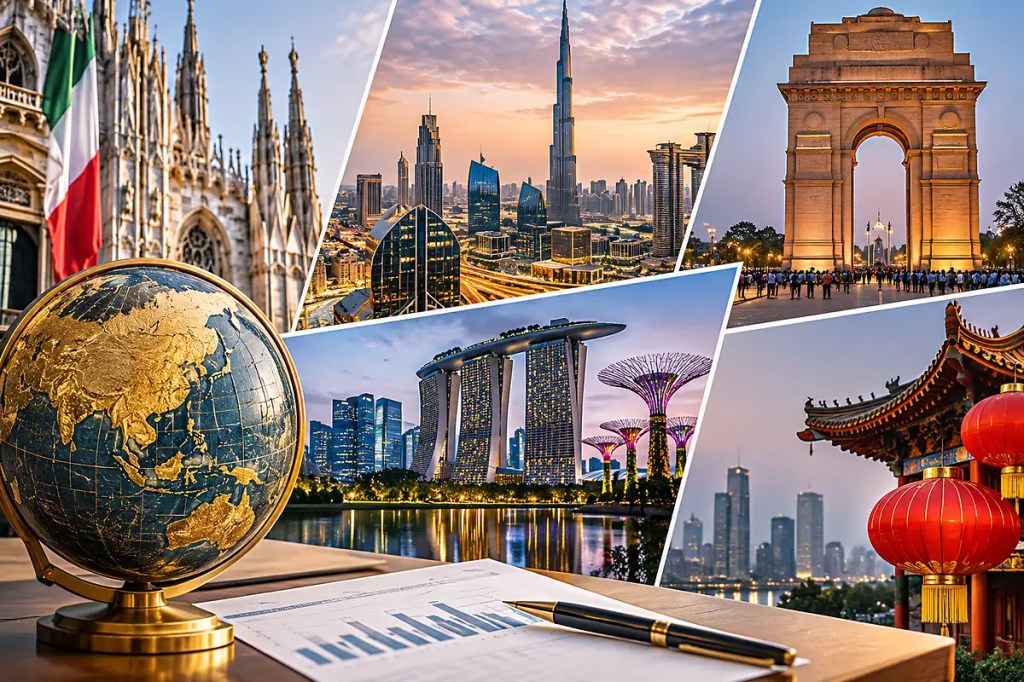
India, Southeast Asia and the Middle East are becoming part of European brands’ expansion strategies as China’s consumer market undergoes a transformation.
For more than a decade, China was one of the main engines of international luxury growth. The outlook is different today. Major European companies are increasingly looking toward India, Southeast Asia and the Gulf states, where demand still has considerable room to grow.
According to the Altagamma–Bain Observatory presented in Milan on November 18, 2026, the global luxury market exceeds €1.5 trillion. Forecasts for 2027 point to growth in personal luxury goods of 6% in India, 5% in North America, 4.5% in the Middle East and 4% in Asia excluding China. Europe follows at 3%, Japan at 2.5% and China at 1%.
According to Bain & Company, the Middle East, Latin America, Southeast Asia, India and Africa already represented a combined market worth approximately €45 billion in 2025, comparable in size to mainland China.
ASIA’S EMERGING MARKETS
Mumbai and New Delhi offer two particularly useful vantage points for understanding Indian demand. A growing affluent population and the development of retail infrastructure are creating favorable conditions for European brands.
In Southeast Asia, Thailand, Vietnam and Indonesia have distinct economic and cultural characteristics that require distribution strategies tailored to each market.
THE MIDDLE EAST: OPPORTUNITY AND RISK
Dubai, Abu Dhabi and Riyadh remain strategic destinations for luxury investment. Real estate development, luxury hospitality and the Gulf states’ economic diversification programs support the long-term outlook.
Geopolitical tensions nevertheless call for caution. The contraction in Middle Eastern demand recorded in 2026 illustrates the sector’s vulnerability to changing tourism flows and international instability.
THE OUTLOOK FOR ITALIAN BUSINESSES
For Italian companies in fashion, tailoring, leather goods, jewelry and design, the central question is the economic sustainability of expansion.
Opening a boutique in an Asian capital requires considerable investment. Agreements with local distributors, selective placement in department stores and commercial partnerships allow companies to test demand before committing substantial capital.
China will remain a fundamental market, but entrusting an entire industry’s growth prospects to a single country would be imprudent.
For many midsize Italian businesses, the quality of international distribution and an understanding of local markets may prove more profitable than an indiscriminate store-opening strategy.

Contacts
Brand Strategist | Photographer | Art Director | Project Manager
Alessandro Sicuro Comunication


