
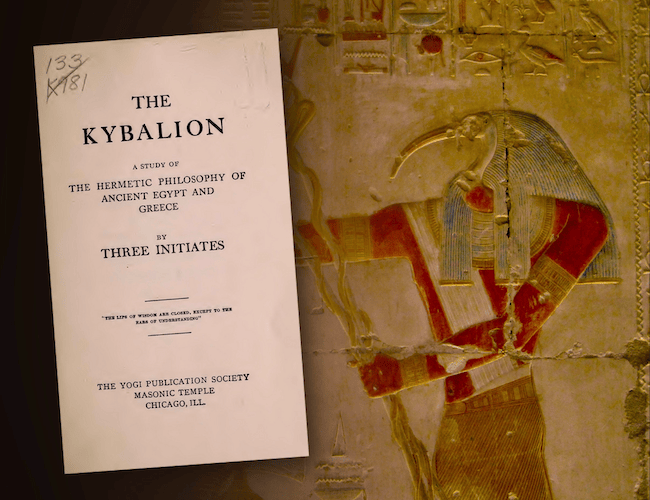
The Three Initiates’ seven Hermetic principles, from teachings attributed to Hermes Trismegistus to the exercise of the will.
The Kybalion, a book of esoteric philosophy signed by the “Three Initiates,” appeared in Chicago in 1908. It was dedicated to Hermes Trismegistus, the legendary teacher to whom the writings behind Hermeticism were attributed. His name means “thrice greatest.” An earlier Greek wording on the Rosetta Stone calls Hermes “great and great.” The 1908 edition
Atlantis already appears in Plato. In the Timaeus, an Egyptian priest tells the story to the Athenian Solon. In the Critias, Plato goes on to describe the city and its canals. The island’s existence remains a matter of legend.
In The Emerald Tablets of Thoth the Atlantean, an esoteric work usually dated to around 1939, Maurice Doreal tells how Thoth flees as the waters swallow Atlantis. He gathers the survivors and reaches Egypt with the records of his civilization. He settles there and, in Doreal’s account, passes on what he has brought with him.
Doreal gives Thoth three incarnations after his life in Egypt. The first two go unnamed. In the last, he is said to return as Hermes. Those three lives are behind the phrase “thrice-born” in Doreal’s telling.
The seven principles of The Kybalion
The Three Initiates offer seven principles that they believe govern reality. The first is mentalism. In their account, the whole universe, including matter, exists within a universal mind the book calls “the All.” Think of a novel. The city, its streets and the people in them exist in a world the writer has imagined.
The second is correspondence, summed up in “as above, so below.” The authors see parallels between the physical, mental and spiritual realms. Something we can observe directly may give us a clue to something harder to reach. The Kybalion compares that line of reasoning to an astronomer using geometry to study the movement of distant stars.
The third is vibration. In the book’s account, everything is in motion, even what seems still. A string produces different notes depending on the frequency at which it vibrates. The authors extend the analogy to inner life, associating different moods with different degrees of vibration.
The fourth is polarity. The north and south poles belong to the same magnet. A thermometer makes another side of the idea clear. Between hot and cold there are plenty of intermediate degrees, all on the same scale. The Three Initiates apply the reasoning to light and darkness, love and hate, and go as far as putting good and evil at opposite ends of one scale.
The fifth is rhythm. The tide comes in and goes out. The book sees a similar motion in periods of growth and decline. Polarity gives us the two ends of the scale. Rhythm describes the movement from one toward the other and back again.
The sixth is cause and effect. Every effect has a cause, and every cause has an effect. In The Kybalion, “chance” is what we call an event when we don’t know its causes. A decision we make enters that same chain and can change what happens next.
The seventh is gender. The book calls two functions it sees in every creative process “masculine” and “feminine.” One supplies the impulse, the other receives and develops it. An idea can come in an instant and only take shape later, when you come back to it and work it out.
Mental transmutation in practice
In “Hermetic Axioms,” the final chapter discussed by Francesco Lamendola for Arianna Editrice, the Three Initiates explain how to put polarity to work. They call the deliberate passage from one inner state to another “mental transmutation.” When fear sends us through all the things that could go wrong, the book proposes using the will to turn our attention toward the other pole, courage. The word is “cultivate.” To show what they mean, they use the image of a dark room. Opening the shutters lets in light and gives the quality we want to develop some room.
Take someone who dreads speaking in public. They could prepare a short talk, try it out with people they know and then speak in a less familiar setting. Courage takes shape in the things they manage to face, one at a time. When the problem is inertia, the quality to cultivate is activity. You might pick one part of a job you’ve put off, do it and come back the next day. In both cases, the book puts the emphasis on practice. The way we meet a difficulty changes by degrees.
What happens if the first talk goes badly and you want to back out? The authors call holding your course while your mood swings “neutralization.” You might go over the point where you got stuck and prepare it for the next occasion. The day you speak up about a decision that affects you, the discussion gains an idea you’d previously kept to yourself. That’s one way a change in how we face things can alter what happens around us.

Contacts
Brand Strategist | Photographer | Art Director | Project Manager
Alessandro Sicuro Comunication


