
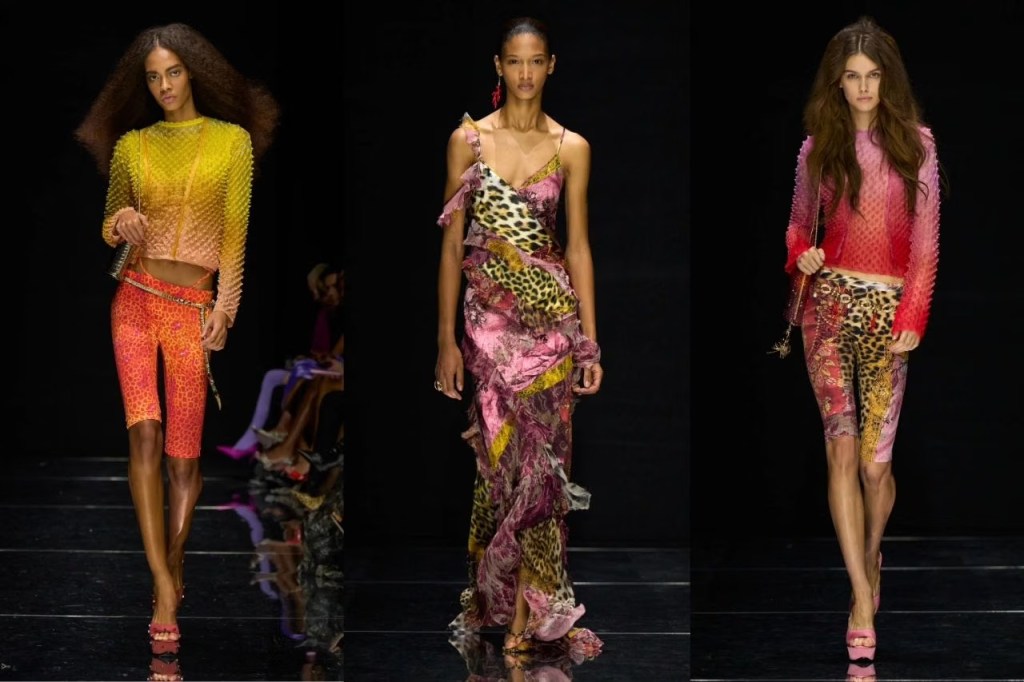
Fausto Puglisi interprets the brand’s character through prints, sheer fabrics and proportions that accentuate the female form. It is a direction I appreciate, though the construction of the clothes is where it must prove itself.
What I like most about Fausto Puglisi’s interpretation of Cavalli is its relationship with the female body. A defined waist, the movement of the hips, a neckline that follows the torso: the dress is designed to bring out the figure and let the woman wear it on her own terms. It is an idea of fashion in which I recognize a pleasure in dressing that I continue to appreciate. Curves become part of the design, suggesting proportions and setting the fabric in motion.
The Spring/Summer 2027 collection takes Los Angeles as its reference and puts the brand’s archive back to work through layered prints, fluid shapes and more sharply defined tailoring. Denim meets bold embellishment and elaborate treatments; chiffon, feathers and crystals make up a wardrobe deliberately seeking attention. These choices are consistent with Cavalli, but consistency alone is not enough: an animal print makes a garment recognizable, not necessarily successful. The difference lies in how it is cut, combined and worn.
This is where Puglisi’s work interests me. His sensibility finds suitable ground in this brand, where a taste for exuberance can develop without having to justify its presence at every turn. Femininity is expressed assertively through close fits, openings and lightness. It is a proposition one may like or dislike; personally, I prefer it to certain volumes that hold the fabric so far from the body that its presence becomes almost irrelevant. I appreciate a dress that can flatter a waist, follow a hip and convey the beauty of a figure in motion.
That does not mean measuring sensuality by how much skin is exposed. A neckline requires proportion, a sheer panel needs careful placement, a light fabric must fall in the right way. These are the points at which the design is put to the test. Even a very showy proposition can be precise; when decoration takes over, the risk is that we remember the effect and lose sight of the person.
This, in my view, is the boundary Cavalli must continue to work on. Layering prints, adding sparkle and multiplying details can give a collection energy, but it makes knowing where to stop more difficult. Each garment must be judged on its own merits, without mistaking every excess for creative freedom. Some clothes gain strength through accumulation; others would benefit from one less intervention.
The current direction convinces me because it preserves a clear relationship between the brand’s character and what it offers women. Those who turn to Cavalli know they can find color, sensuality and a desire to be seen. Puglisi works within that expectation and carries it forward in a recognizable voice. The most interesting test remains a dress that, even after catching the eye, continues to appeal because of the way it fits.



Contacts


