
The experiment dates back to 1999 and 2001, not 2003. NASA is now working on memories capable of storing information carried by photons.
Light does not stop like a car at a traffic light. Yet under extreme conditions, a pulse of light can be slowed until it comes to a halt for a brief interval. The physicist Lene Hau and her research group at Harvard achieved this.
In 1999, Hau brought the speed of light inside a cloud of ultracold sodium atoms down to about 17 metres per second. Two years later, in 2001, the group managed to stop a pulse and store its information in the atomic medium. 2003 was the year Focus reported on the experiment, not the year it was carried out.
In this case, light does not remain suspended in empty space. When the pulse enters the atomic cloud, its information is transferred to the atoms; it can later be retrieved and converted back into light. It is a delicate process, but it opens a practical possibility: temporarily storing information that would normally travel on photons.
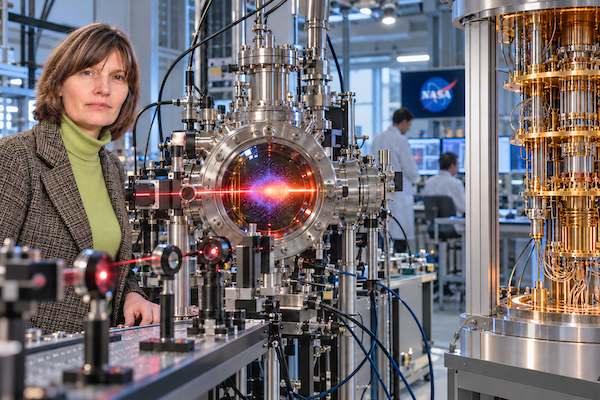
This is where Hau’s research meets a current topic. NASA is studying quantum memories, devices able to store information and return it in the form of photons. In 2024, the agency announced a memory developed with Infleqtion, using a cloud of cooled rubidium atoms. The aim is to help develop quantum networks and long-distance communications, including in space.
The general principle—controlling the interaction between light and matter in order to preserve information—recalls Hau’s work. But this is neither the same experiment nor, on the information available, a direct continuation of her technology. NASA’s memory is designed chiefly for quantum networks; photonic quantum computers belong to a broader field in which controlling and storing photons may play a role.
The news, then, is not that NASA has stopped light today. It is the return of a question that has accompanied physics for decades: how can information carried by light be held and sent on again without being lost? Hau’s experiment showed that it was possible to begin doing so. Quantum memories are now trying to turn that idea into a useful tool for the communications of the future.
Contacts


