
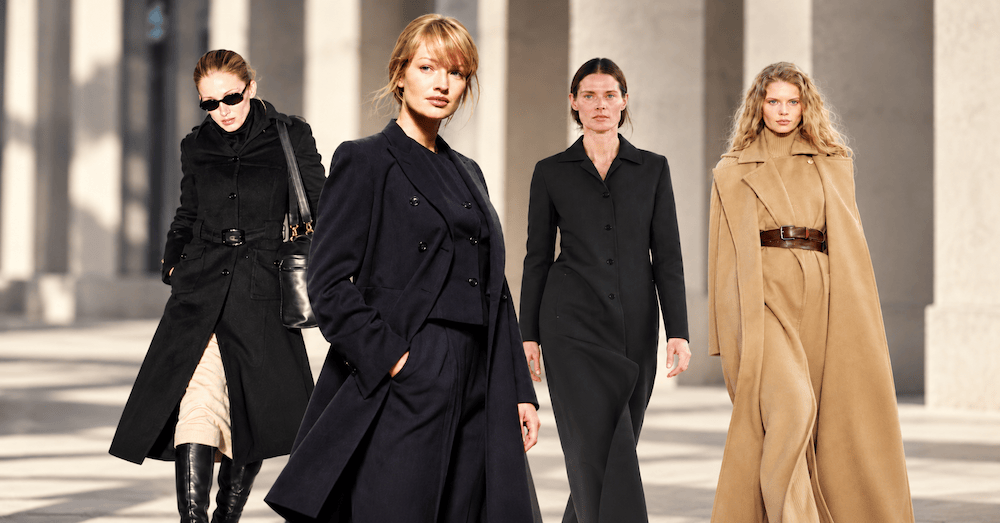
Autumn-winter 2026-27 brings back Nineties lines, built shoulders and substantial fabrics. A trend that puts manufacturing back at the centre, right as luxury seems ever more interested in image than in the substance of the product.
There is something interesting in the return of the tailored coat. After years of exaggerated volumes, dropped shoulders and proportions that often seemed designed to draw attention rather than to dress a person, fashion rediscovers construction. The coat regains a line, a shoulder, a waist, and above all it asks for competence again. For autumn-winter 2026-27 the references look to the Nineties, to the minimalism of Calvin Klein, Jil Sander and Helmut Lang, when a black coat, falling below the knee, with a good lapel and a well-drawn shoulder, needed no particular effects to make its point. Carolyn Bessette-Kennedy made it a personal signature, showing how elegance could depend on proportion more than on showing off the brand.
Today we find that same cleanliness in the new collections, alongside more pronounced shoulders, squared volumes and robe-coat models. Prada, Fendi and Max Mara interpret outerwear through different languages, but the question that interests me is another one: do we still know how to tell a beautiful coat from a well-made coat? Because the two don’t necessarily coincide. A photograph can flatter any silhouette, a runway can make even a questionable proportion look interesting. Then comes the moment of actually wearing the piece, moving, sitting down, watching how the fabric falls and how the structure responds. That is where quality is measured.
The shoulder must follow the body without losing its shape, the front must fall correctly, the collar must sit without constricting, and the sleeve must allow movement. The weight of the fabric must match the model. Fine wool does not save a bad construction, just as a famous label does not guarantee a finish to match. These are considerations that belong to the craft, even before fashion, and that is exactly why I find it interesting that the coat is back at the centre of collections: it reopens a question that has often been neglected in recent years, the value of manufacturing.
Italy holds important expertise in textile production and garment making. Biella, Prato and the many specialised districts hold knowledge built over generations of work, a heritage that cannot be improvised with an ad campaign and cannot be replaced by a creative director’s storytelling. The question is how much of that expertise still finds space in the product that reaches the boutique. When a coat reaches a certain price, I would like the fabric, the cut and the work needed to make it to be what justifies it, first of all. A brand’s prestige certainly has commercial value, but it should not become an alibi for forgetting everything else.
Finally, there is a contradiction worth noting. Fashion keeps recovering the past, presents it as something new, and after a few months looks for something else to replace it with. The Nineties become a trend this way, as the Eighties had come back before them, and the Seventies before that. Yet a well-made coat should not need to come back into fashion: it should simply keep being beautiful, even after ten winters. Perhaps the real return to tailoring will begin when we stop judging a coat by the name it carries and start looking again at how it was made.
–

Alessandro Sicuro
Brand Strategist | Photographer | Art Director | Project Manager
Alessandro Sicuro Comunication


