
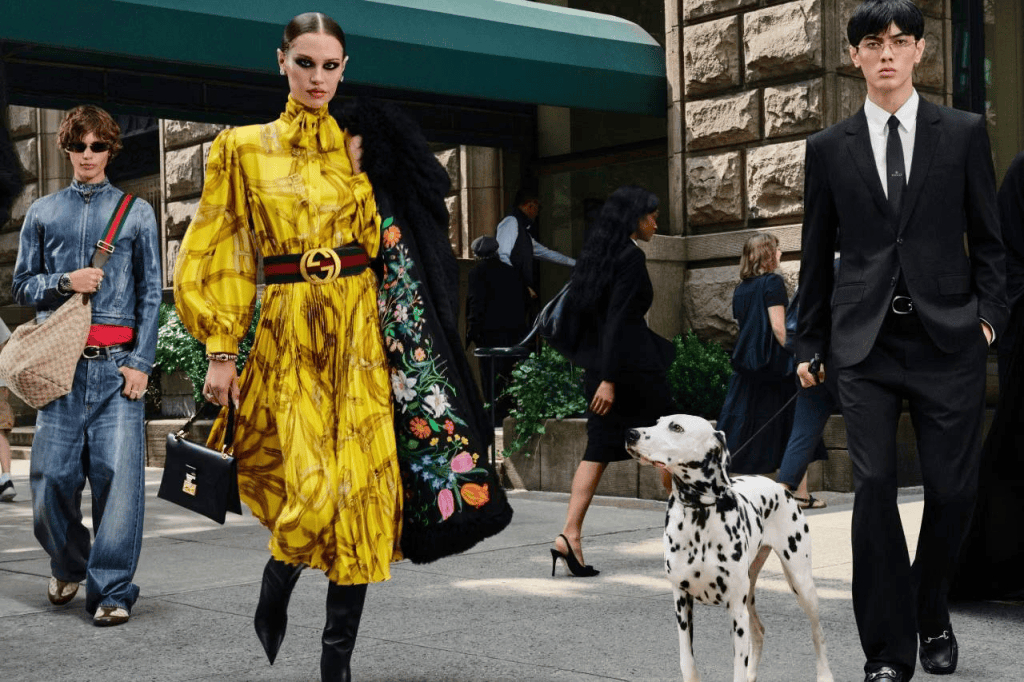
The new GucciCore campaign, photographed by Peter Funch on the streets of Manhattan, brings the house back to the American city. An understandable choice on the commercial side, but one that leaves open a question about the brand’s Italian identity.
Gucci has chosen New York again. In May, the Cruise 2027 show in Times Square, with giant screens lit up over the runway. On October 21, the GucciCore campaign, signed by Danish photographer Peter Funch: groups of people crossing the streets of Manhattan wearing trench coats, coats, suits and pencil skirts. The house describes it as a portrait of New York’s plurality. Looking at these images, I appreciate the photographic work, but one question stays with me: where did Florence go?
Funch is a smart choice. For nine years, from 2007 to 2016, he photographed the same commuters on the streets around Grand Central, observing gestures, habits and coincidences in the crowd. He knows the city well. As a photographer, I understand the appeal of those images: the clothes feel like they belong to everyday life, even when the composition is carefully staged. The result works, and that is exactly why I find myself asking what is missing.
New York certainly has a place in Gucci’s history. In 1953 the house opened its first store outside Italy there. But Gucci was born in Florence in 1921, from a leather workshop. Its story is made of leather, craftsmanship, artisans and expertise that still today represent a fundamental part of the brand’s value. It is this heritage that seems to me increasingly absent from its communication.
The American choice also has economic reasons. In the third quarter Gucci posted revenue of €1.291 billion, down 4%, or 6% at comparable exchange rates and scope. North America remains the most resilient market, and Luca de Meo has reiterated that reviving the house is an absolute priority for Kering. You go where you sell. An understandable logic, especially when customers and revenue need to be won back.
But communication and market do not necessarily coincide. Made in Italy keeps an international value because it points to recognisable places, materials and skills. In the GucciCore campaign I see a contemporary wardrobe, well put together, but its setting could belong to many other brands. If a house gives up telling its own origins, what is really left to set an Italian house apart?
In September, looking at the SS27 collection, I had already noticed how visible Demna’s signature was, at times even more than Gucci’s own identity. Here I sense something similar, but on a geographic level. I see New York, I recognise Funch’s eye, I find the new creative director’s aesthetic. Florence, instead, stays out of frame.
I am not asking for a return to Ponte Vecchio postcards, that would be the easiest and also the most predictable answer. A house that needs to rebuild its desirability should start from what others cannot copy. Anyone with a good lens can photograph the crowds of Manhattan.
So why not ask Funch to tell the story of Florence, on the beautiful Via Tornabuoni, home to the historic Gucci store, or Scandicci, among the artisans who cut and work the leather? Or Forte dei Marmi, with its discreet elegance, the streets of its centre and that particular Versilia atmosphere that has belonged to the imagery of Italian luxury for decades? Why not turn that same gaze, able to capture life on the streets of New York, toward the places where Gucci built its own story and could rediscover part of its identity?
–

Alessandro Sicuro
Brand Strategist | Photographer | Art Director | Project Manager
Alessandro Sicuro Comunication


