
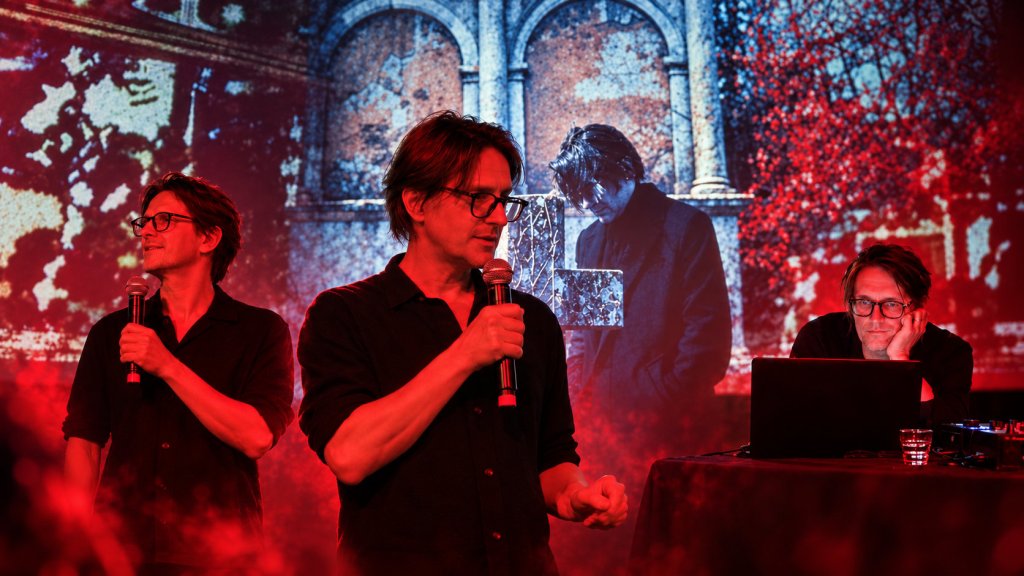
Milan, October 6. Steven Wilson arrives at Combo, at Ripa di Porta Ticinese 83, to present Requiem For A Village, his new solo album out on November 6. A meeting with the audience, a preview listening session and a DJ set. But calling it just a record falls short: Wilson has built a graphic, narrative and digital universe that continues far beyond the music.
The project revolves around a small British village suspended outside of time, with a church, a station, inhabitants, rituals, photographs, documents and even a website. The site looks deliberately home-made: basic graphics, small photographs, spartan pages, public notices and parish communications. It truly looks like an old community website from the Nineties, and that is exactly the point: everything must seem born inside the village, not inside a marketing office.
The same logic runs through the vinyl. Photographs, layout and materials look as if they came out of the archive of a community that really existed. No glossy perfection: everything carries the mark of time, memory, even error.
Then the story turns unsettling. The men who die become stones, the women birds; the inhabitants seem destined to stay there forever. The station has a single line and the train leaves every day at 11:06 to return, at the same hour, to the same spot. On the website a phrase appears that sums it all up: “all destinations end here”.
Death runs through the project without becoming a mere gothic exercise. It is an inevitable presence, something to be reckoned with. Perhaps this is also why Wilson looks for music that is less perfect, less correct, more human: fewer digital interventions, no artificial intelligence, instruments that are not always flawless, mistakes left alive. Analog synthesizers remain, Moog included, but alongside the electronics come acoustic instruments, rough timbres and deliberately imperfect performances. Wilson speaks of the need to rediscover the “fingerprints” of the people who play.
And this is where everything holds together. The website looks hand-made because the music, too, wants to be hand-made again. The vinyl looks like a relic, the sound seeks matter, flaw and presence. Technology remains, but goes back to being a tool.
Andy Partridge of XTC takes part in the narrative construction, while David Tennant lends his voice to the narrator. Wilson has described Requiem For A Village as “54 minutes of cinema for the ears”.
In Milan, today, October 6, Steven Wilson therefore presented much more than a new album: a work to listen to, but also to open, look at and explore.
Because in his village the train leaves. But it goes nowhere.
A WEBSITE THAT LOOKS BUILT BY HAND
The first thing that strikes you on entering the Requiem For A Village website is precisely its apparent simplicity. For someone who has been designing websites for years, it looks almost like an old home-made portal: essential graphics, small photographs, elementary menus, noticeboards, notices, parish communications. But it is all intentional. Wilson built the site as if it truly belonged to that imaginary community, almost as if the villagers themselves had made it.
And this is where the project gains strength: craftsmanship is not a pose, but part of the story. The same philosophy runs through the album, the artwork, the vinyl and the music: recovering the human gesture, the flaw, the matter, what is born from hands before machines. Within this universe appear symbols, rituals, stones, birds, a church, a train that leaves and always returns to the same spot. Better not to tell too much: the charm lies precisely in entering the village little by little and discovering what lies behind every detail.
Wilson calls it “54 minutes of cinema for the ears”. And that is exactly what it is: not just an album, but a story to listen to, watch and walk through.
–
–

Alessandro Sicuro
Brand Strategist | Photographer | Art Director | Project Manager
Alessandro Sicuro Comunication


