
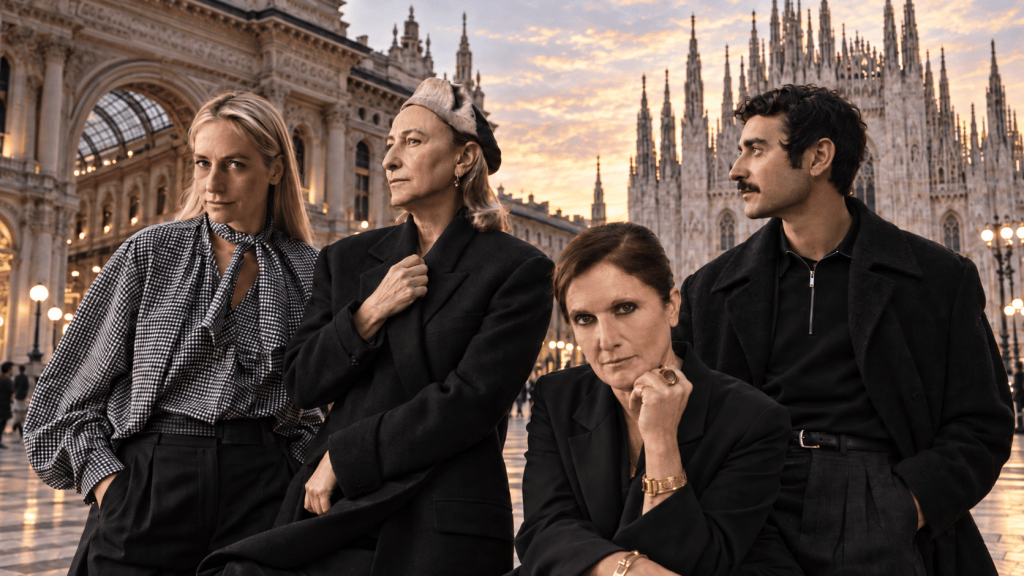
From September 22 to 28, Milan is back at the center of international fashion with the Spring/Summer 2027 Fashion Week. There are 203 events on the calendar, between shows, presentations and other happenings. That’s a big number, but this time the schedule seems to be telling us something more than a simple sequence of collections.
Prada opens the week and Giorgio Armani closes it. Glenn Martens is leaving Diesel. Loris Messina and Simone Rizzo, who come from Sunnei, make their debut as creative directors of Moschino. Maria Grazia Chiuri continues Fendi’s new chapter, and Marni keeps going with the transformation Meryll Rogge started.
Then there’s Armani. Dario Vitale has just taken over as creative director of Emporio Armani and of the Giorgio Armani accessories, the first big outside hire in the group’s creative history. The collection we’ll see this week still belongs to the previous phase, but from here another story inevitably begins. I’m curious to see how Vitale will read Emporio Armani, and how far he can push it without losing the recognizability Giorgio Armani built over more than fifty years.
Versace isn’t showing this time. After Dario Vitale’s exit and the maison’s move to the Prada group, new creative director Pieter Mulier is working on his debut, planned for February 2027. That absence says a lot too: another great Italian house is going through a handover.
Behind all these changes there’s a bigger question, maybe the most important one: the generational shift. Italian fashion is entering a phase where many of the people who built the system over the last decades are stepping aside for new faces, new languages, new ways of reading a brand. And it’s not only about creative directors. It’s about companies, families, artisans, workshops, and above all the ability to pass on knowledge that often takes years to build. The real risk isn’t changing generation. It’s losing, along the way, what that generation knew how to do.
While creative directors, strategies and owners change, Milan opens the week with Vogue World, and this year’s theme is a pointed one: The Human Touch in the Age of Technology. The relationship between craft, human skill and technology. Hard to find a theme more timely for Italian fashion. Because maybe that’s the question running through the whole of Milan Fashion Week 2026: how much can we change without losing what makes us recognizable?
In recent years fashion has sped up enormously. We’ve produced more, communicated more, shown everything faster. Social media has turned even the runway show into something that gets watched, photographed, posted and often forgotten within hours. Sometimes the communication has even outrun the product.
And this is where a question that should come naturally to Made in Italy takes center stage again: the value of what we know how to do. A jacket is not just a shape. Behind it are fabrics, proportions, construction, cut, experience, and above all people who learned a craft over years of work. That heritage is what made Italian fashion recognizable all over the world.
Today technology is part of the process, and it can’t be otherwise. It can speed up design, let us see a garment before it’s made, read the market better and make production more efficient. It can be a great opportunity. The trouble starts when we confuse the tool with the value.
Because when everyone has access to the same systems and can produce perfect images in seconds, the difference will probably come back to what we’ve always had in front of us: knowing how to do something well.
The same goes for brands. Changing a creative director is relatively easy. Changing a maison without damaging its identity is much harder. It’s one of the things I’ll be watching most closely this week. Fendi, Moschino, Marni, Versace, Armani: different stories, different transitions, but one underlying question.
The real challenge isn’t just becoming contemporary. It’s changing generation, language and tools without wiping out what makes a brand instantly recognizable.
That, more than the number of events, is what makes this year’s Milan Fashion Week worth following. Behind many of the shows there’s a system looking for a new direction, while the world races toward production that is faster, more digital and more automated.
Milan might remind us of something very simple: the future of fashion won’t be a choice between people and technology. It will be about learning to use technology without losing the human.

Alessandro Sicuro
Brand Strategist | Photographer | Art Director | Project Manager
Alessandro Sicuro Comunication


