
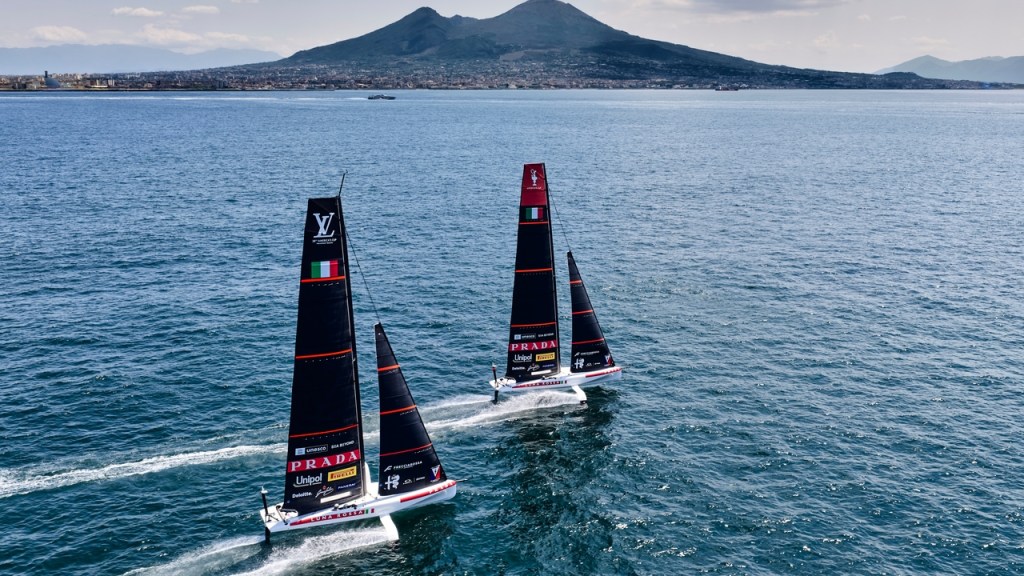
From September 24 to 27, Naples starts to truly breathe the America’s Cup. We are not yet at the challenge that will award the trophy, which comes in 2027, but this week in the Gulf the teams preparing for the next edition will finally be seen on the water. It is the second Preliminary Regatta and, more than the result, what will matter is understanding where crews and organizations stand.
One thing needs to be made clear right away, because it is easy to get lost among names and formats. The America’s Cup proper is the final showdown. Emirates Team New Zealand, who hold the trophy after winning in Barcelona in 2024, will not have to take part in the challenger selection. They will wait. The others, Luna Rossa included, must first face each other in the Louis Vuitton Cup. Whoever wins it earns the right to challenge the New Zealanders. That, in the end, is how it works.
WHAT THEY RACE IN NAPLES: THE AC40s
This week is another story altogether. The racing is done in AC40s, foiling boats smaller than the AC75s we will see in the decisive phase, but already very fast and highly spectacular. Since the boats are essentially identical, what happens on board matters a great deal: the start, tactics, maneuvers, the ability to read the wind and, above all, to make fewer mistakes than the others.
And this is perhaps the interesting part. Naples will not award anything in these days, but it will let the teams truly size each other up. In simulators you can build scenarios, analyze data, test solutions. At sea, with your rivals right next to you, everything changes. That is where you find out whether a crew really works and whether what you prepared for months holds up under pressure.
In 2027 the AC75s will take the stage, and the level will rise again. These are enormously more complex boats, capable of exceeding 50 knots and sailing practically lifted out of the water. There is by now far more in it than traditional sailing: aerodynamics, materials, software, simulation, design and an enormous amount of data. The human being still makes the difference, but does so inside a highly sophisticated technological machine.
LUNA ROSSA AND THE GULF OF NAPLES ON THE ROAD TO 2027
For Luna Rossa the path is simple to explain and much less simple to accomplish: first you have to beat the other Challengers. Only then, if all goes well, will Team New Zealand be waiting. And that is what makes the America’s Cup so unique: the defender does not have to earn its place in the final again. The Cup is theirs until someone manages to take it away.
Then there is Naples. And here the story changes too. The racecourse will lie in front of the city, with Vesuvius in the background and the Lungomare turning into a natural grandstand. The Race Village at Rotonda Diaz will accompany the race days and will be the first real test for a city that in 2027 will have to handle a much bigger international event.
Because the America’s Cup is not just a sailing race. It holds technology, industry, research, sponsors, communication, prestige and years of work that in the end must find their answer at sea.
In 2027 only two will remain.
One will hold the Cup.
The other will try to take it from them.
–
–
–

Alessandro Sicuro
Brand Strategist | Photographer | Art Director | Project Manager
Alessandro Sicuro Comunication


