
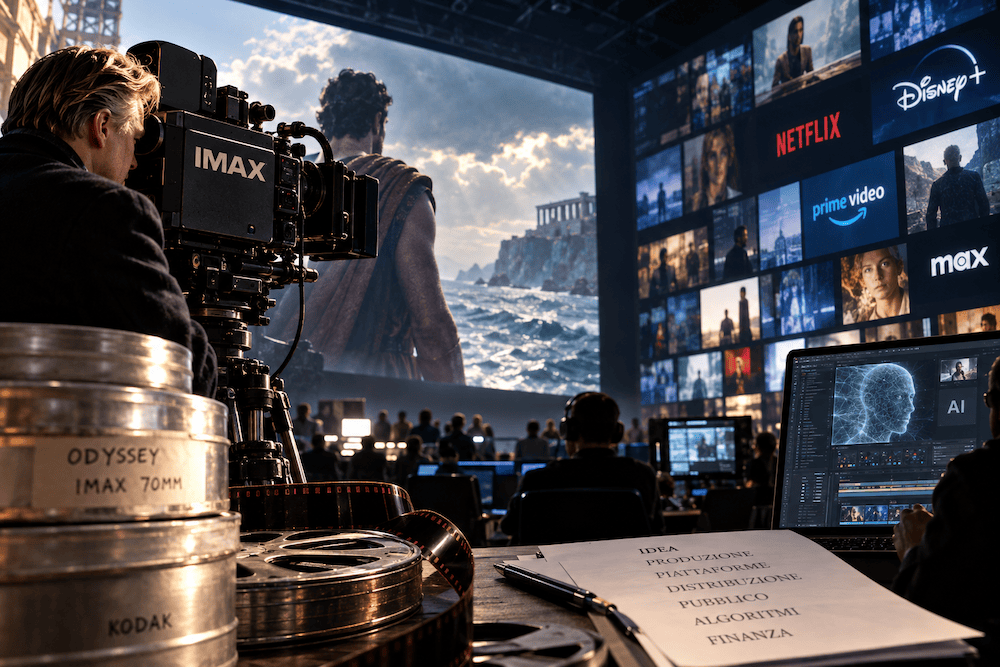
At the peak of image dematerialization, Christopher Nolan’s Odyssey chooses the extreme physicality of IMAX film. But it would be a mistake to turn this into nostalgic praise for analog. Nolan isn’t going backward. He picks a technology because it serves his vision of cinema. This brings us straight to the real question: does technology still serve the work today, or is the work increasingly designed to fit technology and the market?
Audiovisual is no longer just a work to be made and shown. It has become an ecosystem. Creativity, technology, distribution, finance, platforms, algorithms, and communications now intervene long before the work reaches its audience.
Platforms have vastly expanded access to content. They’ve changed distribution and consumption. They’ve created new production spaces. But they’ve also introduced a wealth of audience behavior data the industry never had before. We know what gets watched. When it gets abandoned. What gets searched. What holds attention. Data becomes part of the editorial strategy.
Then AI arrives. But not as a separate chapter. It’s an acceleration of the same process. Writing, previsualization, production, post-production, localization, marketing: the audiovisual machine gains tools that cut time and costs while multiplying possibilities. The interesting problem isn’t deciding if they’re good or bad. It’s asking who keeps creative control when the tools can also suggest what to produce and how to produce it.
This is where finance comes in. At MIA, it’s not just directors and producers. There are investors, distributors, broadcasters, platforms, sales agents. A project must be fundable, sellable, exportable, marketable. All legitimate. But the more these criteria enter upstream of creation, the thinner the line between building conditions for a work to exist and building a work to satisfy those conditions.
And here we are in Venice. The question we identified there gets much bigger: how much of contemporary cinema still comes from something an author feels compelled to tell? And how much is designed based on what producers, platforms, algorithms, festivals, and audiences are supposed to want to see?
No need for an ideological answer. In fact, the strength lies in not pitting old against new. Nolan and Netflix, film and algorithm, theater and streaming aren’t necessarily enemies. They’re different expressions of the same contemporary audiovisual landscape.
Maybe the issue isn’t choosing between analog and digital, theater and platform, creativity and artificial intelligence. It’s establishing who comes first. Because when technology, market, and communications precede the work’s identity, the risk isn’t just producing a different kind of cinema. It’s producing cinema perfectly designed to work, but less and less able to say why it exists.

Alessandro Sicuro
Brand Strategist | Photographer | Art Director | Project Manager Alessandro Sicuro Comunication


