
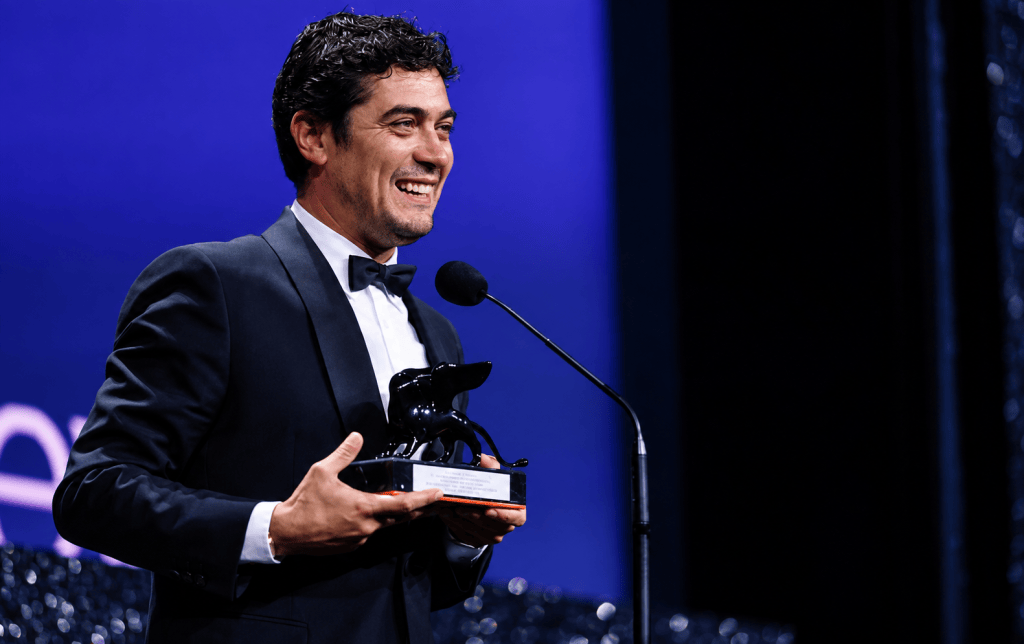
For a long time, Riccardo Scamarcio was mostly the good-looking face of Italian cinema, the one from Tre metri sopra il cielo, who almost overnight became the idol of a generation and one of the most recognizable faces in our cinema. But being handsome doesn’t mean being superficial, lightweight or incapable, even though cinema and audiences often end up building exactly that association. Over the years, Scamarcio has shown that stereotypes don’t always tell the truth: sometimes they only tell you what is easiest to see.
His career took a different road. Without disowning his beginnings, without trying to erase the image that made him famous, he began choosing more adult, more complex, less comfortable roles, moving away little by little from the character that had been tailored to him.
I, for one, loved him in L’ombra del giorno by Giuseppe Piccioni, opposite Benedetta Porcaroli, now his partner. In that film Scamarcio is already far from his beginnings: more measured, restrained, adult. He isn’t trying to please, he’s looking for the character. And perhaps that is exactly where the shift becomes clear.
Then came auteur cinema, international productions, major directors and very different characters. He has worked with Paolo Sorrentino, Michele Placido, Kenneth Branagh and Johnny Depp, moving across different genres without losing an identity of his own. In Modì, playing Amedeo Modigliani, this maturity becomes even more evident, with a restless, physical, tormented character, tackled without the burden of having to prove anything about his own image.
In the meantime, his relationship with cinema has changed too. He is no longer just the actor called to play a role: he has become a producer, takes part in building projects, and chooses stories in which he evidently wants to recognize himself.
And now comes Venice. At the 83rd Venice International Film Festival he won the Orizzonti Award for Best Actor for I figli della scimmia, directed by Tommaso Landucci. In the film he plays Dario, the father of a child with a disability, a man completely absorbed in caring for his son and pulled by desires, frustrations and contradictions that shake the balance of the family.
It isn’t an easy character, and perhaps it is no accident that a role like this brought him recognition in Venice. Scamarcio is also a producer of the film, a detail that is no longer secondary today because it says a lot about where he has arrived: from the symbolic face of a season of Italian cinema to a performer who seeks out, chooses and builds his own paths.
The Venice prize, then, feels less like a turning point than a confirmation of something that had already happened. Riccardo Scamarcio simply kept working, film after film, until the image he was labeled with at the start mattered less and less.
The good looks have stayed. But in the meantime, the actor has arrived.

Alessandro Sicuro
Brand Strategist | Photographer | Art Director | Project Manager Alessandro Sicuro Comunication


