
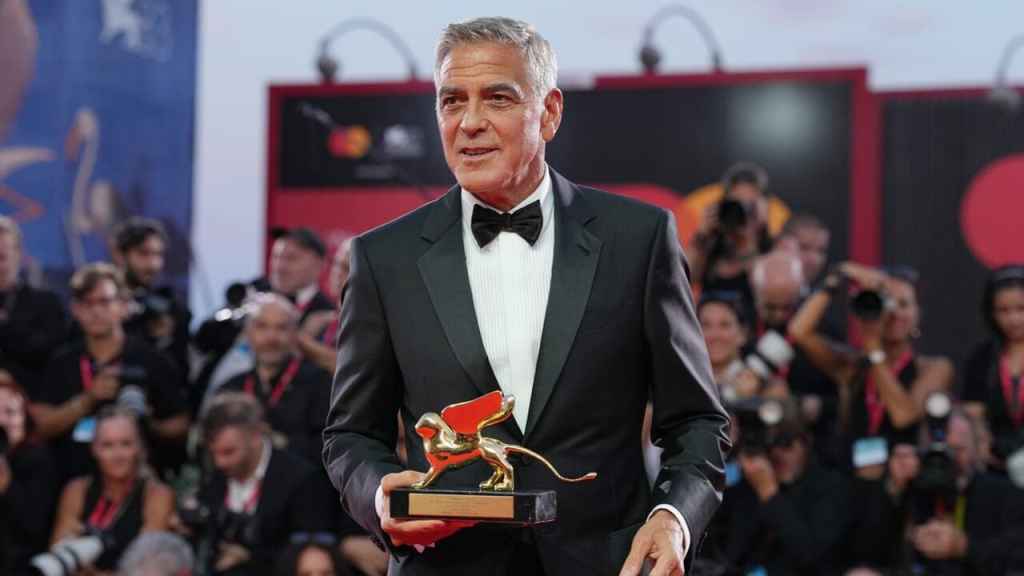
George Clooney has returned to Venice to receive the Golden Lion for Lifetime Achievement. Not to accompany a new film, but to be celebrated for a career that now spans almost thirty years of cinema.
And this is perhaps the most interesting point. Clooney has not remained only the elegant, ironic star the public recognizes at once. Over time he has chosen very different roles, often more complex than his image suggested, and at the same time he has built a second career behind the camera. The Golden Lion thus becomes an occasion to reread a filmography that has managed to hold together popular success and quality.
There is also an aspect that in his case has always risked distracting from the rest: George Clooney has been, and still is, one of the most handsome men in Hollywood. But it would be truly reductive to stop there. The charm, the presence and that natural ease with which he stands in front of the camera could have simply consigned him to the role of the great star. Instead, over the years he has proved to be also a great actor and a director capable of carving out a very precise space, without settling for the image that cinema had already tailored for him.
Out of Sight established him definitively as a leading man, while Ocean’s Eleven turned that charisma into a global success. But if I have to name the role I personally find most congenial to him, I gladly go back to The Peacemaker, alongside Nicole Kidman. In that film Clooney already had an almost perfect naturalness inside the character: authoritative without being rigid, credible in action, ironic without forcing it. A role that fits him extraordinarily well and that, in my view, anticipates much of the cinematic Clooney to come.
Then came films that showed a more complex side of his talent. Syriana took him toward a more political cinema, Michael Clayton toward less reassuring characters, while Up in the Air and The Descendants worked on apparently self-assured men who, little by little, reveal very human fragilities and contradictions.
And then there is Good Night, and Good Luck, perhaps one of the most important steps of his career. Presented in Venice in 2005, it told of journalism, power and freedom of information with a rigor that went far beyond the image of the Hollywood star. It is one of those films that explain well why Clooney, at a certain point, felt the need not only to play stories, but also to decide how to tell them.
This is also why the Golden Lion for Lifetime Achievement has a particular meaning. It doesn’t simply reward a long presence on screen, but a path in which Clooney managed to change without disowning himself and, above all, without settling for the role Hollywood seemed to have already assigned him. Being one of the good-looking ones in cinema could have been enough. Evidently, it wasn’t enough for him.
In Venice he showed himself once again as we know him: ironic, approachable, able to joke with photographers without turning everything into a celebration of himself. But behind that lightness there is now a career far more articulated than the public persona lets on.
Perhaps this is exactly what makes Clooney still so credible today. The more the weight of his career grows, the less he seems to need to prove it. He doesn’t constantly try to remind us that he is George Clooney.
It is enough for him to be.

Alessandro Sicuro
Brand Strategist | Photographer | Art Director | Project Manager Alessandro Sicuro Comunication


