
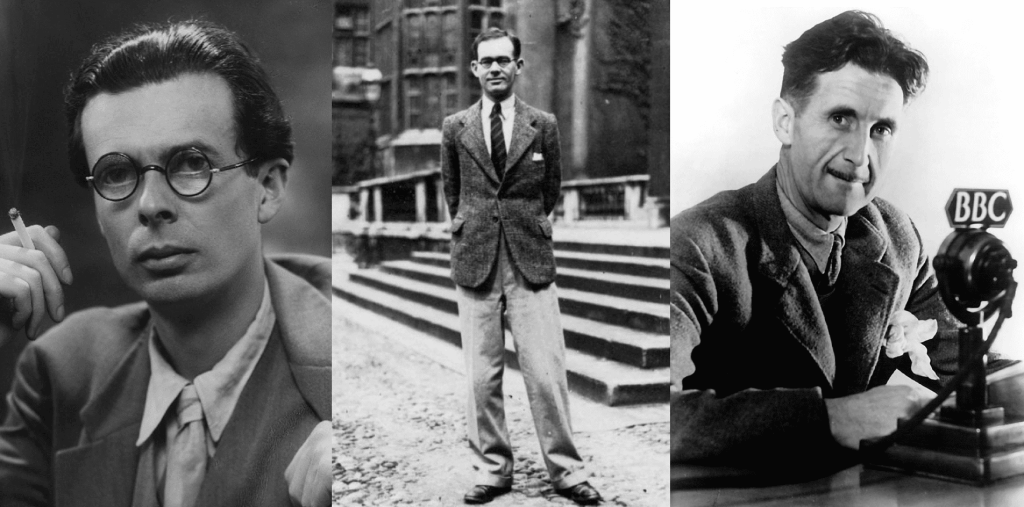
 This is the thread that connects them. All three, in different ways, refused to serve the most convenient narrative. Jones chose to see with his own eyes. He bore witness to what others preferred to ignore. Orwell understood how language could be weaponized to reshape reality. Huxley went further. He anticipated dynamics that would become central to contemporary society.
Read today, they appear as more than great twentieth-century figures. They were men capable of observing their own time. They sensed processes that were barely visible back then. Orwell and Huxley, in particular, imagined societies where individuals gradually lose autonomy, originality, and critical thinking. People increasingly recognize themselves within common models. Shared behaviors. Repeated language. Collective thought patterns.
This is where their vision becomes strikingly relevant. Ours is a society with unprecedented access to information. Yet precisely because of this, it’s also a society where distinguishing what truly matters becomes harder. The constant flow of stimuli reaches us every day. Social networks, algorithms, digital platforms, 24/7 news, global communication systems—all have vastly expanded our ability to know. But at the same time, they’ve acquired an extraordinary power. They select what we see. They steer our attention. They reinforce certain behaviors. They make some cultural models increasingly dominant.
We don’t need to imagine explicit censorship. We don’t need a power imposing a single vision from above. Conformity can emerge far more subtly. Through repetition. Through the relentless pursuit of approval. Through fear of exclusion. Through the need to belong. Through the speed at which one opinion replaces another. Through the growing difficulty of escaping the collective noise.
From this perspective, Huxley may appear the most modern today. He understood that social control doesn’t necessarily require coercion. It can work through comfort. Entertainment. Consumption. Distraction. A continuous production of stimuli. A society can conform not because someone forbids thinking. But because finding the time, the silence, and the distance to truly think becomes increasingly difficult.
Orwell focused mainly on the danger of reality being altered through language and the  manipulation of facts. Huxley imagined something even more subtle. Individuals who appear free. Surrounded by possibilities and choices. But progressively conditioned to desire, think, and react within increasingly similar patterns. Two different visions. But perhaps less distant today than they once seemed.
Jones leaves us the value of direct testimony. Verify before you believe. Orwell leaves us the necessity of defending the meaning of words. And the reality of facts. Huxley leaves us the most unsettling warning. Perhaps the most contemporary one. The hardest freedom to defend isn’t just external freedom. It’s inner freedom. The ability to maintain autonomous thought inside a society that constantly tells us what to watch. What to desire. What to discuss. Even how to interpret what happens.
Three different men, then. But united by the same form of intellectual independence. They refused to tell convenient

Alessandro Sicuro
Brand Strategist | Photographer | Art Director | Project Manager Alessandro Sicuro Comunication


