
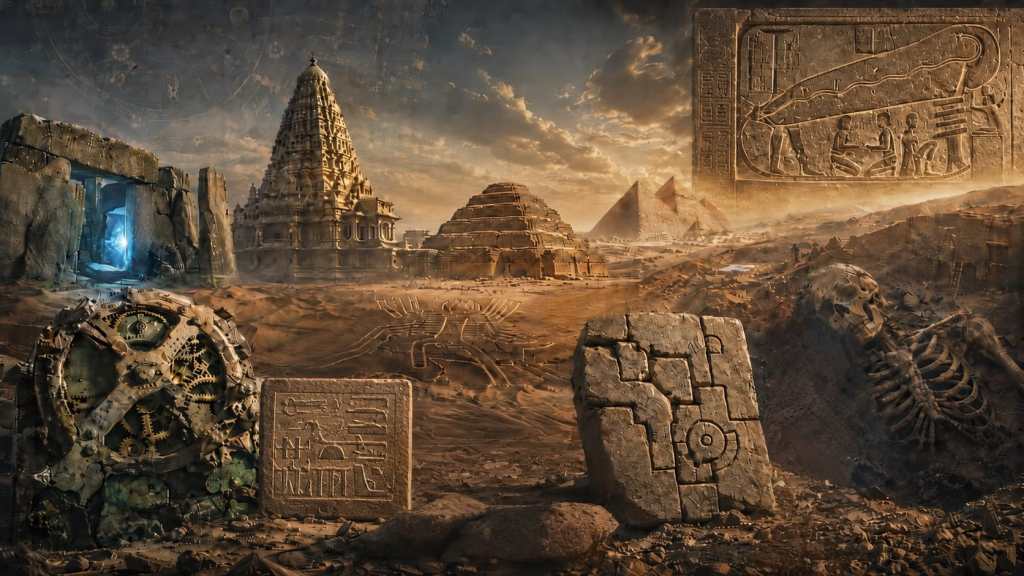
Some artifacts belong to history. Others seem to resist it. Objects, carvings, and mechanisms from ancient times keep challenging the story we thought we knew. So the question arises naturally: how much do we really know about our past?
It’s in these gray areas that the Ancient Astronaut Theory takes root. The idea that long ago, someone came from far away. That they made contact with ancient civilizations. That they left behind knowledge we still struggle to explain. This isn’t about deciding right or wrong. It’s about looking at anomalies without dismissing them too quickly.
THE ANTIKYTHERA MECHANISM
The Antikythera Mechanism is probably the most striking example. Recovered in the early 1900s from a shipwreck, it contained a complex network of metal gears. Later scans revealed it could model astronomical movements. It calculated lunar cycles. It predicted eclipses with stunning accuracy.
A machine like this doesn’t appear out of nowhere. Behind it lies knowledge. Trial and error. Experience. A developed technical culture. That’s the interesting part. Maybe we didn’t just find an exceptional object. Maybe we found a fragment of a much larger body of knowledge.
THE DENDERA LAMPS
In the temple complex of Dendera, Egypt, certain reliefs look almost provocative. They resemble large lamps. Archaeologists interpret them through Egyptian religious symbolism. But seen through modern eyes, the resemblance remains intriguing.
The question keeps coming back. How did they light those deep chambers and corridors? The explanation is probably far less mysterious than we imagine. Still, those images remain. They seem to speak a strangely modern language.
THE BAGHDAD BATTERY
The so-called Baghdad Battery is even more concrete. A clay jar with metal components. When reconstructed and filled with an acidic solution, it produces a small electric charge.
We don’t know for certain what it was used for. But the interesting fact remains. Something built many centuries ago produces an effect we associate with modern technology. Perhaps some knowledge appeared far earlier than we ever thought.
THE SAQQARA BIRD
At Saqqara, a small wooden object was found. It looks like a bird. But the shape of the wings and tail made some wonder if it represented a small aircraft.
We don’t know if it was ritual. A simple model. Or something else entirely. But once again, we face an ancient form that, viewed from the present, seems to anticipate concepts that came centuries later.
THE NAZCA LINES
In the Peruvian desert, we find the Nazca Lines. Giant figures traced on the ground. Some stretch hundreds of meters. From the ground, you can only see parts. From above, their shapes become clear.
They probably served ritual or religious purposes. But it’s fascinating to consider the skill needed to design images of that scale without seeing them whole. No need to invoke spaceships. Just recognize that those civilizations had knowledge and abilities that still surprise us.
THE GIANT SKELETONS
Then there are the giants. They appear in myths across distant civilizations. From the Bible to the Greek Titans. From one culture to another. Stories of extraordinarily large humans keep recurring.
Modern photos of giant skeletons circulating online are often fakes. No scientific proof exists of a human race standing ten or twelve feet tall. But it’s interesting that the same theme crosses different cultures and continents. Maybe it’s just myth. Maybe distorted memory of exceptional individuals. Either way, it’s a presence that keeps returning with surprising consistency.
ANCIENT “ASTRONAUTS”
The same happens with certain ancient figurines and depictions. Figures with huge eyes. Bodies covered in strange decorations. Heads that look enclosed in helmets. Archaeologists generally interpret them as deities. Ritual figures. Symbolic representations.
And they’re probably right. But we look at them today through images the ancients couldn’t have known. The resemblance to an astronaut becomes unavoidable. The real question isn’t whether they depicted extraterrestrials. It’s what they actually meant to represent.
MEGALITHIC STRUCTURES
And finally, the great constructions. Pyramids. Temples. Walls made of enormous stone blocks. Transported and crafted with precision that still impresses.
We know ancient people were fully capable of building massive works. But we may still underestimate their level of organization. Their mathematics. Their engineering. Their knowledge of materials. When we look at certain blocks perfectly fitted together, the question “how did they do it?” is far from trivial.
THE REAL POINT ISN’T ALIENS
At this point, the issue isn’t whether extraterrestrials actually arrived. Maybe they did. Maybe not. Today we lack sufficient proof to say for sure. But we have artifacts, structures, and knowledge that force us to reconsider at least one thing: the overly simple picture we’ve painted of our ancestors.
The Antikythera Mechanism. The Baghdad Battery. Dendera. Saqqara. Nazca. The great megalithic structures. These belong to reality. Other stories, like giant skeletons, remain in the realm of myth, interpretation, and often fabrication.
And that’s exactly where the discussion gets interesting. Not in forcing aliens behind everything. But in recognizing that our past may have been far more complex, technological, and surprising than we’ve always believed.
Maybe the real mistake isn’t believing too easily in ancient aliens. It’s believing too easily that we already know our entire history.
Gallery


Alessandro Sicuro
Brand Strategist | Photographer | Art Director | Project Manager Alessandro Sicuro Comunication


