
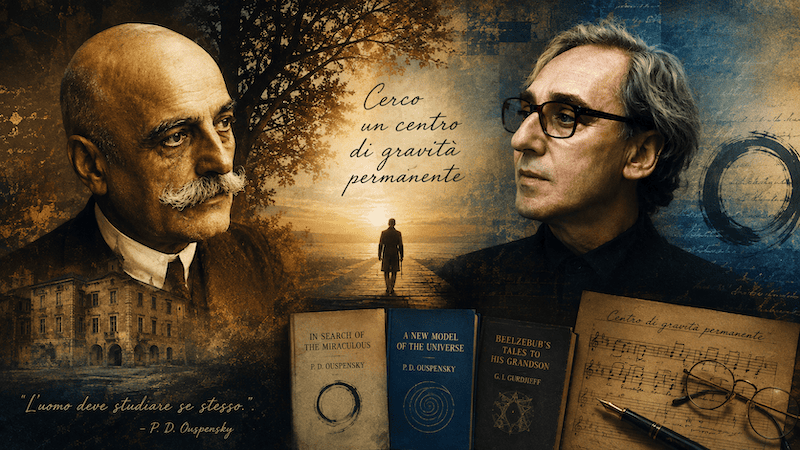
For more than forty years we have been singing “cerco un centro di gravità permanente” (“I’m looking for a permanent center of gravity”). A line that has entered common language, almost proverbial. But behind those words Franco Battiato brought into music a very precise search, linked to the thought of Georges Ivanovich Gurdjieff and Pyotr Demianovich Ouspensky.
It is the search for the Fourth Way.
Not an escape from reality, nor a mystical path in the most banal sense of the term, but work to be done within everyday life, seeking greater presence, self-knowledge and inner unity.
Ouspensky starts from a simple but uncomfortable observation: we constantly say “I”, as if inside us there were a single, coherent will. In reality, according to his teaching, what we call “I” is made up of different parts that take turns.
There is the I of work, that of the family, that of friends, the one who wants one thing and the one who the next day wants the exact opposite. One decides, another contradicts. One promises, another forgets.
But the point is not to stop at this plurality.
The point is to go in the opposite direction: from fragmentation toward a possible unity.
And this is where Battiato’s permanent center of gravity takes on a different light. It is not simply the desire to find something that “never changes”. It is the search for an inner centrality capable of giving greater coherence and awareness to what normally lives inside us in a scattered and contradictory way.
Gurdjieff maintained that ordinary man lives much of his existence in a condition of “sleep”. He was not speaking of physical sleep, but of our tendency to react to events, emotions, desires and fears without being truly present to what happens inside us.
From here comes one of the fundamental points of the Fourth Way: self-observation.
Before even changing, we must manage to see. To see how we react, how quickly we change opinion, how easily an emotion manages to take command and become, for a few minutes or a few hours, all that we are.
Linked to this observation is self-remembering. It doesn’t mean remembering one’s own name or story, but being present while we are living something: noticing anger as it arises, fear as it arrives, a reaction before that reaction occupies all the space.
At that point the meaning of freedom changes too. It is not enough to be able to say: “I do what I want.”
The question becomes: who, inside me, is wanting that thing?
In this sense the Fourth Way doesn’t just propose a philosophy to be understood, but work on oneself.
In 1922, in Fontainebleau near Paris, Gurdjieff had founded the Institute for the Harmonious Development of Man, housed in the Prieuré des Basses Loges. His teaching involved body, thought, emotions, attention, movement and discipline, in the conviction that man could not develop by working on only one part of himself.
Ouspensky then contributed decisively to collecting and spreading these concepts in the West.
And this is where Battiato becomes an extraordinary key to interpretation.
What Gurdjieff and Ouspensky explained through a complex system of ideas, Battiato was often able to condense into a single line:
“Cerco un centro di gravità permanente.”
Millions of people have sung it without necessarily knowing Gurdjieff, Ouspensky or the Fourth Way. But inside those words there was already the fundamental tension of that search: moving from a scattered and mechanical condition toward something more present, aware and unified.
Perhaps this is also why that line keeps working after more than forty years.
Because it isn’t only about philosophy. It is about us.
Ouspensky sums it up in a very simple sentence: “Man must study himself.”
Perhaps the permanent center of gravity begins right there.

Alessandro Sicuro
Brand Strategist | Photographer | Art Director | Project Manager Alessandro Sicuro Comunication


