
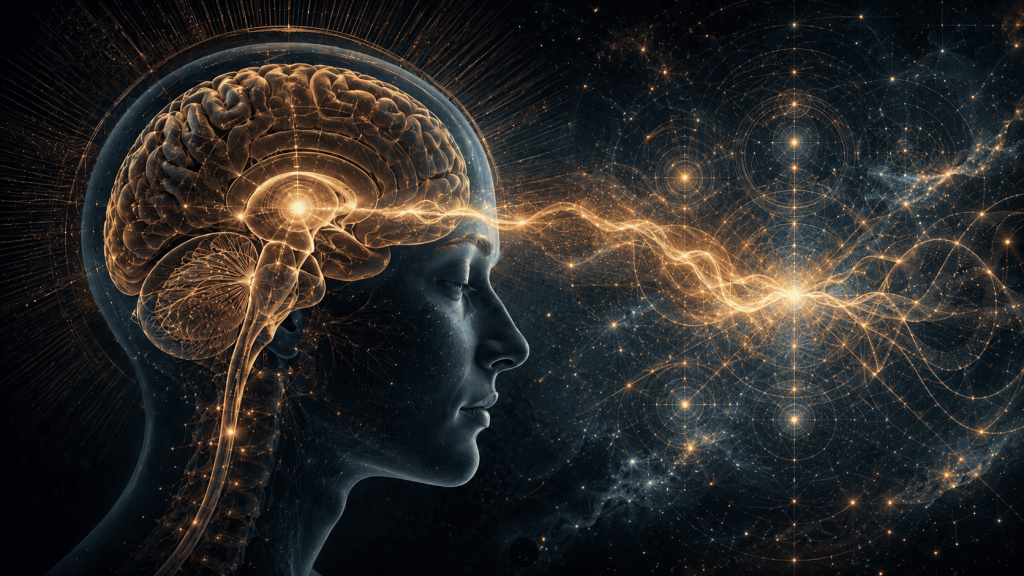
We have heard about the pineal gland in every possible way, especially over the last fifty or sixty years. Medicine, neuroscience, ancient traditions, the third eye, meditation, DMT, fluoride, calcification, the subtle field. A tiny gland at the center of the brain on which theories, intuitions, studies and quite a few exaggerations have been built.
Some things, however, we know for certain. The pineal produces melatonin and takes part in regulating circadian rhythms, that is, the relationship between light, darkness, sleep and wakefulness. We also know that it tends to calcify with age. On fluoride there are interesting studies and observations, but it would be wrong to turn a possible relationship into an absolute certainty. The same goes for many theories about “decalcifying” the pineal and about the effects attributed to certain substances or drinks.
Then another territory begins.
For centuries the pineal has been associated with inner perception, the third eye, intuition and the relationship between body and consciousness. Descartes went so far as to consider it a privileged point of relation between soul and body. Eastern traditions and much older symbolisms have placed at the very center of the head a place linked to knowledge and inner vision.
Is this scientific proof? No.
But that doesn’t mean I consider it all devoid of interest.
This is where I feel closest to an approach I would call holistic-scientific, in some ways very Jungian. Accepting what is demonstrated, distinguishing what is still hypothesis, but not automatically closing the door on what we cannot yet explain.
I don’t like a science that turns “we don’t know” into “it doesn’t exist”, just as I don’t like a holism that turns any suggestion into truth.
The idea of the pineal as an antenna of consciousness also belongs to this border. We don’t know whether consciousness arises there, nor can we claim that the pineal creates the scenario of reality we perceive or that it is connected to a subtle field. But the subject remains fascinating precisely because consciousness itself remains one of the great unsolved problems of human knowledge.
The image of the antenna, however, I like. Biologically the pineal responds to the relationship between light and darkness and helps synchronize our organism with the environment. On a symbolic level it becomes natural to ask whether it might represent something more: a passage point between what we perceive outside and what happens inside us.
Then there is the contemporary paradox.
We constantly talk about the third eye, awakening, frequencies and higher states of consciousness, but we sleep worse and worse, live in front of screens, are subjected to continuous stimuli and have almost lost our natural relationship with darkness and silence.
We say we want to awaken, but we no longer even know how to sleep.
Perhaps this is exactly where many ancient traditions still have something to teach us. Breathing, meditation, silence, attention and discipline of the body are not necessarily doors to mysterious worlds. They can be, much more simply, tools to bring order back inside us.
And this is the point I consider most important.
The pineal can be a gland, it can become a symbol, and it can even represent, for those who want to explore this possibility, an antenna toward something we still cannot define.
The important thing is not to confuse the levels.
Curiosity must not become credulity, but neither should prudence turn into the conviction that everything we haven’t yet measured cannot exist.
Perhaps the true meaning of the pineal, at least today, lies right here: reminding us that between what we know and what we imagine there is still an enormous territory to explore.
And consciousness, before showing us what we don’t see, should at least help us see better what we have in front of us.

Alessandro Sicuro
Brand Strategist | Photographer | Art Director | Project Manager Alessandro Sicuro Comunication


