
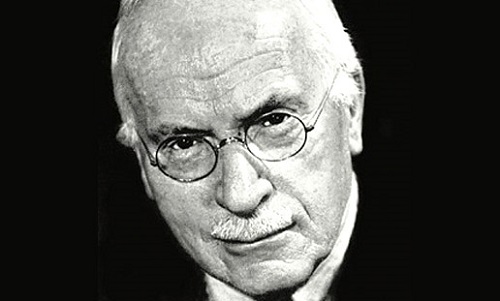
Carl Gustav Jung devoted his life to the study of the human mind, but reducing him to psychology alone would be limiting. This is one of the aspects I have always appreciated about him.
He started out close to Freud, then took another road. Freud focused much of his research on the individual unconscious, childhood, repression and sexuality. Jung didn’t deny all this, but went further.
He spoke of the collective unconscious, archetypes, symbols, dreams. He studied religions, myths, alchemy and arrived at the concept of synchronicity. Subjects that still divide people today, but that show how willing he was to explore even what found no immediate explanation.
Perhaps this is the reason why I feel closer to him than to Freud.
Jung doesn’t look only at what has happened to us. He tries to understand what we can do with what we have become. And when he speaks of the Shadow, of that part of us that we tend to hide or project onto others, he touches on a theme I still consider highly relevant.
Knowing oneself, after all, also means having the courage to meet what we like least about ourselves.
Hence these twenty reflections, some very harsh, others almost disarming in their simplicity.
1) “Do not cling to someone who is leaving, otherwise it will not be possible to meet the one who is about to arrive.”
2) “Everything that irritates us about others can lead us to a better understanding of ourselves.”
3) “The meeting of two personalities is like the contact of two chemical substances: if there is any reaction, both are transformed.”
4) “Praising and preaching the light is useless if there is no one who can see it. It would be necessary instead to teach man the art of seeing.”
5) “Knowing our fears is the best method for dealing with the fears of others.”
6) “If you are a person of talent, this doesn’t mean you have won something. It means you have something to offer.”
7) “Mistakes are, after all, the foundation of truth. If a man doesn’t know what a certain object is, he will be ready to increase his knowledge.”
8) “Your vision will become clear only when you look into your heart. Who looks outside dreams. Who looks inside awakens.”
9) “People will do anything, no matter how absurd, to avoid looking at their own soul.”
10) “Loneliness doesn’t come from having no people around you, but from being unable to communicate the things that seem important to you, or from holding certain views that others find inadmissible.”
11) “Depression is a lady dressed in black who must be made to sit at your table and listened to.”
12) “A man who has not passed through the hell of his passions will never be able to overcome them.”
13) “Your perception will be clear only when you can look into your own soul.”
14) “The pendulum of the mind oscillates between sense and nonsense, not between right and wrong.”
15) “When a man knows more than others he becomes solitary. But solitude is not necessarily the enemy of friendship, because no one is more sensitive to relationships than the solitary person, and friendship flourishes only when an individual is mindful of his own individuality and no longer identifies with others.”
16) “A dream is a hidden door in the deepest and most intimate sanctuary of the soul.”
17) “We think we know ourselves totally. However, a friend can easily reveal something about us of which we have absolutely no idea.”
18) “I am not what happened to me, I am what I choose to become.”
19) “It is a pity that we take account of life’s lessons only when they are no longer of any use to us.”
20) “Thinking is very difficult. That is why most people judge. Reflection takes time, so those who reflect have no way of constantly passing judgment.”
Reread today, these sentences still have a very evident common thread: before judging what is in front of us, it would be useful to understand what we ourselves are bringing into that gaze. This is perhaps what I continue to appreciate most in Jung: he doesn’t offer us many escape routes from ourselves.

Alessandro Sicuro
Brand Strategist | Photographer | Art Director | Project Manager Alessandro Sicuro Comunication


