
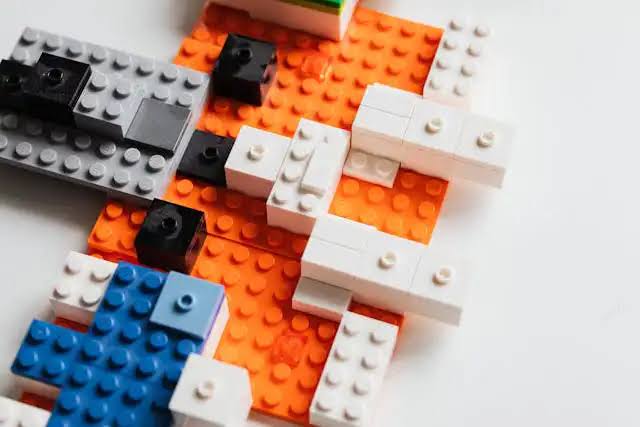
Before the brick, before plastic and even before the LEGO name, in the life of Ole Kirk Kristiansen there was fire.
It was 1924 and Ole worked as a carpenter in Denmark. Two of his sons, still very small, were playing near the heater used for glue when wood shavings caught fire. In a short time the flames destroyed the workshop and reached the family home too.
Years of work gone in a day.
Ole rebuilt everything, but shortly afterwards the Great Depression arrived. People no longer bought furniture, houses weren’t being built and orders dwindled almost to nothing. He was forced to lay off his employees one after another, until he found himself alone again.
In 1932 his wife died too and Ole was left with four children to raise. It was in that period that he began to produce small wooden toys. I don’t think he imagined in the slightest what would happen next. He was trying to work, to support his family and to turn what he knew how to do into something that could still be sold.
The toys slowly began to work and the business picked up. It seemed the worst had passed, but in 1942 the factory burned again.
For the second time Ole found himself facing the flames. Along with the factory, drawings, models and many years of work were lost. The insurance wasn’t enough to rebuild and, frankly, after everything he had already gone through, no one could have blamed him for the decision to stop.
Instead he didn’t stop. He asked for a loan and started over once again.
Then, in 1947, he made a choice that hardly anyone in the family found convincing: he bought a plastic injection molding machine. His sons kept believing in wood, a material they knew well and on which they had built the company. Plastic seemed poor, not noble, and above all risky.
Ole, however, was looking further ahead. He had understood that through that material one could create something precise, repeatable and able to join with other elements. No longer just a toy, therefore, but a system with which to build something different every time.
The modern LEGO brick arrived in 1958. Its real strength was not only its shape, but its compatibility: every piece could connect to the others, leaving imagination to do all the rest.
LEGO, too, many years later, seriously risked disappearing. In the early 2000s the company had drifted too far from its center, chasing different projects and directions. To save itself it had to remember where it had started and go back to focusing on the brick.
Perhaps this is the most interesting part of the story. Ole Kirk Kristiansen didn’t build LEGO because everything always went well in his life. He built it despite two fires, an economic crisis, the loss of his wife and a number of obstacles that would have convinced almost anyone to give up.
The next time something doesn’t go as you planned, remember Ole and LEGO. Not because wanting it is enough to solve every problem, but because losing what we have built doesn’t necessarily mean having lost the possibility of starting over as well.
Sometimes the future restarts right there, from what is left. One brick at a time.

Alessandro Sicuro
Brand Strategist | Photographer | Art Director | Project Manager Alessandro Sicuro Comunication


