
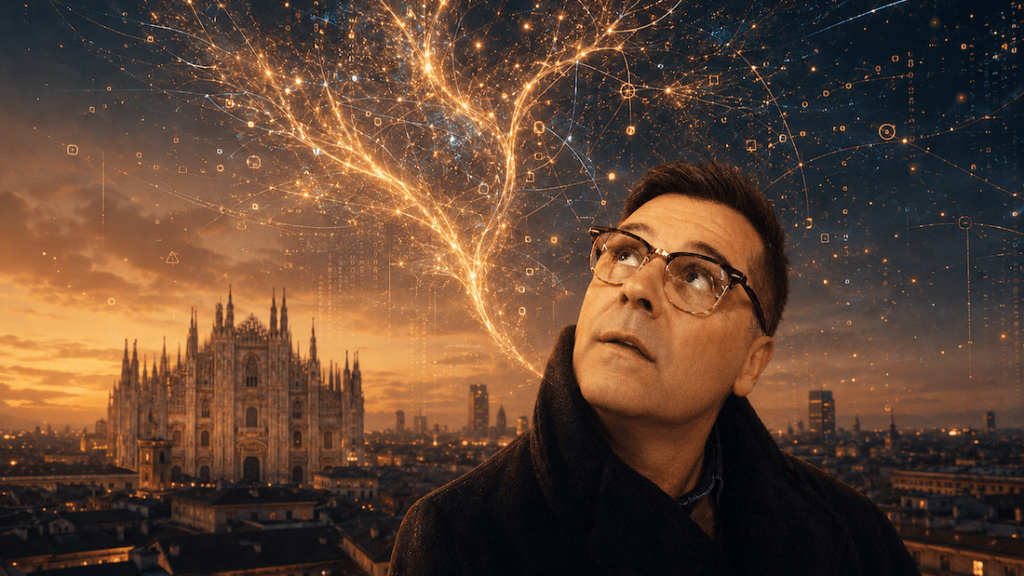
After bringing artificial intelligence into everyday work, Anthropic opens a new threshold: a model capable of reading software vulnerabilities with such power it could become an extraordinary defense or a dangerous weapon.
Behind Anthropic lies the story of Dario Amodei. One of the most influential names in contemporary artificial intelligence. Born in San Francisco. Son of Riccardo Amodei, a leather craftsman of Italian origins, and Elena Engel, a librarian. Dario worked at OpenAI before founding Anthropic in 2021 with his sister Daniela and other former members of the company.
The phrase that best captures this trajectory is attributed to Amodei himself. He recalls his sister Daniela’s role in refocusing the meaning of their work: not just building technology, but trying to make the world a better place. This is where you understand Anthropic’s dual soul. On one side, the race toward ever more powerful models. On the other, an obsession with safety, control, and alignment with human values.
Claude was the first great jewel of this vision. Not a simple chatbot. A model capable of reading, writing, reasoning, programming, analyzing complex documents, and supporting human work. With Claude Code, Cowork, and agents, Anthropic pushed the concept even further: systems that don’t just respond but can perform parts of the work in place of humans.
Of course, anyone who actually works with these tools knows reality is less magical than advertised. You can’t just write a command and expect everything done perfectly. Agents make mistakes. They get lost. They misinterpret. They produce results that need checking. But when set up right, guided with method, and verified by human expertise, they become an enormous force. They don’t eliminate humans. They change their role. From execution to direction.
Even the name Anthropic seems to tell this philosophy. It references the anthropic principle. The idea that the universe we observe is linked to the presence of observers capable of observing it. At its core, Anthropic’s work moves precisely along this threshold: building ever more powerful machines, but still guided by a human vision. From here comes Constitutional AI. The attempt to give models a sort of “Constitution” made of principles, criteria, and values. So they’re not just intelligent, but also steerable, controllable, responsible.
Then came Mythos.
And here the conversation goes deeper.
Claude Mythos, developed within Project Glasswing, is a model designed to read software and identify vulnerabilities. A vulnerability, put simply, is a hidden crack inside a program. An error. A weakness. An unprotected passage that can be exploited to enter a system, steal data, block services, or strike critical infrastructure.
According to initial data released, Mythos identified thousands of serious or critical vulnerabilities in strategic software, sensitive infrastructure, and open source projects. The point isn’t just that it finds them. The point is it finds them so fast it disrupts the traditional cybersecurity cycle. Artificial intelligence discovers flaws faster than humans can fix them.
This is why Anthropic can’t simply release it to the public. Mythos, in the right hands, can become an extraordinary tool for companies, banks, hospitals, institutions, and strategic infrastructure. It can help find weak points before attackers do. Strengthen systems. Protect essential data and services. In perspective, such analytical power could have implications for scientific research, medicine, and the study of complex structures.
But in the wrong hands, the same capability could become dangerous. A model capable of discovering cracks in computer systems can be used to defend them. Or to attack them. This is why Mythos is entrusted only to selected companies and organizations. The goal: study it, contain it, and build security systems worthy of its own power.
Meanwhile, Anthropic prepares to open an office in Milan, after Paris and Munich. This news isn’t marginal. It means this game no longer concerns Silicon Valley alone. It enters Italian territory. The heart of business, finance, technology, and European digital culture.
The deeper issue, however, goes beyond cybersecurity. It concerns the very way software is changing nature. Until now, we’ve known artificial intelligence mainly through large language models, LLMs: ChatGPT, Claude, and other systems capable of generating text, code, images, analysis, and strategies. At first they seemed like assistants. Today they’re becoming operational platforms.
When AI enters code writing, code review, and code correction, the relationship between human and machine changes. For decades, programming languages were a bridge. Python, JavaScript, Java, C++ were technical tools. But also readable and verifiable languages. Humans wrote. Machines executed.
Now this balance is shifting. AIs are starting to design, correct, and optimize software. Producing structures increasingly less meant to be read by humans. The risk isn’t just that code becomes more complex. The risk is that it becomes opaque. Powerful, efficient, functional. But increasingly incomprehensible to those who should control it.
This is where Mythos becomes a signal. It doesn’t just tell us about a new phase in cybersecurity. It tells us about the moment when artificial intelligence begins reading the invisible foundations of the digital world better than we can.
Sooner or later, tools like Mythos will reach closer to market. Perhaps with limits, filters, and regulated access. When that happens, those who know how to use them will truly make a difference. Not because they’ll simply have more powerful software. But because they’ll have the ability to see, before others, where the digital world is fragile.
The future won’t reward only those with access to the most advanced artificial intelligence.
It will reward those who know how to guide it, understand it, and prevent it from building a world humans can no longer read.
–
–

Alessandro Sicuro
Brand Strategist | Photographer | Art Director | Project Manager
Alessandro Sicuro Comunication


Alessandro Sicuro
Brand Strategist | Photographer | Art Director | Project Manager
Alessandro Sicuro Comunication


