
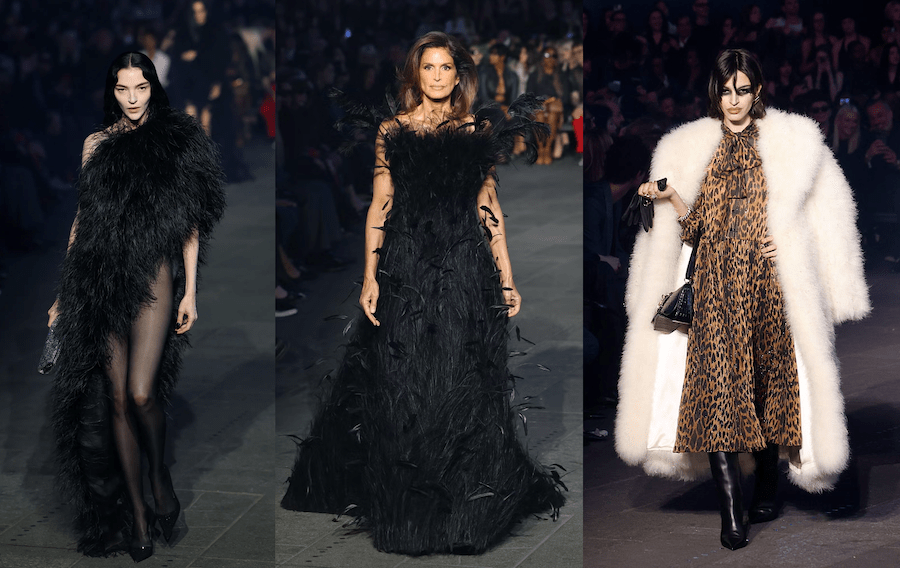
I am also tired of writing negative reviews about the brand I have loved most in Italian Made. Not because Gucci does not deserve criticism, not because the New York show does not raise profound questions, not because Demna has not constructed a powerful spectacle. But because, at a certain point, criticism risks becoming an automatic reflex. Gucci does something and they say it is cynical. Gucci quotes itself and they say it is archive. Gucci provokes and they say it is marketing dressed up as language.
The problem, however, has become something else. A brand is not relaunched with shocks, but by making it desirable.
And desire does not arise simply from noise, from provocation, from quotation, from the great media operation. It arises when it returns to inhabit an internal desire, when what it shows does not seem merely clever or brilliant, but inevitable. When beauty does not appear as a comment unto itself, but as a living form of attraction.
The GucciCore show in New York was a strong operation. Times Square was not a casual backdrop. It was a declaration. The place where advertising becomes landscape, architecture; where desire is projected on a monumental scale; where every image competes with another image to survive a few more seconds in the gaze of passersby. Bringing Gucci there means accepting a brutal truth: today luxury also lives in the battle for attention, even at the cost of falling into the commercial.
But winning attention does not automatically mean reconstructing desire.
Demna is too shrewd not to know exactly what he is doing. His GucciCore is conscious, constructed, sharp. It plays with consumption, with celebrity culture, with America, with capital, with bad taste, with nostalgia, with the logo fetish, and with the obsession of the distorted image. It is a clever, spectacular collection — they say sellable; I would like to see the numbers, coming soon, before saying so. But the question is not whether it works as an event. The question is whether it works for Gucci.
Because Gucci is not an empty container to be filled every season with the most useful theory of the moment. It is a brand that has built one of the most recognizable grammars of modern desire: travel, craftsmanship, jet set, eroticism, Italian bourgeoisie, decadence, power, ambiguity, luxury. Touching Gucci means touching a complex organism, not simply updating a wardrobe.
And let us say it clearly: if it were true that our time forces all brands to disturb beauty, to distort themselves, to betray their genetic code just to remain contemporary, then we should see all the great maisons precipitate in the same way. But this is not the case. There are brands that traverse this time without losing their own grammar, that manage to be contemporary without becoming caricatures of themselves, that update desire without reducing it to noise.
It is here that everything is at stake.
Gucci still has enormous force, enormous memory, enormous symbolic power. But precisely for this reason it cannot be treated as an infinite experiment. It cannot be continually dismantled, reinterpreted, theatricalized, corrected, deformed, as if its identity were simply material available for the intelligence of whoever arrives.
Gucci can survive many things: changes of creative direction, market crises, fashion cycles, provocations, even mistakes. But it cannot survive the idea that its identity has become simply a material to manipulate.
The real question is not whether Gucci has made people talk about it. The real question is whether it has made people want Gucci again.
GALLERY


–
–
Alessandro Sicuro
Brand Strategist | Photographer | Art Director | Project Manager
Alessandro Sicuro Comunication


