
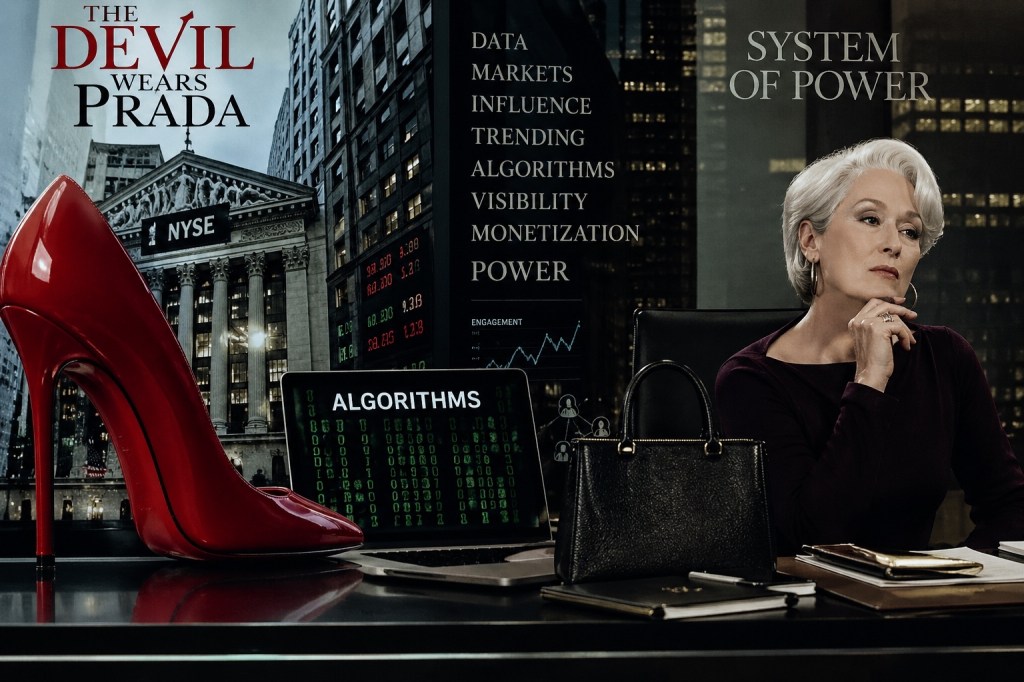
When The Devil Wears Prada came out, the title worked because everyone understood the joke. Prada was not just a brand name. It was a signal. It suggested a certain kind of power: cold, intelligent, severe, beautifully controlled. Miranda Priestly did not simply wear fashion. She wore authority.
That was the strength of the film. Behind the comedy, behind the cruelty, behind the unforgettable office rituals, there was a very recognizable world: a magazine powerful enough to shape taste, an editor capable of deciding what mattered, and a fashion system still built around human figures. Designers created. Editors filtered. Photographers interpreted. Magazines consecrated.
The 2006 film, directed by David Frankel and written by Aline Brosh McKenna, was based on Lauren Weisberger’s 2003 novel. Weisberger had worked as a direct assistant to Anna Wintour, and although the story was fictionalized, its architecture was not difficult to read. Fashion appeared as hierarchy, culture, intimidation, privilege and selection.
Miranda Priestly was the perfect face of that order. Ruthless, cultivated, terrifying, but readable. Her power had a desk, a coat, a silence, a look. It was brutal, but it still belonged to a world where someone chose, someone judged, someone took responsibility for taste.
Today that world has not disappeared completely, but it has lost its center.
The designer is still there, of course, but less often as the absolute author of the system. He appears as creative director, interpreter, image builder, sometimes visionary, sometimes executive of a larger strategy. The editor is still there too, but no longer as the only gatekeeper of desire. Her authority has been absorbed into something wider, faster and less visible.
This is why the idea of the Devil changes.
The Devil is no longer only a person. It is the mechanism around her. It is the pressure that decides what must be seen, what must sell, what must circulate, what must become desirable before the public has even had the time to understand why.
That is where The Devil Wears Prada 2 becomes interesting. Not because it brings back a beloved world, but because it returns to a world that no longer exists in the same form. Runway is no longer just a magazine. It becomes a sign of something larger: the decline of print, the fragility of editorial authority, the rise of platforms, the dependence on visibility, the need to transform every image into value.
The old system was cruel, but it had a grammar. The new one is smoother, more seductive, almost polite. It looks democratic because everything circulates. But it is also more opaque, because no single voice appears to command it.
Advertising no longer knocks at the door of culture. It is already inside.
The brand no longer sponsors the dream. It produces the dream.
Marketing no longer follows fashion. It often arrives before fashion does.
In this landscape, Miranda becomes almost nostalgic. Not softer, not innocent, but strangely human compared with the machine that has replaced her centrality. She was severe, manipulative, even monstrous, but she still represented taste as a decision. Today taste is increasingly treated as performance: measurable, adjustable, monetizable.
Andy Sachs returning to Runway, then, is not just a narrative device. It feels like a contemporary confession. We leave the system, we criticize it, we try to stand outside it, and then we discover that outside has become smaller than we thought.
We return to what we rejected.
We learn the language we once despised.
We call maturity what is often adaptation.
Perhaps this is the real point. The Devil has not vanished. It has simply become harder to recognize. Twenty years ago, power had a face, a magazine, an office, a coat, a voice. Today it hides inside timing, visibility, strategy and market logic.
The Devil no longer wears Prada.
Today, the system wears the look of power.
And perhaps that is why it makes less noise, but governs far more.
–
Alessandro Sicuro
Brand Strategist | Photographer | Art Director | Project Manager
Alessandro Sicuro Comunication


–
–
–

