
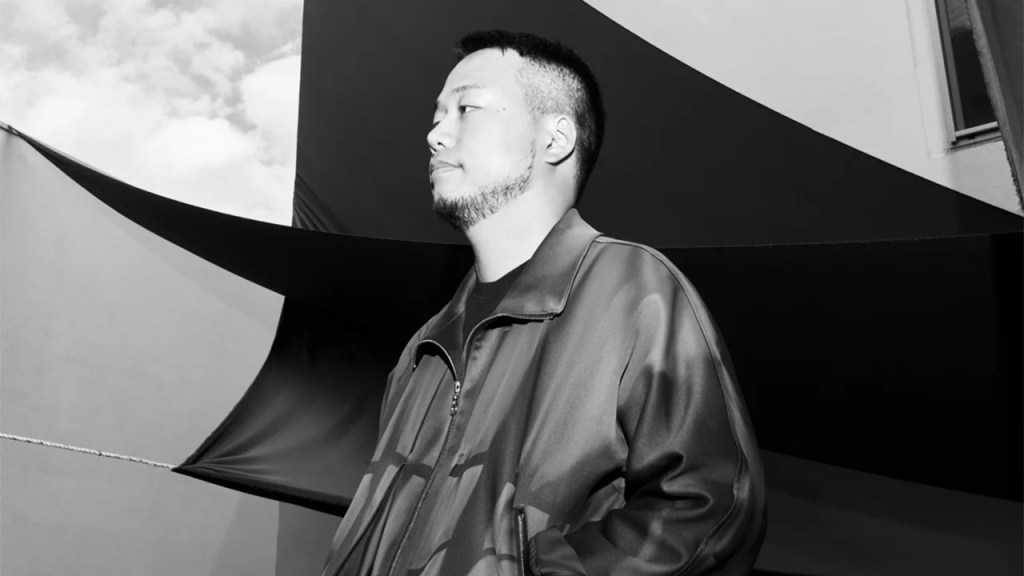
Some names come to Pitti to confirm the system. Others come to shift it a few degrees. JiyongKim clearly belongs to the second category. For the 110th edition of Pitti Uomo, scheduled in Florence from June 16 to 19, 2026, the Florentine fair has chosen the brand of South Korean designer Jiyong Kim as its Special Guest. He won’t present a conventional runway show. Instead, he’ll deliver a project-event designed specifically for the Fortezza da Basso.
The choice isn’t random. And it’s definitely not neutral. JiyongKim doesn’t represent reassuring, polished, easily digestible menswear. He represents a fashion that accepts time as a co-author of the garment. His language revolves around the famous Sun-Bleach process. Fabrics and surfaces are left for months under sunlight and weather conditions. They develop fading, shadows, irregularities, and tones impossible to replicate twice in the same way. In an era that has turned the word authenticity into an empty slogan, here it means something material, visible, almost tactile again.
This is precisely the interesting point. Jiyong Kim doesn’t use sustainability as a moral varnish to spread on the product. He brings it into the garment’s very construction. Into its controlled decay. Into the idea that a piece of clothing can be alive, vulnerable, exposed. It’s no coincidence that Pitti described his work as an approach capable of giving materials a second life. He transforms fabrics and vintage pieces into unique items, marked by signs of transience and references to the climate crisis.
But reading him only as an “ethical” designer would be reductive. JiyongKim is interesting because he holds concept and form together. On one side, there’s reflection on time, alteration, imperfection. On the other, there’s rigorous work on garment construction, pattern making, and the relationship with the body and movement. The fact that he was noticed in the LVMH Prize 2024 circuit isn’t a minor detail. It signals that his work has long been on the radar of those truly watching where contemporary menswear can go.
The smartest thing, though, might be something else. For Florence, he chose not to limit himself to a runway show. Instead, he spoke of an exhibition. A space where clothes, environment, and time can interact. This is where his arrival at Pitti stops being simple calendar news and becomes a cultural signal. Because today’s most interesting menswear isn’t the kind that screams novelty through styling. It’s the kind that still manages to change skin, slowly, right before our eyes.
–
–
–
Alessandro Sicuro
Brand Strategist | Photographer | Art Director | Project Manager
Alessandro Sicuro Comunication


