
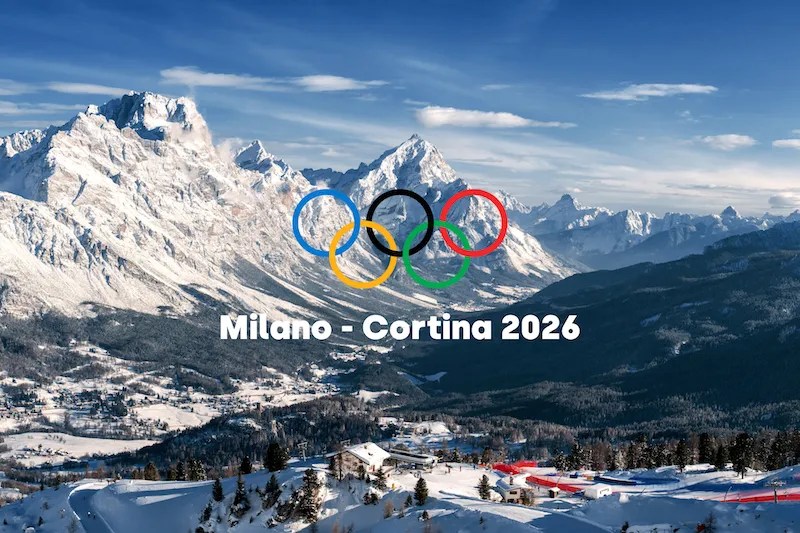
The name says Milan–Cortina, but the reality is bigger and, if you will, more ambitious: these Games are not based on a single Olympic capital, nor on two “closed” hubs, but on a network of locations that must function as a single organism. Northern Italy as a chessboard: metropolises, valleys, passes, stadiums, slopes. It’s not a detail. It’s the theme.
I say this also for personal honesty: Milan and Cortina are in my DNA, and the North—with its bustling cities and picturesque, yet never decorative, mountains—is a part of Italy I’ve always loved. This is why Milan–Cortina 2026 feels closer to me than other Olympics: because the world will see up close a landscape that’s more than just “beautiful.” It’s a defining characteristic, and here you can see it even at altitude.

The competitions will begin on February 4, 2026: the sporting calendar will heat up before the Opening Ceremony, as some disciplines must start qualifying and group stages earlier to accommodate the pace of the following days. The Opening Ceremony will be on February 6 in Milan, at the San Siro Stadium. The Closing Ceremony will be on February 22 in Verona, at the Arena. Three fixed points. And in between, a geography that will run as a single organism.
MILAN: THE ICE HUB AND INTERNATIONAL IMAGE
Milan will be the metropolitan center of the Olympic narrative: the inauguration will take place here at San Siro, and a significant portion of the ice sports will be concentrated here, in arenas designed for global enjoyment. The Milanese “Olympic city” will not be based on a single location: it will be distributed across multiple hubs, each with a different access logic.
San Siro will be the major media and logistics hub, with rapid subway connections.
The Assago Forum will remain a well-oiled machine: it will be directly accessible via the subway and the southwest ring road.
The Rho-Fiera complex (Ice Park) will be the most “flow-oriented”: subway and trains, more management in the style of a large trade fair/event, therefore entrances designed for large numbers.
The new Santa Giulia Arena, on the other hand, will be the most delicate point: it’s a new facility, and between delivery, testing, and running-in, everything will need to be carefully calibrated. Access will revolve around the rail hubs and dedicated connections (shuttles and flow management), because there will be no room for improvisation there.
CORTINA D’AMPEZZO: DOLOMITES, IMAGE, MEMORY (AND OPERATIONAL MACHINE)
Cortina is the iconic part of the story: the one that, even without knowing the sport, you “understand” at first glance. It’s a place with a rare proportion, almost like a small nativity scene: in summer, a green theater, tidy and bright; in winter, a true pearl, with snow that cleans the edges and the houses that seem delicately placed there, while the Dolomites act as a backdrop. Cortina doesn’t need to be invented: just look at it. And those who have never been there rarely return home feeling “indifferent.”

Cortina Dolomites. A photo of the Tofane “schuss,” the slope that will host the Alpine skiing events at the Milan–Cortina 2026 Winter Games in Cortina d’Ampezzo. Taken on January 16, 2025.
On a sporting level, the Tofane are the most immediate symbol: a true, legendary rink, already accustomed to speaking its own mind. The Olympic Ice Stadium, a legacy of 1956, returns to the forefront with curling: a sport that seems niche until you realize it has a unique fascination on TV.

A view of the start of a women’s World Cup downhill training run on the Tofane slope, the venue for the alpine skiing competitions at the Milan–Cortina 2026 Winter Games, in Cortina d’Ampezzo, Italy, on Friday, January 17, 2025.
Sliding Centre. The word that, in recent months, has generated more attention and discussion than many others: Sliding Centre. The bobsleigh, skeleton, and luge track, one of the most complex and delicate infrastructures of the Games, because with facilities like this, simply “building” isn’t enough: you have to get to the ice, the testing, the inspections, the certifications. Here, the good news is clear: the new Sliding Centre in Cortina has been completed and tested, with certification arriving in November. In other words: the most technical and sensitive part has been made safe.
BORMIO: THE STELVIO, THE DESCENT THAT SELECTS THE BEST
Bormio is the mountain when it stops being a stage and becomes a judge. The Stelvio is a descent that allows no respite: steep, fast, and intense, with a pace that doesn’t let you “breathe” for even a second. The spectacle here isn’t glamorous: it’s pure technique, a clean line, total control at high speed. It’s one of those places where you know you’re watching a real Olympics: because a mistake isn’t a detail, it’s the difference between staying in the race and disappearing.
 The Olympic rings next to a slope at the Stelvio Ski Center in Bormio, the facility that will host the alpine skiing and ski mountaineering competitions at Milan–Cortina 2026.
LIVIGNO: THE YOUTH FREESTYLE AND SNOWBOARDING CENTER
Livigno brings the most contemporary aspects of winter sports to the Games: freestyle and snowboarding, disciplines where difficulty is measured not only in speed, but in the quality of the movement—lines, rotations, clean landings, control. It’s a cluster that appeals to a younger audience because the language is immediate, but the structure is rigorous: here, performance is technical, judged, built on years of training and on details that at first glance seem “natural” only because they are performed by professionals.
Furthermore, Livigno has a clear narrative advantage: parks and competition areas produce powerful images without the need for artifice, because the movement itself is a narrative. But the point isn’t aesthetics: it’s the sporting level these disciplines have reached, and the fact that they are now a central—not ancillary—part of Olympic modernity.
Within the Milan–Cortina constellation, Livigno is a necessary star: it doesn’t add folklore, it adds future. It’s the hub that reminds us that the Olympics aren’t just about tradition and memory, but also about the evolution of sporting gestures and the spectators who follow them.

VAL DI FIEMME: PREDAZZO AND TESERO, THE NORDIC MACHINE
Predazzo and Tesero are the backbone of Nordic skiing: jumping and combined skiing on one side, cross-country skiing on the other. Here, there’s no need to invent anything: everything just needs to work, every day, with almost industrial precision. It’s the section that seems less dazzling until you realize that it’s often what sets the pace at the Games: rhythm, consistency, endurance, discipline. In Nordic skiing, you don’t win with spin: you win with endurance. And indeed, it doesn’t forgive improvisation—because here, the Olympics aren’t “a competition,” it’s a sequence that tests organization and athletes alike: for a long time, seriously.
ANTERSELVA: BIATHLON, PRECISION AND BORDERLAND IDENTITY
Antholz is one of those places where biathlon doesn’t “arrive”: it’s already at home. And this is a real asset: a knowledgeable crowd, an authentic atmosphere, an immediately palpable pace. In biathlon, tension arises from contrasts—shortness of breath on skis, then silence and precision at the shooting range—and here that contrast is felt, because the place knows it, respects it, demands it. It’s a perfect cluster for a clean, escalating narrative: days that pile on the pressure, leading up to the decisive trials, where even the smallest mistake can change the standings and the story.

A view of the village of Anterselva, where the biathlon competitions will be held during the Milan–Cortina 2026 Winter Games in northern Italy, on Saturday, January 25, 2025.
VERONA : THE FINAL SIGNATURE
Verona is the finale: a theatrical, Roman, definitive gesture. It’s the Italian signature at the end of a distributed Olympics. And it works because it closes the circle: from the urban ice of Milan to the mountains, to a two-thousand-year-old amphitheater that reminds you of a simple thing: great events pass, forms remain.

Milan–Cortina 2026 , if you look closely, isn’t just a sporting event. It’s a test of direction: bringing together different locations, different audiences, different disciplines, and making them seem like a single story. This is what makes the constellation fascinating and ruthless. Because here, the winner isn’t the one who promises. The one who delivers.
GALLERY


-GALLERY
G-
–
Alessandro Sicuro
Brand Strategist | Photographer | Art Director | Project Manager
Alessandro Sicuro Comunication


