
SNAIL
From the vision of four young engineers to international recognition: when research meets industrial beauty.
There’s an invisible thread that unites American innovation and Italian workshops, a thread made of intuition, courage, and that concrete creativity that has always defined Italian genius . This is the foundation of Caracol , one of the world’s most surprising companies in advanced robotic manufacturing .
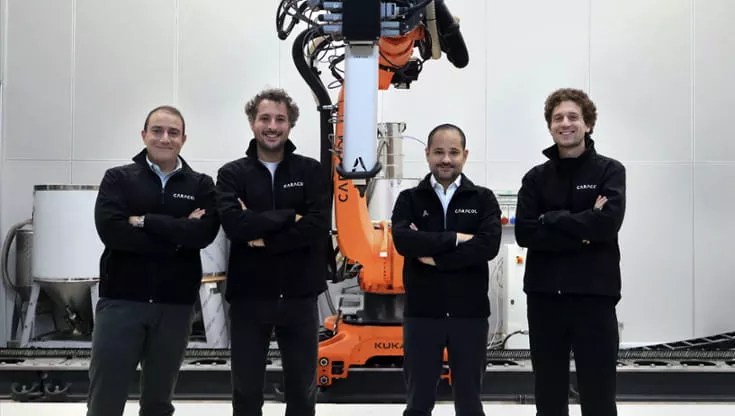
It all began in 2017, when four young engineers— Francesco De Stefano , Paolo Cassis , Jacopo Gervasini , and Giovanni Avallone —decided to combine their skills and vision to overcome the limitations of traditional 3D printing. Their goal was clear: to create a new form of production that was smarter, more sustainable, and freer from the constraints of industrial serial production. They were betting on the fusion of robotics, artificial intelligence, and composite materials , envisioning a factory capable of manufacturing without molds, waste, or scale limitations.
In just a few years, that spark transformed into an international benchmark. Today, Caracol operates in Europe, the United States, and the Middle East , has installed more than one hundred platforms worldwide, and has recently raised forty million dollars in investment from international funds to expand its research and production capacity. This achievement speaks not only of technology, but also of Italian research and industrialization , of a country that is once again planning its own future rather than suffering it.
Their large-scale additive manufacturing system enables the creation of monumental components for the aerospace, marine, construction, and automotive industries, with a level of precision and sustainability that blends digital craftsmanship with the power of automation. This isn’t science fiction, but applied ingenuity: industrial beauty in its purest form, where technology becomes an aesthetic gesture and the production process transforms into language.
What’s truly fascinating, however, isn’t just the machines: it’s the philosophy. These guys have chosen to do , to believe in work as a tool for evolution and in knowledge as a driver of change. And in an era when many talk about innovation, Caracol makes it happen , embodying that quintessentially Italian tradition that unites function and form, vision and craft, mind and hand.
Behind their black suits and orange KUKA robots, a broader vision can be perceived: that manufacturing can become poetic again, that research can be art, and that industry can be beauty. It’s the same thread that runs from Leonardo to Olivetti, from Pininfarina to the present day: the belief that progress is not an abstract concept, but a form that takes shape in reality, an idea that takes shape and becomes material.
Caracol represents the Italy that still knows how to amaze the world, demonstrating that genius, when met with method and vision, can be reborn in new forms. From the digital Renaissance to the industrial future, Italian creativity continues to generate development, value, and wonder, reminding us of a simple, almost elementary truth: the future isn’t announced, it’s built , with the lights on late and the persistence of those who transform an intuition into a lasting form.
–
–
Alessandro Sicuro
Brand Strategist | Photographer | Art Director | Project Manager
Alessandro Sicuro Comunication


