
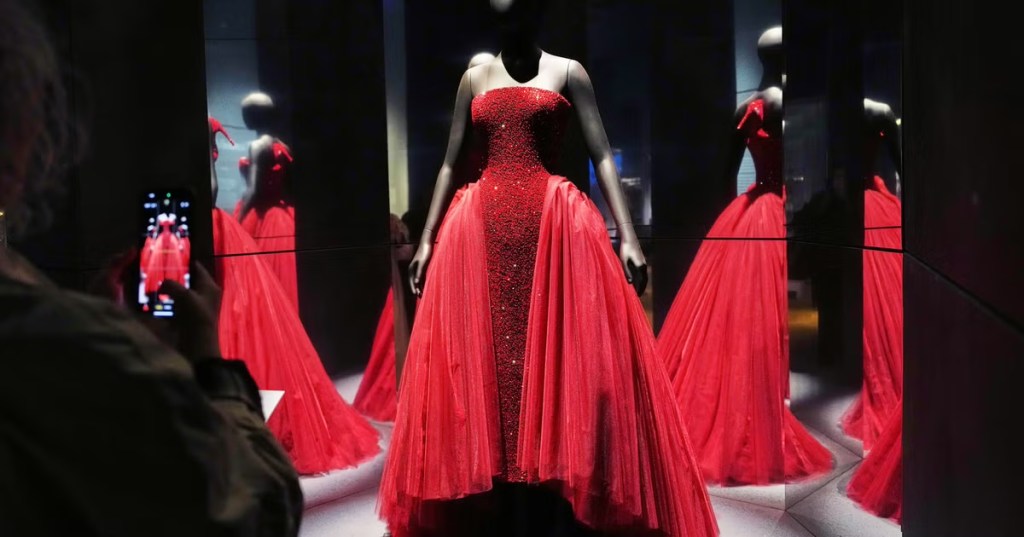
I’ve always believed that separating fashion and art is nearly impossible in certain cases. Some designers don’t just sketch clothes. They build entire worlds. They connect with painting, theater, sculpture, and creativity in its broadest sense. Elsa Schiaparelli is one of these figures. That’s why the Victoria & Albert Museum’s decision to dedicate a major exhibition to her feels so meaningful.
This isn’t just a tribute to a twentieth-century couture icon. The point is different. One of the world’s most important museums is acknowledging that Schiaparelli’s work carried cultural weight beyond fashion in the strict sense. Her visual universe always occupied a unique borderland. There, clothing stops being mere elegance. It becomes invention, disruption, provocation, and image.
The exhibition, open since March 28, traces this journey from the 1920s to today. It even reaches the contemporary era of the maison under Daniel Roseberry. The result isn’t a simple parade of famous garments. It’s a broader interpretation of what Schiaparelli represented. She was a woman who brought genuine artistic tension to fashion. Not decorative. Not superficial.
Just look at the names appearing alongside her work to understand what we’re talking about. Salvador Dalí, Jean Cocteau, Pablo Picasso, Man Ray, Eileen Agar. These aren’t names dropped to embellish a story. They’re concrete evidence of Schiaparelli’s real connection to the art world of her time. For her, cross-pollination wasn’t a pose. It was method, instinct, and vision.
The exhibition gathers over 400 objects. These include garments, accessories, jewelry, photographs, paintings, sculptures, perfumes, and archival materials. Among the most famous pieces are the Skeleton Dress and Tears Dress from 1938. The celebrated upside-down shoe hat is also featured. These emerged from her collaboration with Dalí. They still captivate today because they weren’t designed just to be worn. They were meant to be seen, remembered, almost interpreted.
The exhibition unfolds across four sections. It guides visitors from the maison’s origins to its most current legacy. It begins with the first Parisian ateliers opened in 1927. That’s when Schiaparelli started making her mark with surprising, cultured, unconventional designs. The famous trompe-l’œil bow sweater says a lot about her vision. It was ironic, refined, and remarkably modern for its time.
One of the exhibition’s most compelling sections naturally explores her relationship with surrealism. In 1920s and 1930s Paris, Schiaparelli moved within circles where art and fashion observed each other closely. They provoked and influenced one another. The Lobster Dress displayed alongside Dalí’s Lobster Telephone perfectly captures this relationship. It shows how thin—sometimes nonexistent—the boundary was between artwork and fashion creation.
Then there’s the London chapter. It’s far from secondary. The 1933 opening of the Mayfair salon strengthened the maison’s international reach. It helped spread her sophisticated, visionary, theatrically charged aesthetic throughout the United Kingdom. The exhibited pieces—evening gowns, embroidered velvets, outfits linked to George VI’s coronation—beautifully demonstrate Schiaparelli’s ability to inhabit luxury, high society, and public image-making all at once.
The final section connects this legacy to the present. Daniel Roseberry’s creations, worn in recent years by stars like Ariana Grande and Dua Lipa, prove that language hasn’t run dry. It has evolved and updated itself. Yet it still retains immediate, theatrical, recognizable visual power.
Ultimately, this is the London exhibition’s most compelling point. Schiaparelli isn’t portrayed simply as a great couturière of the past. She’s shown as a figure who helped push fashion toward bolder, freer territory. In that territory, clothing doesn’t just dress the body. It also provokes thought, surprises, and leaves a lasting mark.
Alessandro Sicuro
Brand Strategist | Photographer | Art Director | Project Manager
Alessandro Sicuro Comunication


 Sure-com America