
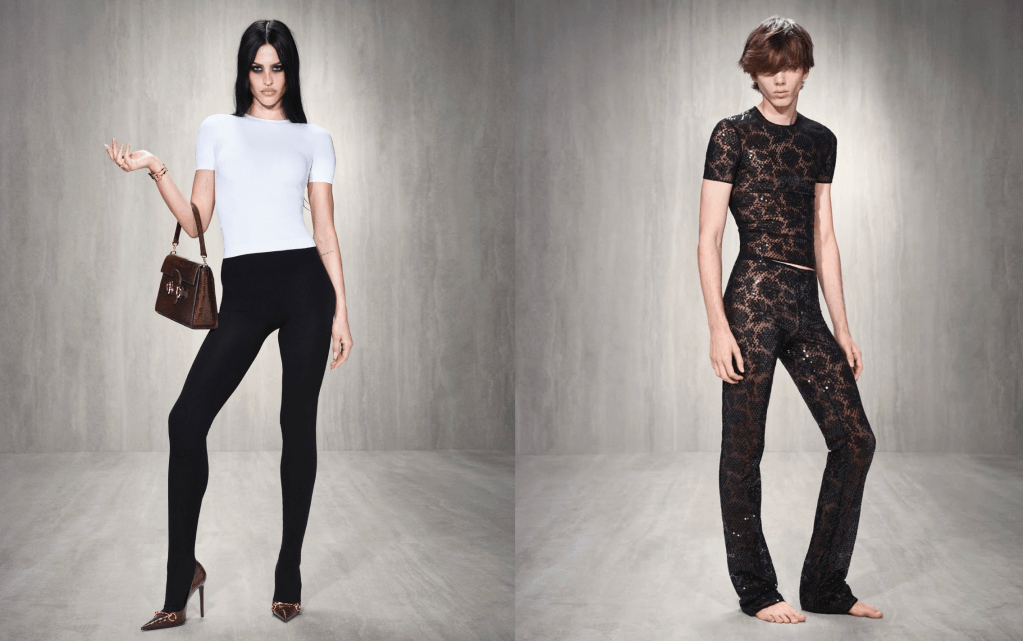
I watched the recent Gucci show closely. I tried to read it for what it is and what it’s trying to become. There are some interesting elements. Some leather pieces have a strong presence. Some bags seem to reference a recognizable archive, perhaps from the ’50s–’60s. But the overall impression is of a project that hasn’t yet found a convincing synthesis.
The direction seems aimed at a young audience. Very young. Yet the product tells a partially different story. It’s as if two registers coexist but struggle to communicate. On one side, an irregular, deliberately dissonant imagery. On the other, accessories and constructions that evoke a more classic idea of elegance. Not so much a fertile tension as an overlap that leaves some questions unanswered.
Another aspect that emerges clearly is the reduction of the formal vocabulary in a significant part of the show. The repetition of similar solutions—like the fuseaux, proposed interchangeably for men and women—seems more like simplification than a radical statement. For a brand like Gucci, this kind of choice inevitably shifts the focus from the garment to the brand itself. It assigns the name a supporting function that the product alone struggles to provide.
At the same time, speaking with people who have worked for years in production—across bags, clothing, and footwear—a recurring theme emerged: the relationship between design and body. Some footwear in particular showed clear issues on the runway. Walking difficulties. Instability. Forced postures. This isn’t an aesthetic judgment. It’s a functional concern. And when function fails, the entire conceptual framework suffers.
Fashion can be provocative. It can challenge the very idea of comfort and harmony. It can also choose to explore uncomfortable territory. But it remains bound by an implicit pact with the body. When that pact breaks, it opens not just a stylistic debate but a broader reflection on design responsibility.
I know this approach may be read as a failure to grasp the more radical message. The physical and symbolic deconstruction associated with Demna‘s vision. His post-war temperament. His desire to disrupt the traditional image of masculine and feminine. It’s a language with its own internal coherence. However, in the context of luxury, a central question remains. Those who invest significant sums in a garment expect it to work. To accompany the body. To be executed with precision.
The conceptual dimension can inhabit the image, the narrative, even the provocation. It becomes more problematic when it translates into a renunciation of technical competence. In that case, the risk is that the customer is called not to wear an object but to participate in a theoretical demonstration.
The topic of references also contributes to this sense of suspension. Some solutions recall ideas already seen. Past intuitions that seem to resurface here without real reinterpretation. When a reference isn’t supported by a new vision, it loses strength. It becomes a weak signal.
Ultimately, the issue isn’t change itself. Change is necessary. But for change to be effective, it needs a readable direction. In this show, I sensed an unresolved moment of transition. As if the brand were distancing itself from certain certainties without having built new ones yet.
When the design leans on the archive—a bag, a leather piece—a different solidity reemerges. Not out of nostalgia. But out of structure, craftsmanship, clarity of intent. It’s an interesting signal. One that perhaps points to a possible path forward.
 Sure-com America