
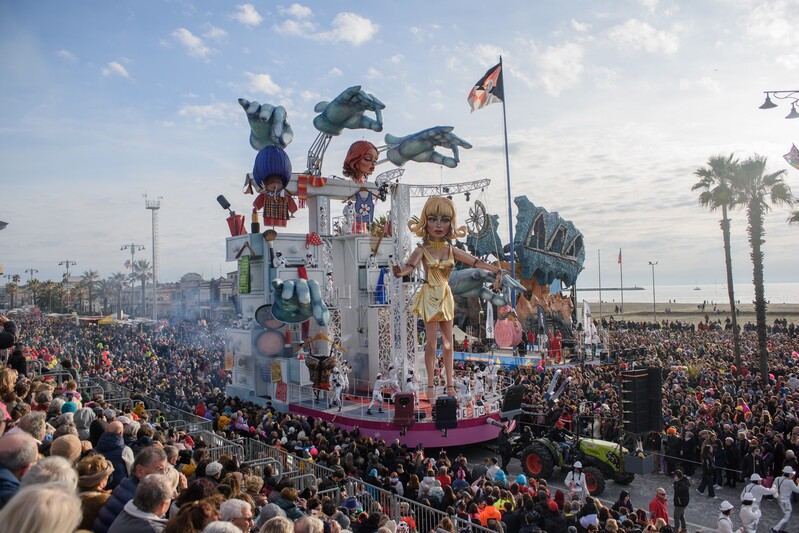
Another Tuscan excellence is the Viareggio Carnival. Yesterday, along the Passeggiata, the traditional parade returned: joy, crowds, music and above all creativity. The large papier-mâché floats have always transformed the city into an open-air theater. On a clear sunny day, Viareggio put on its most recognizable show. Irony becomes collective storytelling. Imagination becomes public space.
In this context, the celebration works even better. The Carnival doesn’t take place just anywhere. In my opinion, the Viareggio Passeggiata is one of the most beautiful waterfronts in the world. Not for flashy spectacle, but for balance. Architecture, palm trees, gardens, beach clubs and urban space coexist in rare continuity. There’s an elegant measure that doesn’t need to raise its voice to be noticed.
Within this continuity lies a precise, immediately recognizable identity: the Liberty style. It dominates the buildings and landmarks along the seafront. It often blends with eclectic elements and Art Deco accents typical of the early 1900s. The urban reconstruction after the great fire of 1917 helped consolidate this character. That event marked the Passeggiata and opened a new architectural chapter for the city.
Just walk around to catch the signs. Decorated facades, wrought iron, floral stucco motifs, turrets, ceramic elements that catch the light. It’s as if the architecture chose to be scenery too. The most immediate symbol is the Gran Caffè Margherita. It’s one of the icons of Viareggio’s Liberty style, recognizable by its domes and theatrical character. Another essential stop is Villa Argentina. This modernist/Liberty masterpiece from the early 1900s is known for its rich external ceramic decorations.
Then there are the grand hotels. They tell the story of early 1900s Viareggio and its elegant calling. These buildings were designed to welcome and impress. They gave shape to a precise idea of resort living. Among them, the Grand Hotel Principe di Piemonte stands out. It was born as the Select Palace Hotel in 1922. It remains one of the most recognizable symbols of that era.
In a place like this, the Carnival finds its natural home. The floats parade like giant storytelling machines. They’re ironic, visionary, often sharp in their satire. Yet they’re always driven by a popular intelligence that’s never trivial. It’s not just entertainment. It’s collective storytelling. It’s a tradition that knows how to renew itself without losing its identity.
The most obvious thing is the energy. Families, children, young people, seniors: the Viareggio Carnival cuts across all groups. It doesn’t select. It doesn’t create elites. It’s a celebration that belongs to everyone. That’s exactly why it works. The joy isn’t manufactured. It’s shared.
The quality of the public space is also striking. People walk, observe, linger. There’s no rush. Time seems to expand. It’s as if the city grants a collective pause. A moment when it’s okay to slow down and look around. Maybe that’s the Carnival’s true success. Not the event itself, but its ability to turn an ordinary day into an experience.
On days like these, Viareggio shows its best side. Not a glossy postcard, but a living city. Elegant without being stiff. Popular without being trivial. A city that, for a few hours, reminds everyone that lightness, when done well, is serious business.
–
MM
<div class='gallery-row' style='width: 640px; height: 283px;' data-origin
 Sure-com America