
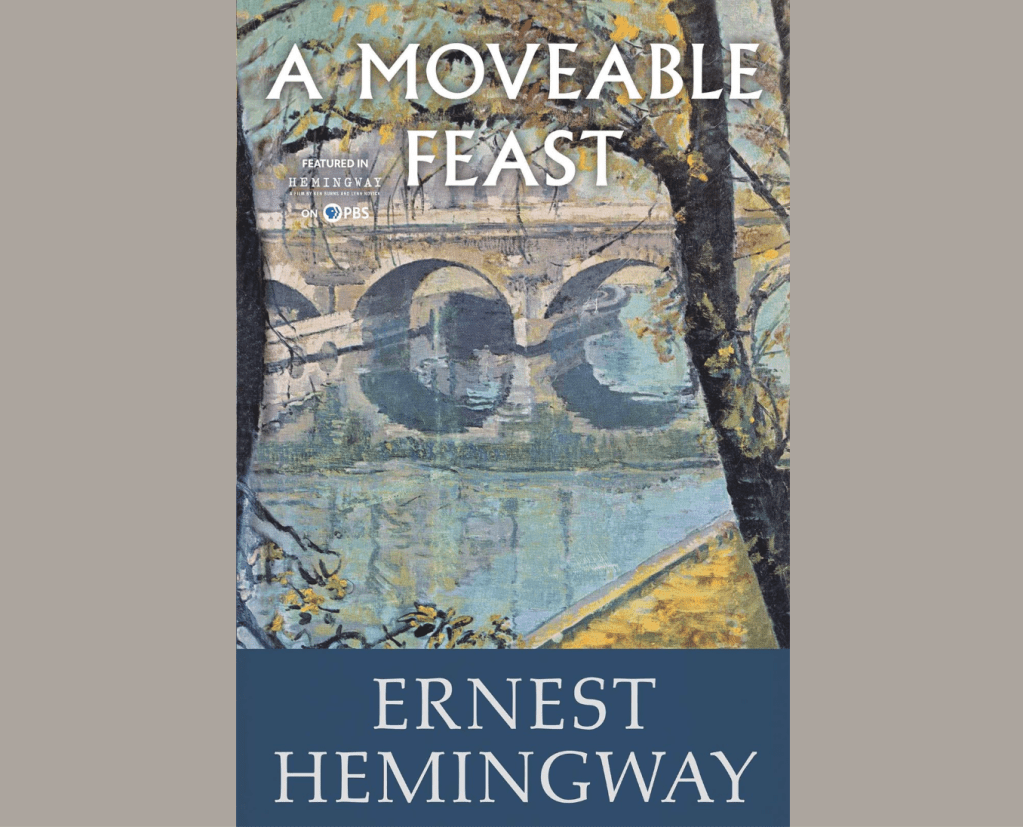
Hemingway and the art of telling what you feel, taste, and savor.
A Moveable Feast is Ernest Hemingway’s Parisian memoir. He wrote it in his final years. It was published after his death. It tells the story of 1920s Paris. Hemingway was young, poor, and hungry. But he focused on one thing only: learning to write well. This isn’t a mythologized Paris. It’s Paris lived day by day. Among cafés, streets, work tables, and discipline.
The title itself is a statement of method. A Moveable Feast describes something that doesn’t stay fixed in one place or time. It keeps living inside those who experienced it. It’s not nostalgia. It’s active memory. An experience you carry with you because it left a real mark.
The book moves through brief episodes, essential scenes, and encounters. Gertrude Stein, Ezra Pound, Scott Fitzgerald. But above all, it’s a book about the craft of writing. Hemingway shows how you work when you have nothing. How you learn to subtract rather than add. How you stay true to an honest sentence before chasing a clever one. Here, style doesn’t decorate. It makes you feel.
And this is where his famous iceberg theory comes in.
Hemingway writes by showing only a small part. He lets the rest stay beneath the surface. It’s a theory that resonates because it mirrors how we live. What we show the world is always a fraction of who we really are. The bigger part, the more complex and deep part, stays submerged. We float through life unable to fully express ourselves. Unable to convey the wholeness and totality of who we are.
And perhaps this is exactly where Hemingway succeeds where many fail. Through lyrical yet controlled writing and a remarkable descriptive ability, he makes you feel even what goes unsaid. The unspoken weighs as much as the spoken. Silence works as hard as words. Hemingway never forgets to describe the taste of things.
Eating oysters with their strong sea flavor and that slight metallic undertone. Drinking their cold liquid. Pairing it with sparkling wine. And then writing: ‘That empty feeling disappeared and I began to be happy.’
It’s not lyricism. It’s precision.
Happiness isn’t explained. It happens. It passes through the body, the senses, the concrete. This is what makes A Moveable Feast still alive today. Essential writing that immerses the reader in life without overloading it with interpretations. It’s not just a book about Paris.
It’s a lesson on how to be present in things. How to taste them and tell their story while letting the rest—the truest part—stay underwater.
And that’s why it endures.
–
–
–
–
–
 Sure-com America