
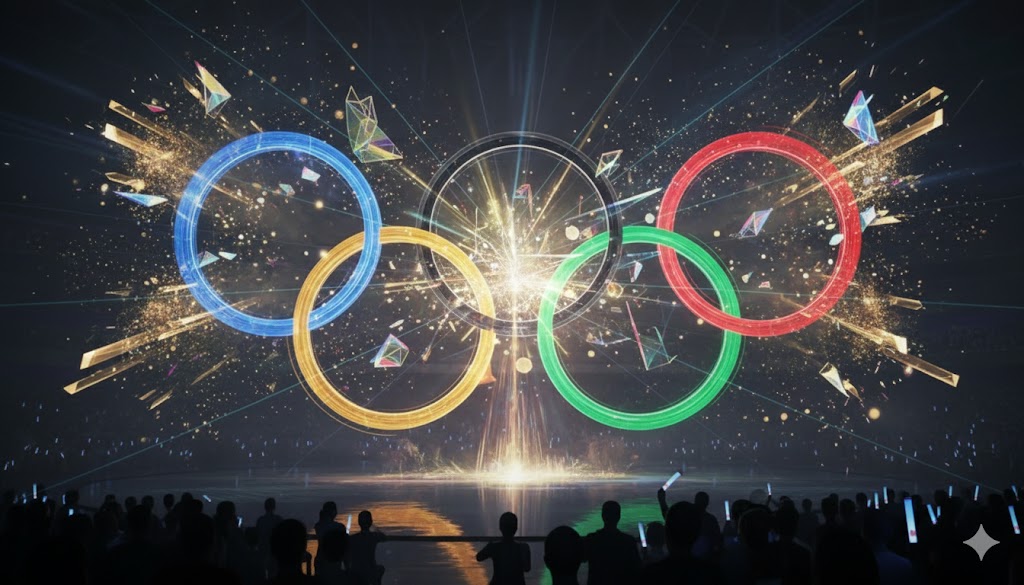
Here we are: on February 6, 2026, at San Siro Stadium, Italy will open the Milan Cortina Winter Games. It is not just sport—it is a global spotlight. Milan, the Alps, the host cities… everything enters the same frame, like a constellation that, for one night, lights up all at once.
San Siro is a stadium, yes. But that evening it becomes a global stage machine: music, images, rhythm, and a direction designed to speak both to those in attendance and to those watching from afar. When Italy chooses to tell its story, it does not rely on monuments alone: it does so through organization, attention to detail, and a certain idea of beauty that lies in the “how” even before the “what.”
On stage there will be a vast, deliberately cross-genre cast: Mariah Carey, Andrea Bocelli, Laura Pausini, Cecilia Bartoli, Lang Lang. And then cinema and theatre, with Pierfrancesco Favino, Sabrina Impacciatore, Matilda De Angelis. It is a clear choice: to show Italy as it is today, without pretending to be a single, uniform thing.
For those entering the stadium, the rule is simple: a personalized digital ticket on the official app. Then comes big-city logistics: no parking at San Siro, travel by metro and tram, with public transport extended late into the night. It is one of those practical details that says a lot—either a modern event holds up on mobility, or it doesn’t.
The evening will unfold with precision: gates opening in the afternoon, a pre-show at 7:15 p.m., the ceremony at 8:00 p.m. The experience will also be visual and immersive, almost theatrical: illuminated wristbands for the audience, the stadium turning into a living surface rather than a passive grandstand.
There is also an interesting, less “romantic” but useful fact: it is not sold out. Across the Olympic and Paralympic Games there are around 1.5 million tickets available; roughly 1.2 million have been sold, about 80%. Some availability remains across certain sports and sessions, while for highly sought-after events tickets move to resale. Prices, unsurprisingly, are a world of their own: they range from accessible levels (€25–60 for some sessions) to figures that soar for the most coveted competitions.
And yes, as always, there are debates and controversies. This is normal when investments, construction sites, tight timelines, and international visibility come together. The truth usually lies somewhere in between: many elements are ready and operational, others are nearing completion, and some contextual works continue even beyond the event itself. This does not diminish the result; it simply shows how complex a distributed event can be—one that does not take place in a single city but across an entire geography.
This is Milan Cortina 2026: an Italy in motion, between metropolises and mountains. Not perfect. But capable, when it matters, of turning a global event into a story. And in the end, that is where true Made in Italy reveals itself—not in slogans, but in direction.
–
Alessandro Sicuro
Brand Strategist | Photographer | Art Director | Project Manager
Alessandro Sicuro Comunication


 Sure-com America