
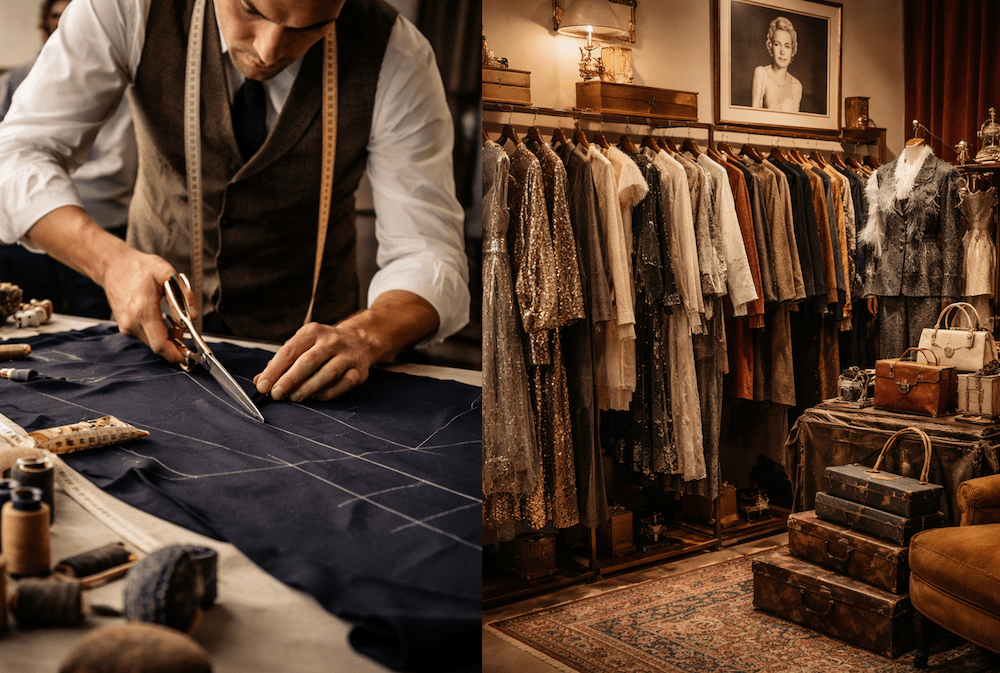
The prestige of time and the mastery of the hand—when fashion stops devouring itself and learns to last.
Luxury used to feel like a closed room. Today it’s everywhere—global access, endless drops, infinite storefronts. And that’s the shift: the more available luxury becomes, the less a logo can carry the whole weight of prestige. Not because it’s suddenly “worthless,” but because it’s no longer enough.
In the post–big brand era, the richest clients increasingly treat luxury less as a badge and more as an experience: something you feel, live with, and eventually pass on. Meaning starts to matter—provenance, construction, rarity that isn’t manufactured, and a kind of quality you can read without being told.
This is where discreet luxury returns. The highest end often doesn’t shout. It’s recognized in cut, cloth, finishing, proportion—what you notice when you know what you’re looking at. The maker’s craft begins to matter more than the name on the outside.
From here, two different paths lead to the same destination: luxury as identity, not performance. One goes through time. The other goes through the hand. And both produce what I call fashion’s survivors: pieces that stay standing after the noise dies down. Not “viral” items, but garments and objects with substance—well-made, repairable, able to age with dignity, still working years later. Ownership shifts too: less accumulation, more selection.
Vintage has moved beyond the old “secondhand” label. It’s not just cheaper or nostalgic—it’s a search for depth. A piece that has lived carries biography, patina, and a rare thing in an economy of endless choice: limitation. That object is that object. It won’t be reprinted next week in five new colorways. In vintage, survivors are selected by time: if they made it this far, they usually had something worth keeping.
Bespoke, instead, is the dignity of the present—built, not consumed. You don’t choose a pre-designed identity; you shape something with someone. Time, fittings, corrections, listening. Handmade is a technique. Tailored is a method. Bespoke is a full architecture: unique by construction, not by hype.
Two grammars, one direction: vintage restores time and memory; bespoke restores craft and relationship. And when these become the new status symbol, fashion stops devouring itself—and learns to last.
–
-GALLERY
G-
–
Alessandro Sicuro
Brand Strategist | Photographer | Art Director | Project Manager
Alessandro Sicuro Comunication


 Sure-com America