
–
My perspective on an entrepreneur who transformed capitalism into a project of industrial humanism: a self-made man, listed on the stock exchange and faithful to the numbers, but who always put people, the Solomeo community, and a work ethic at the center of everything he did, a vision that many today are trying to understand and imitate.
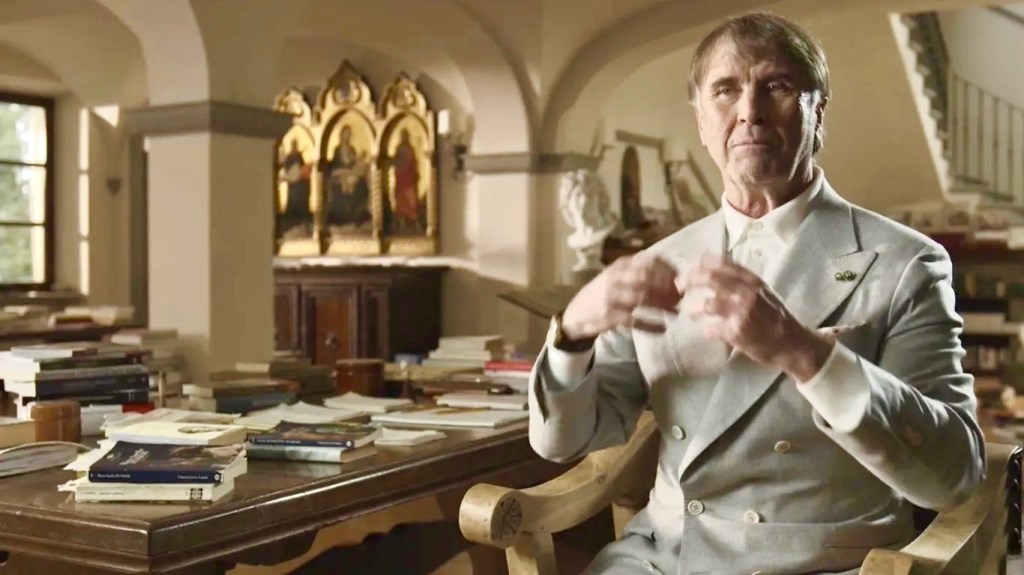
Brunello, the Gentle Visionary , the film in which Giuseppe Tornatore portrays not just an entrepreneur, but an Italian cultural phenomenon, has hit theaters . It’s not a documentary in the strict sense, nor a traditional biography: it’s a story that spans memory, philosophy, business, and staging. Because Brunello Cucinelli isn’t just a self-made man who became a global leader; he’s someone who has reinterpreted the very concept of business.
Her story begins with a poor but dignified childhood in Castel Rigone, with a father who insisted, “Try to be a good person,” and an uncertain youth, without any predetermined plans. Intuition strikes with cashmere: not the classic, austere beige, but a vibrant, colorful cashmere, treated as a creative material. From that gesture, a journey begins that unites the highest quality, pure craftsmanship, and a work ethic.
Cucinelli’s model is both simple and sophisticated: what creates value must return value. Products are of the highest quality, prices commensurate with the workmanship, and workers are paid their true worth. Embroiderers, tailors, and specialized artisans earn salaries that, in many cases, exceed those of professions considered more “noble.” It’s not marketing: it’s a structure that Cucinelli has built over the years, along with concrete support for employees—from guaranteed housing in the village to living spaces designed to balance work and dignity.
Solomeo, the restored village transformed into a working community, is the symbolic heart of this vision: a place where laboratories, theater, vineyards, and architecture coexist in a design that unites enterprise and beauty. It’s no surprise that in recent years, some of the world’s leading tech leaders have requested to spend days there, participating in workshops and discussions to gain a firsthand understanding of a management philosophy that overturns the hyper-productive logic of the tech economy.
Tornatore chooses an elegant register: he alternates firsthand testimony with sequences performed by Saul Nanni, allowing the protagonist himself to guide the narrative. Nicola Piovani’s music delicately accompanies the film, transforming the entrepreneurial journey into an intimate and almost poetic tale.
For my part—having experienced Pitti Immagine in many forms, including photography, journalism, and campaign design—that image is not new. I’ve observed Cucinelli often: present at every edition, next to his team, his hands in his jacket pockets, scrutinizing every detail with a watchful calm and a rare “good manners.” I have a few photographs of him taken during those years, memories that confirm what the film portrays: a person consistent with his narrative.
Brunello, the gentle visionary, doesn’t aim to debunk a myth, nor to construct an artificial one. It’s the portrait of a man who transformed a business into a vision and a village into a community. He offers a possible model: solid, recognizable, capable of uniting ethics and business without losing sight of reality.
What happens when a company truly decides to put humans at the center?
GALLERY


-GALLERY
G-
–
Alessandro Sicuro
Brand Strategist | Photographer | Art Director | Project Manager
Alessandro Sicuro Comunication


 Sure-com America