
–
By the mid-1990s, Gucci was a tired giant. The house possessed an immense legacy, but had lost its voice, direction, and desire. Tom Ford, who had long since joined the company and was appointed creative director in 1994, was considered brilliant but perhaps too bold, too American for a tradition that feared sudden departures. Yet, what then seemed like a risk would become the key to its rebirth.
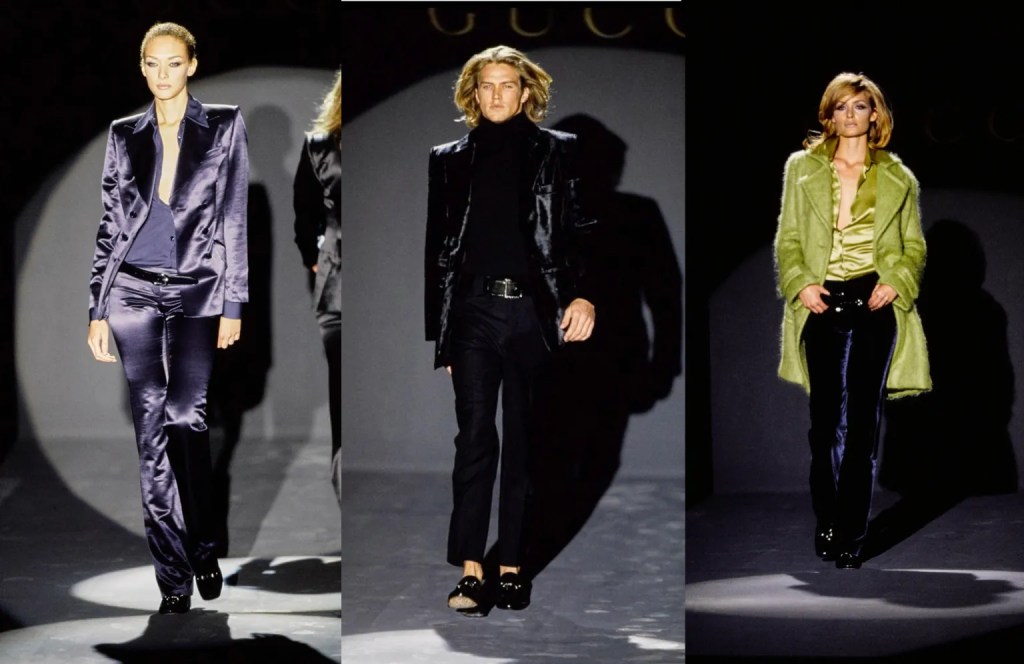
The turning point took shape with Fall/Winter 1995, a show constructed like a movie set. The room was plunged into darkness, a single spotlight delineating bodies, fabrics, and movements. In that controlled light, a new Gucci identity emerged: direct, sensual, modern. Amber Valletta, Shalom Harlow, and Helena Christensen embodied this metamorphosis with absolute ease. Shirts left open just enough, velvets that envelop the body with liquid softness, sculptural belts, and green coats that reimagined the spirit of the 1970s with a contemporary edge.
And it was precisely from the 1970s that Ford took a style destined to become iconic: the low waist. It wasn’t born in the 1990s, but it was he who reinterpreted it with a fresh eye, making it flowing, sensual, almost cinematic, until it became one of the most recognizable silhouettes of the decade. Alongside this, a bold color palette: bright silks, electric colors, materials that catch the light and create an almost Hollywood-like imagery.
At first, the fashion house was taken aback. The language seemed too distant from traditional composure. But fashion doesn’t reward prudence: it rewards vision. The market’s response was immediate. Mario Testino’s campaign spread the brand’s new face everywhere; Madonna wore a look from the collection to the 1995 MTV Awards, and Gucci returned to the center of global pop culture.
The numbers confirm what the runway had already predicted: revenues doubled in the first nine months of 1995. This was the result of the joint leadership of Tom Ford, as creative director, and Domenico De Sole, a CEO with a clear and courageous vision. It was De Sole who recognized Ford’s potential—until then relegated to the margins and filtered by the creative committee because he was considered too American—and finally granted him carte blanche. From that moment on, their partnership became one of the most effective in contemporary fashion: total trust on one side, aesthetic revolution on the other. A combination that would generate years of extraordinary growth and redefine Gucci’s identity for an entire generation.
Fall/Winter 1995 isn’t just a collection: it’s the turning point when a fashion house stops defending itself and starts building its own future. It’s the moment when Gucci rediscovers its voice and begins to dictate the rules again.
–
GALLERY


–
–
Alessandro Sicuro
Brand Strategist | Photographer | Art Director | Project Manager
Alessandro Sicuro Comunication


 Sure-com America