
–
GENERATION GUCCI
I’d stopped being excited about Gucci for too long. Every time I received a notification from the agencies, the reaction was always the same: the new Gucci has come out, fine, I don’t care. A slow disaffection, born of repeated aesthetics, changes of direction without a real horizon, an identity that, instead of being reborn, was fraying. Then, at 2:30 in the morning, when the filter of rationality loosens and instinct takes over, I opened the Maison’s Instagram account. And there I found Demna’s most immediate signature: everything erased. A monumental archive reduced to a blank sheet of paper. It’s not graphic design: it’s politics. Whoever takes over a house like Gucci has two paths: inherit or burn it down. He chose fire.
The first content is Tiger. I haven’t gotten to the end: it’s disturbing by design, an object designed to provoke discomfort and make you stumble into judgment. Novelty, when it’s real, works like this: first it repels you, then it forces you to reconnect, but something remains unresolved. Scrolling down the page, the narrative becomes clearer: Milan, street style as a cinematic prelude, the LACMA transformed into yet another anthropological theater where the guests perform more than the models, Florence with the Oltrarno area next to the Maison’s archive building, and finally this Pre-Fall launch almost as a surprise. A move that smacks of an impatient board of directors: when numbers drop, an immediate signal is needed, even before the screening.
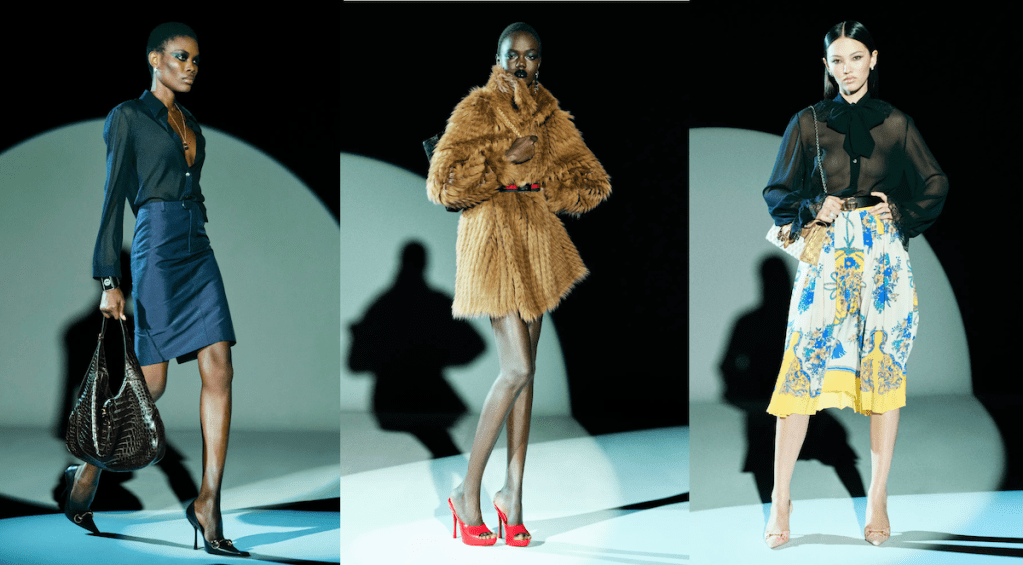
Inside Generation Gucci, the atmosphere is a controlled journey into the archive—controlled to the point of risking nothing. The first silhouette, a sheer black shirt over a midnight blue pencil skirt, evokes the disciplined eroticism of the Ford era, but without its ferocity, as if an inch of courage were still missing. The dark, sleek, almost clinical suit thrives on a studied minimalism, a composure born more from the fear of making mistakes than from a desire to break the mold. The scarf skirt, with its equestrian prints straight from the archives, is a literal gesture, a repechage that doesn’t truly attempt metamorphosis. The camel-colored faux fur seems to have emerged from a Balenciaga campaign; it’s imposing, choreographic, almost an aesthetic slip rather than an act of direction. The long silver dress slides with a perfection that leaves intact everything it’s supposed to shock. Men’s coats, long, linear, paired with surgical denim, live with an intentional normality: as if provocation, today, were precisely the renunciation of effect.
The accessories—Jackie, Dionysus, Web Stripe—resurface like genetic signals, reminders of identity that whisper: “This is Gucci, and this is untouchable.” It’s not nostalgia. It’s preservation. It’s a coherent collection, yes, but it’s not a turning point, it’s an inventory.
The hard part isn’t preserving the DNA: anyone with enough respect for the brand entrusted to them can do that. The hard part is generating something that isn’t an echo of the past, but a present with its own voice. And here, at least for now, the archive isn’t a launching pad: it’s an instruction manual that Demna consults with caution, like someone taking the measurements of a new house and wanting to figure out where to knock down a wall without causing the entire structure to collapse.
Generation Gucci isn’t a manifesto. It’s a prologue. It’s the moment a designer arrives at a Maison ravaged by too many restylings and decides that the first step isn’t to create, but to empty. First, clear away, then draw.
The past has been erased. The present is a time of measurement. The future—the true one—has not yet arrived. Only one question remains, suspended and inevitable, which is the heart of the entire story:
What will happen when Demna stops looking back?


–
–
–
Alessandro Sicuro
Brand Strategist | Photographer | Art Director | Project Manager
Alessandro Sicuro Comunication


 Sure-com America