
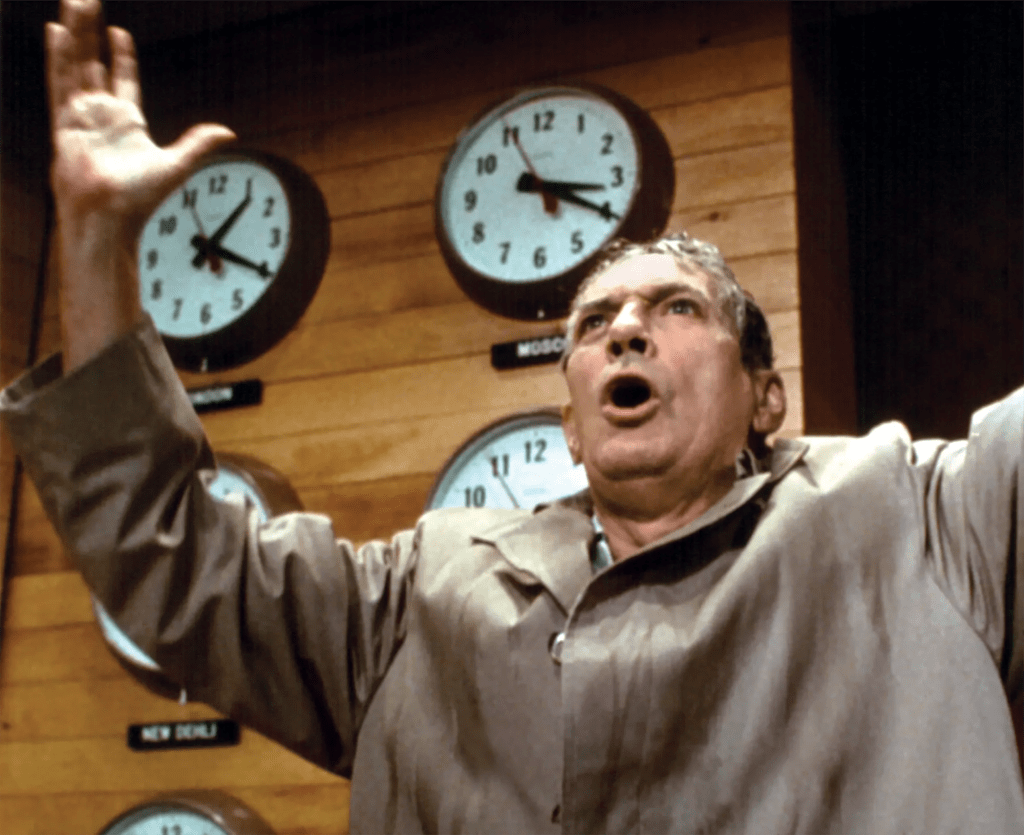
Network ( 1976), directed by Sidney Lumet, is one of those works that defies labels. They call it satire, they call it a parody of the American television system, but the truth is that it transcends both definitions: it is a film that unmasks an era and anticipates two subsequent ones.
Upon its release, it shocked audiences and critics alike, earning ten Oscar nominations and four statuettes, including a posthumous one for Peter Finch, tragic and perfect in the role of Howard Beale, the anchorman who shouts the simplest and most indigestible truth to viewers: “I’m pissed off and I won’t take this anymore!”
From then on, television, real television, was never the same.
The film isn’t about TV itself. Screenwriter Paddy Chayefsky has always said it: the target was dehumanization, the transformation of people into products, the logic of profit that crushes everything, including the human mind. And the impressive thing is how much Network predicted: infotainment as a religion, reality TV as a language, corporations as the new moral authority.
The plot is linear and devastating. Howard Beale, a longtime face of UBS news, is fired due to declining ratings. On air, he announces his suicide. The audience explodes. Executives realize that the audience is a god to be served, and transform him into the “prophet of the airwaves.”
After a brief moment of glory, Beale begins to touch raw nerves, to the point of calling the network itself into question. At that point, the system crushes him: the show must go on, but without him. His death, on air, is planned as a programming choice.
The voiceover says it with perfect coolness: “This is the story of Howard Beale, the first known case of a man who was killed because he had low ratings.”
This is why Citizen Kane isn’t just a successful parody: it’s a film about us, our media addictions, manipulated emotions, the cult of ratings, and a world that becomes indignant on command.
A film that seems more relevant today than it did in 1976, and perhaps that’s the hallmark of masterpieces: they arrive before the others, and then patiently await us.
–
–
Alessandro Sicuro
Brand Strategist | Photographer | Art Director | Project Manager
Alessandro Sicuro Comunication


 Sure-com America