
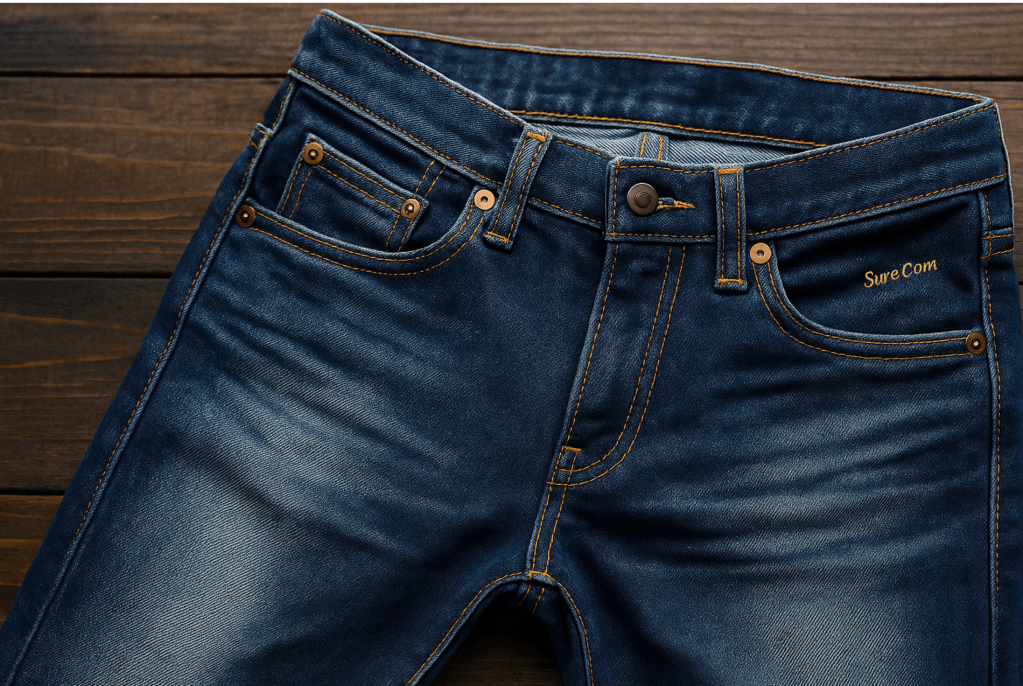
Denim doesn’t need to “come back into fashion” because it never truly left. It simply resurfaces, reclaiming the spotlight with the natural ease of something woven—literally and culturally—into our collective imagination. This was evident in Milan during Denim Première Vision: a fabric stepping forward again, drawing investments, strategic openings, and renewed narrative attention. The timing was almost symbolic. As the fair opened its doors, Levi Strauss & Co. unveiled a monumental flagship on Corso Vittorio Emanuele — a declaration of intent. Once again, jeans are being placed exactly where the market’s future is shaped.
But the phenomenon isn’t only aesthetic — it’s economic. The U.S. numbers speak clearly. Levi’s is posting strong quarters, Gap is regaining momentum, and Abercrombie & Fitch is rewriting its trajectory after years of turbulence, even surprising Wall Street. When denim delivers, it means consumers are turning toward what they perceive as solid, real, and everyday. Jeans have always been a barometer. They don’t follow trends — they anticipate them. They don’t chase — they define.
The story doesn’t stop in America. It crosses the Atlantic and finds fertile ground in Italy, where brands like Rifle — a timeless symbol of Italian denim — remind us how this fabric shaped a popular, democratic style rooted in everyday life. Rifle was the jeans of a working, social, vibrant Italy: durable, distinctive, instantly recognizable. A piece of collective memory that still radiates a manufacturing heritage the world continues to admire.
Yet it’s only when we look East that the last twenty years of denim history acquire something close to an epic tone. Japan didn’t simply import jeans: it studied them, deconstructed them, and rebuilt them from scratch. It acquired original American shuttle looms, revived the depth of selvedge culture, mastered right-hand twill, rope-dyeing, and slow-immersion indigo techniques. And then did what Japan does best: it turned an industrial process into craftsmanship — and craftsmanship into an art form.
Today, the names that command respect in the denim world include not only Levi’s or Wrangler but Studio D’Artisan, Momotaro, Samurai Jeans, Iron Heart, Pure Blue Japan, Oni Denim, The Flat Head, Warehouse & Co.
Brands that brought jeans back into the realm of cultural objects — obsessive research, extreme quality, uncompromising authenticity. They transformed selvedge from a technical detail into a coded symbol of resistance to homogenization.
The result is a perfect cultural triangle: America preserves the myth, Italy preserves the style, and Japan preserves the technique and that unmistakable aesthetic made of essentiality, discipline, and a uniquely Japanese sense of elegance.
And it’s within this triangulation that we understand why denim is rising again. Because it’s more than a garment — it’s a language, a memory, a textile technology that never stopped evolving. Its strength lies in its adaptability: more comfortable silhouettes, gentler washes, higher-performance textures, and a more authentic, less performative aesthetic.
Jeans aren’t “coming back.”
They’re repositioning themselves.
Reclaiming their place as a universal item, capable of speaking to different generations, cultures, and contexts.
And Milan, once again, was the first to sense it.
–
–
–
Alessandro Sicuro
Brand Strategist | Photographer | Art Director | Project Manager
Alessandro Sicuro Comunication


 Sure-com America